
Coworking etiquette is the simple practice of treating shared space and the people in it the way you'd want to be treated: quiet, tidy, and predictable. That means headphones on for calls, notifications silenced, desks wiped down before you leave, meeting rooms booked and canceled honestly, and shared gear like printers and coffee machines left in usable shape for the next user.
TL;DR:
- Keeping shared spaces clean, respecting meeting-room bookings, and sharing equipment fairly are essential to prevent friction and maintain a productive environment.
- Using headphones for calls and turning off notifications helps control noise levels, which is the top complaint in open coworking layouts.
- Booking meeting rooms through official systems, arriving and leaving on time, and canceling reservations promptly reduce conflicts and ensure fair usage.
- Bringing guests requires signing them in and restricting their movement to prevent resource overuse and maintain security.
- Addressing issues with a short, polite request or involving staff after repeated problems keeps conflicts manageable and the space harmonious.
Table of Contents
- What Is Coworking Etiquette, Exactly?
- The Core Rules Every Member Should Know
- Dos and Don'ts You'll Actually Use
- Booking and Meeting-Room Etiquette
- Noise, Calls, and Privacy
- Kitchen, Supplies, and Shared Equipment
- Interacting, Networking, and Community Norms
- Handling Problems Without the Awkwardness
- Guidelines for Bringing Guests or Visitors
- Payment and Membership Etiquette
- Personal Workspace and Personalization Rules
- What Changed Once I Started Following the Rules
- Find a Co-Working Partner Instead of Guessing Who's Free
- Sources
- FAQ
What Is Coworking Etiquette, Exactly?
Coworking etiquette covers the informal (and sometimes formal) rules that keep a shared office running smoothly when dozens of strangers with different jobs, schedules, and habits work under one roof. Unlike a traditional office with one employer setting the tone, a coworking space mixes freelancers, startups, remote employees, and consultants who share desks, meeting rooms, and a kitchen but answer to nobody in the room. That's exactly why explicit norms matter more here than in a regular office, not less.
Here's the part most people miss: coworking etiquette isn't really about rules for their own sake. Happier, less-frustrated workers are about 13% more productive according to research out of Oxford, and almost nothing tanks mood in a shared space faster than someone's loud phone call bleeding through a thin wall or a sink full of someone else's dirty mugs. Good behavior isn't just politeness. It's the mechanism that makes the whole shared-office model work financially and socially for everyone paying membership fees.
The ten rules below cover every situation you'll actually run into, from noise control to guest policy to what happens when someone squats in a room you booked.
The Core Rules Every Member Should Know
These aren't suggestions. They're the baseline expectations that separate a coworking space people love from one members quietly stop renewing.
- Wipe your desk before you leave it. Crumbs, coffee rings, and stray papers are the fastest way to annoy the next person who sits there, especially in hot-desk setups where seats rotate all day.
- Wash your own dishes. Don't leave a mug in the sink "for later." Label leftovers in the fridge and toss anything past its date.
- Wear headphones for any audio. Music, video calls, YouTube tutorials, all of it. A shared floor is not a private living room.
- Silence your phone. Vibrate at your desk, ringtone off entirely, and step away for anything longer than a quick answer.
- Book only what you need. Reserving a four-person room for a solo call blocks someone who actually needs the space.
- Cancel the moment plans change. A five-minute heads-up beats a no-show every time.
- Arrive and leave meetings on time. Running long eats into the next person's booking window.
- Share printers and chargers fairly. Don't run a 200-page print job during the 9 a.m. rush, and don't hoard the one working charging cable at your desk overnight.
- Respect visual and audio privacy. Don't read someone's screen over their shoulder or hover near a call you weren't invited to.
- Skip the cold pitch at someone's desk. If you want to sell something, do it at a networking event or a scheduled coffee, not while someone's mid-deadline.
Clean shared facilities and predictable behavior aren't just nice to have. Operator guides consistently flag them as the foundation of a workable member experience, and it shows the moment either one slips.
Dos and Don'ts You'll Actually Use
Some of the friction in shared offices comes down to a handful of recurring situations. Here's the shorthand for handling them without becoming the person everyone complains about.
- Do give a quiet nod or a two-second "morning" when you walk in. Don't stop at every desk for a chat before 10 a.m.
- Do eat at your desk if the smell is mild (a sandwich, a salad). Don't microwave fish or heat up anything pungent at your seat, take it to the kitchen instead.
- Do take long personal or client calls into a phone booth. Don't run a 45-minute Zoom call at an open desk and assume headphones fix everything.
- Do release a desk or room the second you know you won't use it. Don't "ghost book" a spot just in case you need it later.
- Do ask before joining someone's table if seating is tight. Don't assume an empty chair next to a stranger is open season for a conversation.
Pro Tip: Some coworking spaces sell small desk flags or use a red/green sign system to signal "do not disturb" versus "happy to chat." If yours doesn't have one, a simple pair of headphones in versus headphones around your neck sends the same message without a word.
Booking and Meeting-Room Etiquette
Meeting rooms cause more friction than almost anything else in a shared office, mostly because everyone assumes their meeting is the important one.
- Book through the official system, not a verbal agreement with whoever's at the front desk. A visible calendar prevents double-booking arguments before they start.
- Check in on arrival if the space requires it. Many coworking providers now use auto-release policies that free a room after a set no-show window, so a missed check-in can cost you the booking entirely.
- Test your AV setup before your meeting starts, not during it. Fumbling with a screen share five minutes into a booked slot wastes everyone's window.
- Leave the room exactly as you found it, chairs pushed in, whiteboard wiped, cups cleared.
- Cancel as soon as you know you don't need the slot. Same logic applies to shared desks under a book, check-in, use, clean, release cycle that most operators now expect.
- If someone's occupying your booked room, check the booking display first, then knock and mention politely that you have it reserved starting now. If they push back, that's what staff are for.
Noise, Calls, and Privacy
Noise is consistently the top complaint in shared office environments, and it's rarely because someone's being deliberately loud. Sound carries further than people expect in open layouts, since even moderate conversation registers well above ambient office noise once a few desks pick it up and echo it back.
- Take every client or personal call into a booth, never at an open desk, no matter how short you think it'll be.
- Wear headphones for anything with audio, including "silent" typing on a mechanical keyboard that isn't actually silent to your neighbors.
- Turn off notification sounds entirely; a vibrating phone face down is still audible to the person eighteen inches away.
- Default to a message over a tap on the shoulder when you need something from a focused coworker.
- If a call runs long and loud nearby, a quiet "hey, would you mind lowering that a bit?" solves it faster than passive-aggressive staring ever will.
- Loop in the community manager if the same person repeats the problem after being asked once.
Kitchen, Supplies, and Shared Equipment
The kitchen is where etiquette either builds trust or quietly destroys it. Wash your dishes immediately and put them away, don't let them "soak." Wipe up spills the moment they happen rather than assuming someone else will get to it.
- Label leftovers with your name and date, and toss anything sitting in the fridge past a week.
- Print only what you need, and replenish supplies as needed when you use the last paper or toner.
- Avoid bulk print jobs during the morning and early afternoon rush when everyone else needs the queue too.
- Report broken equipment right away, most spaces have a ticketing system, Slack channel, or front-desk log for exactly this.
Interacting, Networking, and Community Norms
A quick nod or a brief greeting is sufficient when you pass someone focused, especially when coordinating distributed teams following best practices outlined in the remote hiring South Africa: employer and job seeker guide. Save extended conversations for communal areas or planned events.
- Pitch your services at organized networking nights or booked one-on-ones, never by leaning over someone's monitor.
- Show up to community events if you want visibility, they're built for exactly that kind of low-pressure introduction.
- Be mindful of accessibility needs (quiet zones, mobility space around desks) and use inclusive language when you're meeting people from different backgrounds and industries.
- If someone clearly has headphones on and is typing fast, that's not the moment for a networking chat.
Handling Problems Without the Awkwardness
Most issues resolve in one polite sentence. Escalation is for repeat offenders, not first-time slip-ups.
- Say something short and direct: "Hey, would you mind taking that call in a booth? It's carrying pretty far." Simple scripts like this consistently work better than silent frustration or passive-aggressive notes.
- For a booking conflict, note the time, the room, and what happened, then flag it to the community manager rather than arguing it out yourself.
- If the same person causes the same issue twice, that's the point to loop in staff formally instead of handling it solo again.
Guidelines for Bringing Guests or Visitors
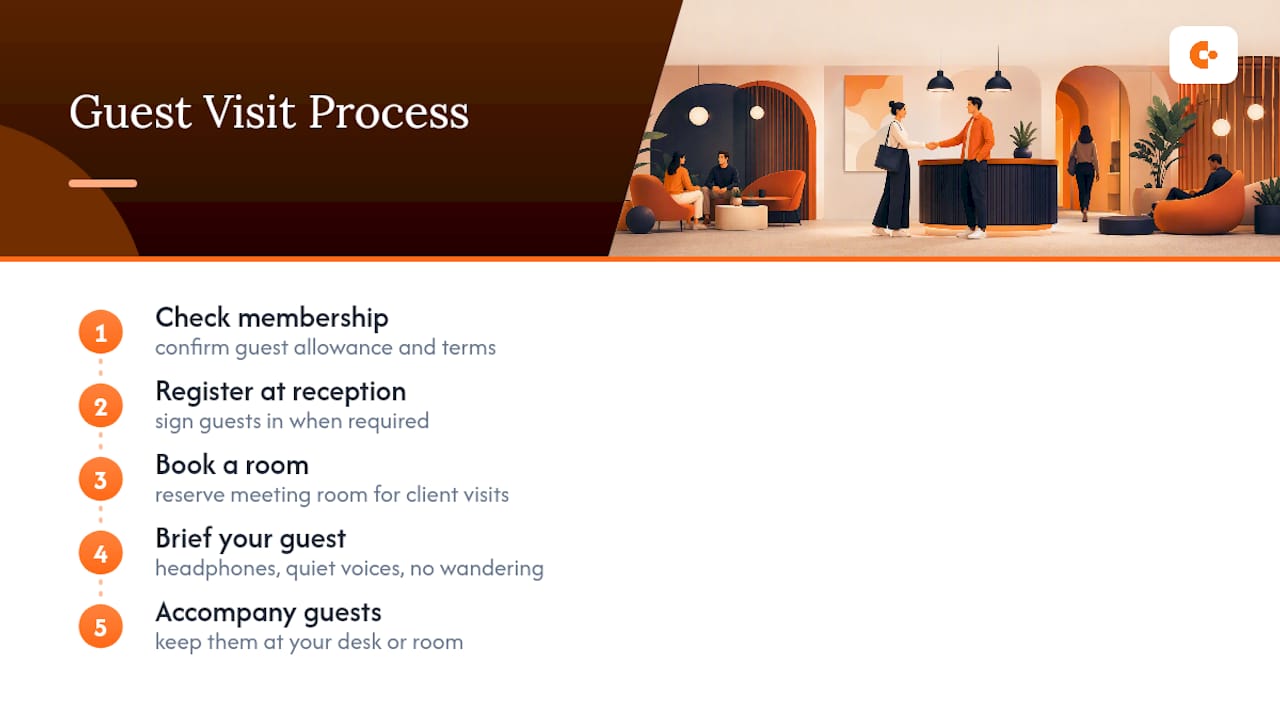
Most coworking spaces allow guests, but almost none of them let you treat that privilege loosely. Check your membership terms first. Many plans include a set number of guest passes per month, and going over that limit without registering visitors at the front desk is one of the fastest ways to trigger a conversation with the community manager.
Always sign guests in when the space requires it. This isn't just bureaucracy: it's a security and insurance issue for the operator, and skipping it can put your own membership at risk if something goes wrong on-site.
Keep guests at your desk or in a booked meeting room, not wandering the common areas unaccompanied. If you're bringing a client for a pitch, book a room in advance rather than hoping an open lounge table stays free. Brief your guest quickly before they arrive: headphones for calls, quiet voices in open zones, no wandering into other members' booked rooms.
Be mindful of how often you're bringing outside visitors versus using the space for your own focused work. A coworking membership is priced around individual usage, and a member who effectively runs a revolving door of guests is using more shared resources (seating, kitchen supplies, bandwidth) than the membership tier accounts for. If your work regularly involves client meetings on-site, ask about a plan built for that instead of stretching a basic membership past its intended use.
Payment and Membership Etiquette
Pay on time. It sounds obvious, but late payments are one of the most common sources of friction between members and operators, and repeated lateness can affect your access to the space, your ability to book rooms, or your standing in the community.
Read your membership terms before you sign, not after something goes wrong. Know your notice period for cancellation, whether unused day-passes roll over, what counts as a guest visit, and what happens if you exceed your allotted meeting-room hours. Coworking contracts vary widely between providers, and assuming your last space's terms apply to a new one is a common, avoidable mistake.
If your plan includes a set number of meeting-room hours or guest passes, track your usage instead of assuming staff will flag it for you. Exceeding your plan isn't just a billing issue, it also means you're using resources allocated to other members' memberships.
If you need to downgrade, pause, or cancel, communicate early. Most operators have a notice window (often 30 days), and giving less notice than that usually means paying for a period you don't intend to use. Treat your membership terms the way you'd treat a lease: something worth actually reading, not skimming past to get to the Wi-Fi password.
Personal Workspace and Personalization Rules
Hot desks and dedicated desks follow different rules, and mixing them up is a common early mistake for new members. If you're on a hot-desk plan, treat every desk as temporary: don't leave personal items overnight, don't claim "your" spot by habit, and clear your workspace completely at the end of each session.
Dedicated desks and private offices usually allow more personalization: a monitor, a plant, a few personal items. Even then, keep it contained to your own footprint. A second monitor stand that creeps into the walkway or a jacket draped over the neighboring empty chair becomes someone else's problem fast.
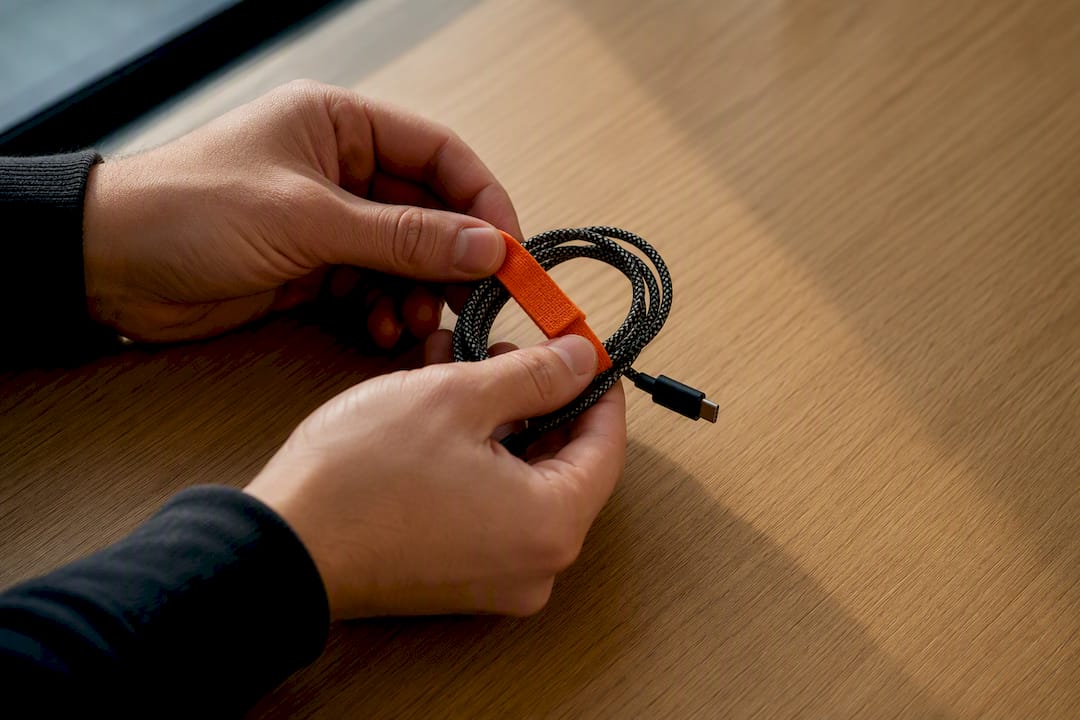
Cable management matters more than people think. A tangle of chargers and cords across a shared desk isn't just messy, it's a hazard for whoever sits there next. Coil what you can and take personal cables with you if you're not on a dedicated desk.
Keep noise-generating personal items (a desk fan, a mechanical keyboard, a phone stand that amplifies vibration buzz) in check if you're in an open area. What feels quiet to you at your own desk often isn't quiet three feet away.
What Changed Once I Started Following the Rules
The clearest example of etiquette actually working: a neighbor's video calls kept bleeding through a thin partition, and one polite, direct request, followed up by the community manager relocating their recurring booking, fixed it permanently. Small habits like that, plus showing up to community events instead of skipping them, turned casual desk neighbors into real networking contacts. Coordinating arrival times with a co-work partner through an app made the whole routine more predictable and a lot less isolating.
— Ilya
Find a Co-Working Partner Instead of Guessing Who's Free
Etiquette solves the friction once you're in the room. There are apps that help you find someone reliable to actually show up and work alongside in the first place. Such an app can match you in real time with people nearby who want the same thing, whether that's a co-work session, a coffee meet-up, or a sports partner, without the swiping or profile-building that dating apps require.

That matters for coworking specifically because a lot of etiquette friction comes from mismatched expectations: one person wants a quiet focus session, the other wants a chatty afternoon. Agreeing on that upfront, arrival time, noise tolerance, room needs, through a quick message before you both show up removes most of the awkwardness this whole article covers. Some apps share only approximate distance, so privacy stays intact while you still find someone close enough to make the session worth it. If you're tired of showing up to a coworking space solo and hoping for good company, find a co-working partner near you and set the terms before you arrive.
Sources
- Happy workers are 13% more productive — University of Oxford
- Top 7 etiquette rules to follow in a coworking space — WeWork Ideas
- Coworking etiquette: rules to make the most of your shared workspace — Mindspace
- Collaboration Without Chaos: Shared Workspace Ground Rules — Coworking Cafe
- Coworking etiquette: dos and don'ts in a shared office — Qdesq Insights
FAQ
What are the 5 basic rules of coworking etiquette?
Keep shared spaces clean, control noise with headphones and booths, respect meeting-room bookings, share equipment fairly, and communicate directly and politely when a problem comes up.
What are 10 important coworking behavior rules?
Wipe your desk, wash your dishes, wear headphones, silence your phone, book only what you need, cancel early, arrive on time, share printers fairly, respect privacy, and skip cold pitches at someone's desk.
What counts as bad coworking etiquette?
Common examples include loud calls at an open desk, leaving dishes in the sink, ghost-booking a meeting room you don't use, and pitching your services to someone who's clearly mid-task.
How do I politely ask someone to be quieter in a coworking space?
A short, direct line works best: "Hey, would you mind taking that call in a booth? It's carrying pretty far." If the behavior repeats, flag it to the community manager instead of confronting them again.
Can I bring a guest to a coworking space?
Most memberships allow guests within a set number of passes, but you usually need to sign them in at the front desk and keep them at your desk or a booked room rather than roaming freely.