
For sustained, all-day productivity, a coworking space wins. Coffee shops win for short creative sessions, casual calls, and low-commitment mornings. The real tradeoff is predictability versus convenience. Coworking gives you reliable infrastructure and a fixed cost, while a café gives you flexibility at the price of unstable WiFi, no privacy, and spending that quietly adds up. The rest of this guide breaks down the cost math, the use cases, and a checklist to decide on the spot.
TL;DR:
- Coworking spaces offer reliable, high-speed internet, private rooms, ergonomic furniture, and a professional community that cafés cannot provide.
- Coffee shops may be cheaper per visit but can lead to higher overall costs over time due to daily spending and lack of privacy.
- Tasks like deep focus work or confidential calls are better suited to coworking spaces, while casual brainstorming suits cafés.
- Testing local coworking and café options with actual spend tracking and checking amenities helps identify the most cost-effective choice.
- Using community apps like Conppi can enhance remote work by connecting you with nearby professionals for shared work or coffee breaks.
Table of Contents
- Coworking vs Coffee Shop at a Glance
- Why Infrastructure and Atmosphere Change Everything
- What Coworking and Coffee Shops Really Cost You
- Matching the Task to the Right Workspace
- How to Decide Right Now: A Quick Checklist
- How Conppi Changes the Coworking vs Coffee Shop Equation
- A Two-Week Experiment Worth Running
- Try Conppi Before Your Next Work Session
- Sources
Coworking vs Coffee Shop at a Glance
Coworking spaces and coffee shops solve different problems, and the fastest way to see that is side by side.
Coworking spaces tend to offer:
- Business-grade, stable internet built for video calls and large file transfers
- Predictable monthly or day-pass pricing
- Private rooms or phone booths for client calls
- Ergonomic desks, real chairs, and outlets at every seat
- Organized events and a built-in professional community
Coffee shops tend to offer:
- Zero commitment. Walk in, order, sit down
- Ambient noise that can spark creative thinking
- No membership fee, but variable daily spend
- Shared, often unreliable WiFi and limited outlets
- No privacy for calls and no real community structure
The catch with cafés is that "free" isn't really free. A coworking day pass has one price tag. A café day has a hidden one: the latte, the second coffee at 2 p.m. so nobody gives you a look, and the pastry you didn't plan on buying.
Why Infrastructure and Atmosphere Change Everything
The differences between these two environments aren't just about vibe. They show up directly in what you can get done.
Internet is the first fault line. Coworking spaces run business-grade networks built for multiple simultaneous video calls. Café WiFi is shared across every customer in the building, often on a single unsecured router, and it can drop mid-upload with no warning. If your work involves client files or anything sensitive, that shared network is also a security risk, not just an inconvenience.
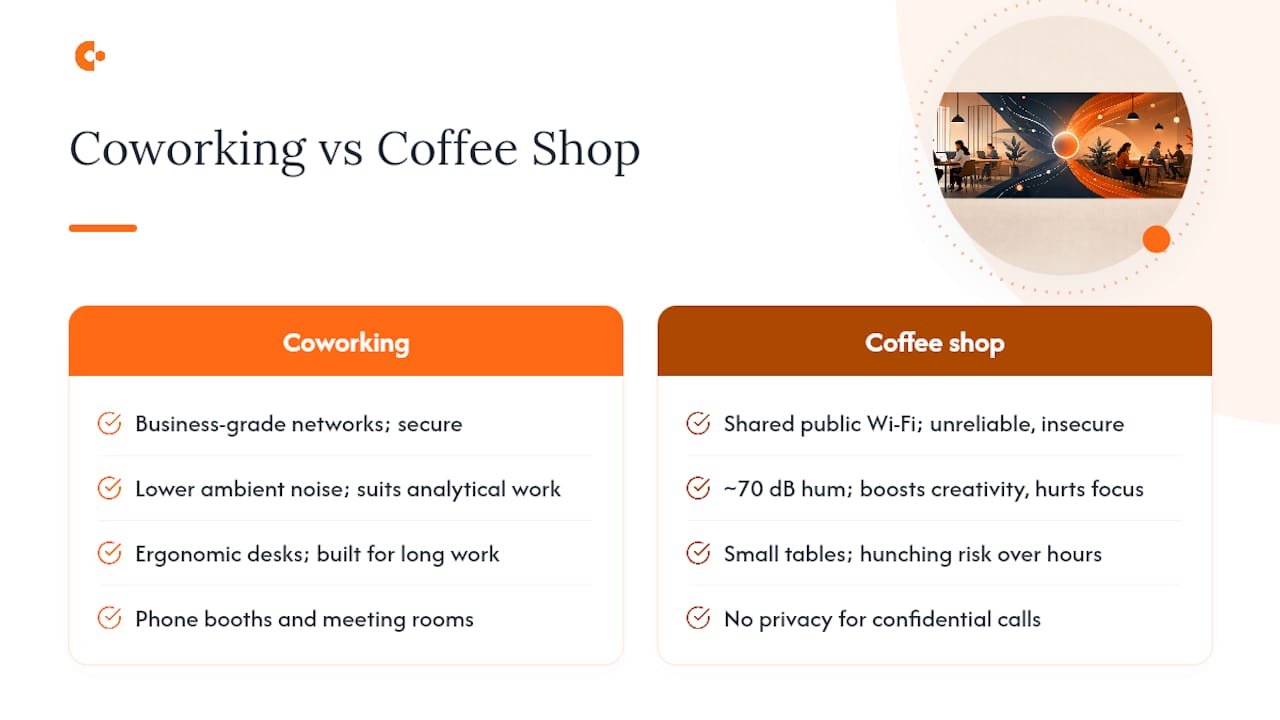
Noise cuts both ways. A 2012 study by Mehta, Zhu, and Cheema found that moderate ambient noise, around 70 decibels, actually improves performance on creative tasks. That's roughly the hum of a busy café. But that same noise level tanks performance on analytical work that needs sustained focus. Use the café for brainstorming, as the ambient noise can boost creativity, but avoid it for tasks that require sustained analytical focus.
Ergonomics matter more than people admit. Hunching over a tiny café table for four hours does something to your neck that a properly set desk doesn't. Coworking spaces build around this; cafés were built around turning tables, not turning out deep work.
Privacy is where cafés fall apart for client-facing work. Try taking a confidential call two feet from a stranger's elbow. Coworking spaces solve this with phone booths and bookable meeting rooms.
Community is the quiet differentiator. Café interactions are accidental. Coworking spaces build in actual networking events and shared kitchens where conversation is expected, not awkward.
What Coworking and Coffee Shops Really Cost You
Coworking pricing across Western Europe typically runs €15 to €35 a day, or €100 to €350 a month, depending on the city and what's included, from meeting room credits to unlimited coffee.
Café "camping" looks cheaper per visit and isn't, once you run the numbers. A coffee plus a snack usually costs a moderate amount per visit. Doing this multiple times a week can add up to a significant monthly expense, easy, before you factor in the second drink you buy to justify staying past lunch. Push it to five days a week and that spend can climb past what a coworking membership costs, minus everything a membership actually includes: fast WiFi, a desk that doesn't wreck your back, and a room to take a call in.
To find your own breakeven point:
- Track your actual weekly café spend for two weeks, purchases included, not estimated
- Compare that number against local day-pass and monthly membership rates
- Check whether your employer reimburses coworking costs or whether it's tax-deductible as a home-office alternative. Rules vary by country, so confirm with a local tax professional
- Most drop-in day passes exist specifically so you can test a space before committing to a monthly plan
Matching the Task to the Right Workspace
Not every task needs the same environment, and treating them the same is how people waste both money and focus.
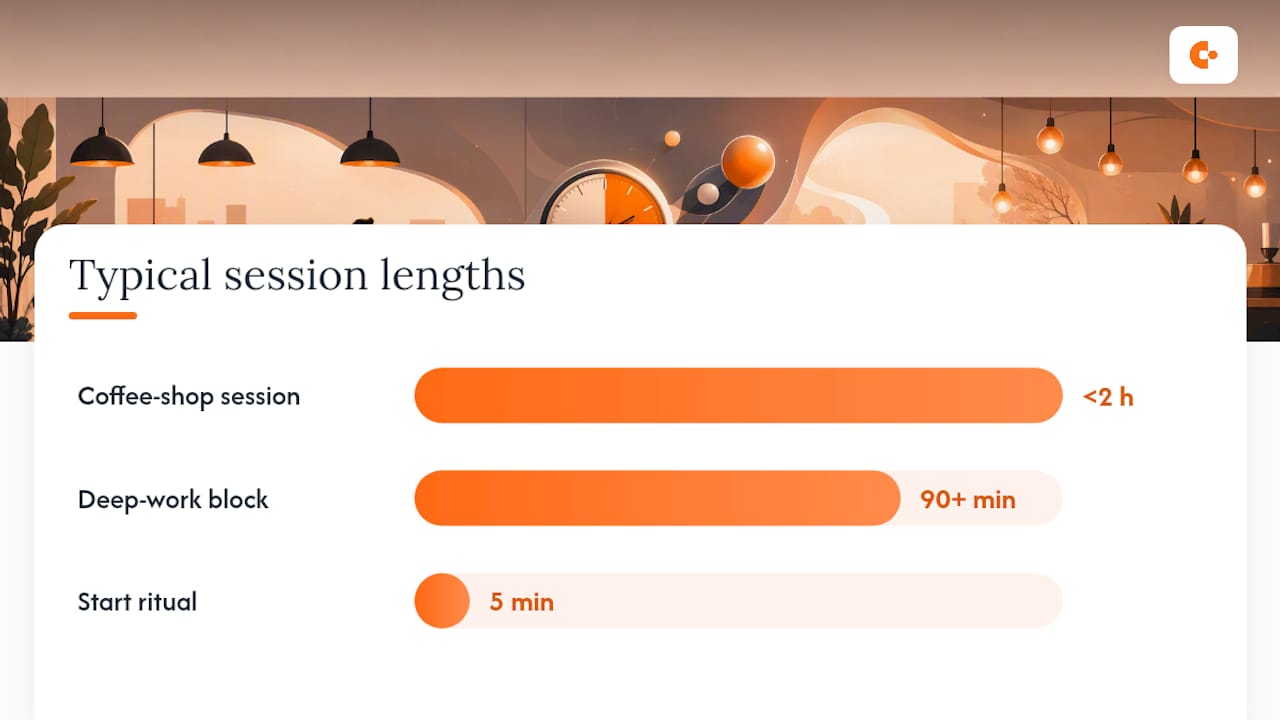
Best done at a coffee shop (under two hours):
- Early-stage brainstorming or freewriting
- Reading, research, or inbox triage
- A casual, non-confidential phone call
- Reviewing work you already finished elsewhere
Best done at a coworking space:
- Video calls with clients or teams
- Deep writing or analytical work needing 90+ minutes of focus
- Anything involving confidential files or contracts
- Full workdays where routine and consistency matter
A workable hybrid pattern: three days at a coworking space for deep work and calls, two mornings at a café for planning and lighter tasks, then home or coworking again in the afternoon once the ambient buzz stops helping.
Pro Tip: Build a five-minute "start ritual" wherever you land: sit down, open your task list, set a 90-minute timer. Doing this consistently trains your brain to focus fast regardless of the venue.
How to Decide Right Now: A Quick Checklist
Before you commit to a location for the day, run through this:
Ask yourself:
- How many confidential or client calls do I have today? (Two or more means skip the café.)
- What's my real weekly spend if I "camp" at a coffee shop?
- Do I need a full 8 hours of focus, or two hours of brainstorming?
- What's my commute cost either way?
Ask the space itself:
- What's the actual WiFi speed, and can I run a quick speed test before I commit?
- Are day passes available, and what do they include?
- Is there guaranteed outlet access at every seat?
- Are there private rooms or booths, and can I book one for a video call?
Red flags that should send you elsewhere:
- WiFi that drops mid-task or requires re-login every hour
- Fewer outlets than seats
- Posted "no laptop" hours during your working window
- No visible option to take a private call
How Conppi Changes the Coworking vs Coffee Shop Equation
Neither option fully solves the isolation that comes with remote work. Coworking spaces build community into the building; cafés leave you to chance. Conppi closes that gap by matching you with people nearby who want the same thing you do right now, whether that's a desk partner or a coffee companion, without swiping through a profile first.
Three ways to use it this week:
- Find someone to share a coworking day pass with so the space feels less like a solo errand
- Schedule a coffee meetup before or after a deep-work block to break up the day
- Use it to meet other professionals nearby who work similar hours, turning a coworking day into an actual network
A Two-Week Experiment Worth Running
Skip the debate and test it: three coworking days for deep work, two café mornings for planning, for two weeks straight. Track focus time, deliverables finished, and how drained you feel by 5 p.m. Pair it with an app like Conppi so the community piece isn't left to chance.
— Ilya
Try Conppi Before Your Next Work Session
There is an alternative to guessing whether you'll be working alone today; learning about loneliness in seniors reveals how community can deeply impact remote work experiences. Instead of hoping someone interesting shows up at the café or the coworking common area, you can open an app and see who nearby wants to share a desk or grab a coffee right now, no cold outreach required. That's the real gap between coworking and coffee shops that neither one solves on its own: infrastructure and cost don't fix loneliness, and community doesn't show up just because you paid for a membership.
Conppi doesn't replace your coworking desk or your favorite café. It fills the space around them: someone to walk in with, someone to take a coffee break with between focus blocks, someone who's also tired of eating lunch alone at their laptop. If you want your workday to include actual people, find a co-working partner near you and see who's around before you even leave the house.
Sources
- Coworking vs Coffee Shop: Where to Actually Get Work Done | Jilani Place
- Coworking Space vs. Coffee Shop: What's Right for You? | Onboard Coworking
- How to find remote work abroad (infrastructure notes) | WhereNext
- Coworking Space vs. Coffee Shop: What's Right for You? | Calendar blog