
If your goal is meeting more people and feeling less alone in a crowd, start with a group. If you want depth, privacy, or accountability on something specific, go one-on-one first. Both formats work, and apps like Conppi can help you line up either one without much friction.
TL;DR:
- Joining multiple groups provides more entry points and buffers against loneliness than relying on a single friendship.
- Groups are ideal for expanding networks and tackling social isolation through shared activities, while one-on-one meets deepen emotional intimacy.
- Choose a format based on goals: privacy, depth, or sensitivity favor one-on-one, whereas networking and quick exposure suit groups.
- Starting with a short, activity-based meetup can reduce awkwardness and encourage repeated engagement for both formats.
- Apps like Conppi facilitate real-time, proximity-based matching for either one-on-one or group activities with minimal coordination.
Table of Contents
- What research says about group versus one-on-one meetups
- A five-question checklist to pick your format
- How to make each meetup format actually work
- When to start with a group and when to switch
- How Conppi helps you try either format
- Sources
- FAQ
What research says about group versus one-on-one meetups
The stakes are real. The World Health Organization reports that loneliness affects about 1 in 6 people globally and links it to higher risk of heart disease, stroke, high blood pressure, and diabetes.
About 1 in 6 people worldwide experience loneliness severe enough to raise their risk of serious physical illness, according to the WHO. That single figure explains why so much research now treats social connection as a health issue, not just a comfort.
Groups have a specific advantage: they scale support. Meta-analyses covered by the American Psychological Association show that group therapy can be as effective as individual therapy for many conditions, while also cutting stigma and building a sense of solidarity that one person alone cannot give you. Groups also let you learn from other people's approaches in real time, something a private conversation cannot replicate. Peer-reviewed work on multiple group memberships adds another layer: belonging to several groups predicts lower loneliness and less stress, with reduced loneliness explaining much of that benefit.
One-on-one interactions play a different game. MIT Sloan Review's research on workplace check-ins found that a predictable cadence and a shared purpose make one-on-one meetings more effective and less anxiety-inducing than ad hoc conversations. The same logic applies outside the office: a standing coffee catch-up with one friend tends to deepen faster than rotating small talk with a group of ten.
Mapped against the dimensions that actually matter for choosing a format:
- Interaction depth: one-on-one wins for emotional intimacy and follow-through.
- Social exposure: groups win for meeting more new people per hour spent.
- Frequency and scheduling ease: groups often run on a fixed calendar, which removes the coordination burden of finding two open slots.
- Privacy and sensitivity: one-on-one is safer for topics you would not share with strangers.
- Cost and time: groups usually cost less per person and absorb no-shows better.
- Best for: groups suit networking, hobby exploration, and combating isolation; one-on-one suits mentorship, accountability, and sensitive conversations.
A five-question checklist to pick your format
Run through these five questions before you commit to either format.
- How specific is your goal? A vague wish to "meet people" points to a group; a concrete goal like "find a running partner for marathon training" points to one-on-one.
- How much privacy do you need? If the topic is personal, health-related, or career-sensitive, one-on-one protects you better.
- What is your budget and time window? Groups often cost less per session and tolerate a missed week; one-on-one demands two calendars to align but gives you more control over timing.
- Do you want new contacts or a deeper bond? Groups expand your network faster; one-on-one strengthens a single relationship.
- What is your social energy right now? If you consistently leave group events drained rather than energized, a dyadic format may suit your current bandwidth better.
Score yourself 1 to 5 on each axis, then look at your top two scores. If exposure and budget rank highest, try a group. If privacy and depth rank highest, go one-on-one. When the scores tie, a hybrid rotation, such as a monthly group meetup paired with a biweekly one-on-one with someone you met there, often works better than picking one format permanently.
Pro Tip: Commit to one format for three to four weeks, track how you feel after each meetup, and only then decide whether to switch.
How to make each meetup format actually work
Groups succeed or fail on structure. A loose agenda, a simple opening icebreaker, and clear roles (someone hosting, someone greeting newcomers, someone keeping time) turn a room of strangers into a group people return to. A short follow-up message after the session, even a one-line "great to meet you, same time next week?", converts casual attendees into regulars.
One-on-one meetups do better with an activity attached. Meeting over a shared task, a walk, a game of padel, or a co-working session lowers the pressure that a bare "let's grab coffee and talk" can create. Agree on a shared purpose before you meet, then set a follow-up plan so the connection does not stall after one good conversation.
- For groups: assign a greeter for newcomers and close every session with a two-minute check-in on what worked.
- For one-on-one: pick an activity-based first meeting and confirm a second date before you part ways.
- For both: meet in public the first time, tell a friend where you are going, and share only approximate location rather than a home address.
Apps that match by activity, time, and proximity remove much of the coordination work here. Some apps let you filter by activity and skill level while only sharing approximate distance, which helps keep the process private when organizing a small group or a single meetup.
Pro Tip: Keep the first meeting under an hour. A short, activity-based session is easier to repeat than a long one that leaves both sides unsure what happens next.
When to start with a group and when to switch

I usually tell people with a thin social network to start with a group. It spreads the pressure across several people instead of one, and it gives you multiple entry points if one conversation fizzles. Research on multiple group memberships backs this up: belonging to several groups over time buffers against loneliness more reliably than betting everything on a single friendship.
Switch to one-on-one when the topic gets sensitive, when you need someone to hold you accountable, or when a group conversation keeps staying shallow. Neither format is permanent. Run small experiments, join more than one group if you can, and let your energy level after each meetup tell you what to try next.
— Ilya
How Conppi helps you try either format
Conppi matches you with people nearby who want the same activity right now, whether that is a tennis partner, a co-working buddy, or a small group heading to the same run. You set the activity and time, get matched by proximity, and only ever share an approximate distance, never an exact location.
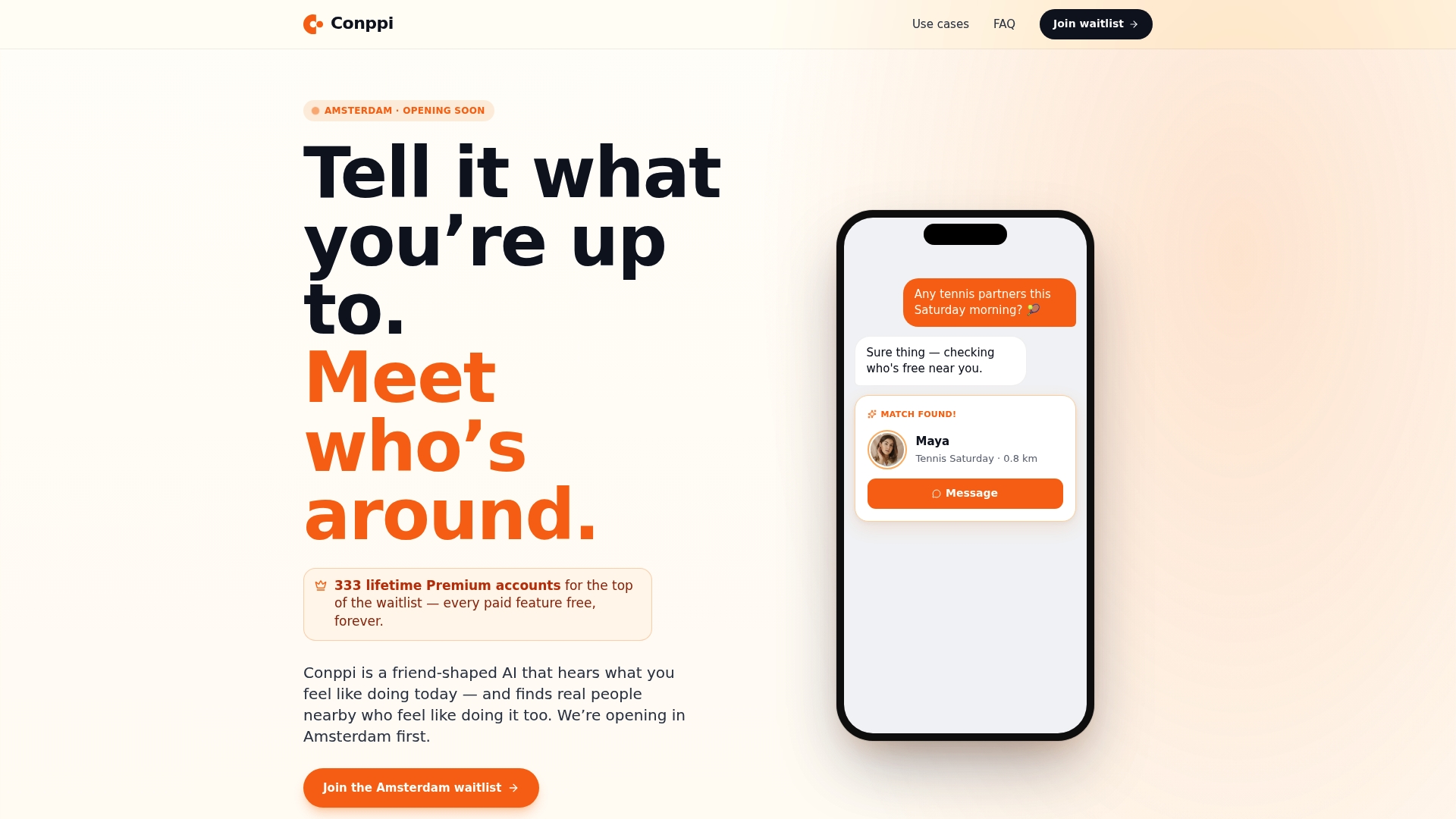
To test the checklist above, open the Conppi activity partner app, pick one activity, and set your intent as either a one-on-one or a small group. Send one invite, show up once, and decide from there.
- Filter by activity, time, and skill level instead of scrolling profiles.
- Match in real time with people already free and nearby.
- Choose one-on-one or group intent before you send an invite.
Conppi is one option among many ways to act on your decision. What matters is picking whichever tool actually gets you out the door.
Sources
For deeper reading: the WHO on social connection and health, APA on group therapy effectiveness, multiple group identification research, and Cleveland Clinic's group therapy primer.
- Social connection linked to improved health and reduced risk of early death
- Group therapy is as effective as individual therapy, and more efficient. Here’s how to do it successfully
- Reduced loneliness mediates the effects of multiple group identifications on well‐being
- Five ways to make your one-on-one meetings more effective
FAQ
Is group therapy as effective as one-on-one therapy?
Meta-analyses covered by the APA found group therapy matches individual therapy on many outcomes while also cutting stigma and adding solidarity. It can also be more efficient since one facilitator supports several people at once.
Does joining multiple social groups actually reduce loneliness?
Yes, peer-reviewed research found that identifying with multiple groups predicts lower loneliness and less stress, with reduced loneliness explaining much of that effect (source). Diverse group memberships give you more than one source of belonging, so losing touch with one group matters less.
What makes a one-on-one meetup less awkward?
Pick an activity-based first meeting rather than an open-ended conversation, since a shared task gives both people something to focus on. MIT Sloan Review also recommends setting a shared purpose and a predictable follow-up cadence to lower anxiety.
Can online groups deliver the same benefits as in-person ones?
Cleveland Clinic notes that virtual groups can work well but need clear ground rules to maintain cohesion and privacy. In-person and online groups both show promise, though comparative evidence is still developing.
How do I find people for group or one-on-one activity meetups?
Apps that match by activity, time, and proximity, such as Conppi, let you set your intent for either format and connect with people nearby in real time. You can filter by activity type and skill level while sharing only an approximate distance rather than an exact location.