
Post the activity, not a vague hangout invite: name what you're doing, set a start and end time, pick a public spot, and say who's welcome. That's the whole formula. Apps like Conppi are built for exactly this kind of low-commitment, real-time invite, so once you've written it, post it and see who shows up.
TL;DR:
- Clearly specify the activity, location, start and end times, group size, and cost to increase trust and reduce hesitation for potential meetup participants.
- Build safety into your post by choosing public venues, avoiding sharing private details prematurely, and arranging your own transportation to maintain control.
- Use activity-focused framing in invitations to lower the psychological barrier and make it easier for strangers to say yes, especially with clear, simple language and timing.
- Send confirmation messages, check in closer to the event, and prepare exit plans to keep casual meetups on track and reduce no-shows or dropouts.
- Follow up shortly after the meetup with a brief message, and adjust future posts based on what draws or deters attendees to improve ongoing success.
Table of Contents
- What Should Your Meetup Post Include?
- How Do You Plan a Meetup That Feels Low-Pressure?
- Is It Safe to Meet Someone From an App?
- What Should You Say Before Meeting Up?
- How Do You Keep a Casual Meetup Running Smoothly?
- What Do You Do When Plans Fall Through?
- How Do You Follow Up After a Casual Meetup?
- How Do You Handle Introductions So Nobody Feels Awkward?
- How Do You Manage Group Dynamics If Things Get Tense?
- Should You Provide Food or Drinks?
- What Keeps People From Flaking on Casual Meetups?
- Why Activity-First Meetups Actually Work
- Post Your First Meetup With Conppi
- Sources
What Should Your Meetup Post Include?
A good activity post takes a short time to write and answers five questions before anyone has to ask. Skip one of these and you'll spend the next hour fielding messages instead of getting ready to leave.
- Activity and purpose: "Coffee, 45 minutes" or "casual 5k, no pace pressure" tells people exactly what they're signing up for.
- Start and end time: Time-boxing removes the "how long is this going to take" hesitation that kills RSVPs.
- Exact location: Name the café, court, or corner, not just a neighborhood. Add one transit note if the spot isn't obvious.
- Group size and cost: "Just us two" or "up to 4, splitting the bill" sets the tone before anyone arrives.
- Contact method and one behavior note: How to reach you, plus a line like "respectful and on time, please."
Hosts who put safety and expectations right in the listing, not buried in a follow-up chat, tend to attract calmer, more comfortable groups, according to the WKND Club's meetup safety checklist. Vague posts read as riskier even when they aren't. Specific ones read as organized, which is the signal most people are actually screening for.
Pro Tip: Write your post like a calendar invite, not a personal ad. "Coffee, Tuesday 8:30 to 9:15 AM, Blue Bottle on 5th" gets more replies than "anyone want to grab coffee sometime?"
How Do You Plan a Meetup That Feels Low-Pressure?
The framing you choose before you post matters more than almost anything else in this process. An invitation built around a shared activity, "anyone want to hit balls at the park courts at 6?", removes the guesswork that makes cold social invites so awkward. Naming the activity instead of the intent (making friends, meeting people) is what turns a stranger's hesitation into a quick yes, according to HerTripGuide's research on solo travel apps.
Here's a simple sequence for building that first post:
- Choose the activity first. Coffee, a walk, tennis, co-working at a café. Something with a natural start and stop point works best for a first meetup.
- Pick a venue with eyes on it. Public, staffed, easy to find on a map, and with more than one way out. A busy coffee shop beats a quiet park bench for a first meet.
- Decide on group size upfront. One-on-one is simplest to manage; three to five people gives more social cover if you'd rather not be alone with a stranger yet.
- Set the timing. Daytime or early evening slots read as safer and easier to commit to than a 10 PM meetup, especially for a first-time match.
- State the cost plainly. "Coffee's on me" or "we're splitting court fees" avoids the wallet-out-at-the-counter shuffle.
Ideas beyond the obvious help too. A local activities guide can spark options you hadn't considered, from mini golf to a farmers market walk, if coffee and tennis feel overdone in your area.
Is It Safe to Meet Someone From an App?
Meeting a stranger for the first time carries real, manageable risk, and most of that risk shrinks once you follow a few habits that cost you nothing. The U.S. Department of State's travel guidance for the Netherlands recommends meeting in public places, arranging your own transportation, and telling someone your plan, advice built for travelers but just as useful for a first meetup with someone from an app.
- Keep private details out of your listing and early chat. Skip your home address, employer, or last name until you actually know someone.
- Meet somewhere with staff and other people around. A café counter beats a secluded trailhead for a first meeting.
- Get yourself there and back. Don't rely on your match for a ride; it's both a safety habit and a way to leave whenever you want.
- Do a quick call first. A two-minute voice or video call before you meet is one of the highest-value, lowest-effort checks you can do, according to Introscape's guide to meeting people met online.
- Have an exit ready. A time-boxed plan already gives you one, but know your transit option or keep a "fake call" excuse in your back pocket just in case.
Government travel advisories consistently point to the same short list: public venues, your own transport, and someone who knows where you are. None of it requires an app feature. It just requires doing it every time.
What Should You Say Before Meeting Up?
Copy these and adjust the details. Having a script ready removes the "what do I even type" friction that makes people put off posting.
Activity listing: "Coffee, 45 min, Blue Bottle on 5th, 6:00 to 6:45 PM Thursday. Just looking for one person to chat with over a drink. On me."
Confirmation message: "Still good for 6 PM Thursday at Blue Bottle? I'll be at a table near the window, blue jacket."
Boundary one-liners: "Keeping this to the coffee shop, no address swaps until we've actually met." "Happy to chat about the activity, let's save the deep personal stuff for later."
Exit script: "Something's come up, I need to head out. Great meeting you, though!"
These aren't scripts you need to memorize word for word. They're a starting point, and using activity-first phrasing like this consistently is what turns a stranger's maybe into an actual yes.
How Do You Keep a Casual Meetup Running Smoothly?
The gap between a meetup that flakes and one that actually happens usually comes down to a few small moves the host makes in the hours and minutes before it starts.
- Send two check-ins. A quick "still on for 6?" two hours out and a "here now" fifteen minutes before cuts down on ghosting.
- Use a visible marker. "I'll have a red backpack" or "sitting at the counter" saves the awkward scanning-the-room moment.
- Announce the end time early. Saying "I've got to head out around 6:45" up front means nobody's guessing when it's polite to leave.
- Let the activity do the talking. Skip the interview-style small talk and dive into the coffee order, the warm-up rally, or the shared work task instead.
- Have a line ready for late arrivals. "Glad you made it, we're just getting started" folds latecomers in without making a thing of it.
What Do You Do When Plans Fall Through?
Even a well-planned meetup can go sideways. Knowing your next move in advance keeps a hiccup from turning into a wasted afternoon.
- Nobody shows: Give it ten minutes past start time, then either enjoy the activity solo, reschedule with a quick message, or repost for later that week.
- Conversation stalls: Redirect to the activity itself, ask what they'd order next, how their serve looked, what they're working on, rather than forcing small talk.
- Someone makes you uncomfortable: Use the exit line you already planned and leave. Report the interaction through the app afterward.
- Plans change last minute: Update your listing immediately and send a short heads-up to anyone who confirmed, rather than leaving them guessing.
How Do You Follow Up After a Casual Meetup?
A quick follow-up message the same day, something as simple as "that was fun, thanks for the game" or "good luck with the project," costs ten seconds and does more for repeat meetups than almost anything else you can do. It signals the meetup went well and opens the door without any pressure to commit to more.
If you'd genuinely do it again, say so directly: "Want to make this a regular Thursday thing?" is a low-stakes way to test interest without overcommitting either side. If it wasn't a great match, a friendly close ("nice meeting you, enjoy the rest of your week") is enough. You don't owe an explanation.
Feedback matters more when you're the one posting regularly. Notice patterns: did a 6 PM coffee slot fill faster than a 10 AM one? Did a specific venue draw more interest? Small adjustments based on what actually worked beat guessing at the next post. Some hosts keep a simple note on their phone, activity, time, turnout, tracking what drew people in versus what fell flat.
This is also the moment to flag anything that felt off, not just what went well. If a match canceled twice without notice, or a venue turned out to be too loud for actual conversation, that's useful information for your next listing. Treat every meetup, good or bad, as data for the next one.
How Do You Handle Introductions So Nobody Feels Awkward?
The first sixty seconds of any meetup set the tone, and the activity you picked is already doing most of the icebreaking work for you. Instead of a formal "so, tell me about yourself," lean into whatever you're actually there to do: "Have you played on outdoor courts before?" or "Do you usually get a pour-over or drip?" gets people talking without the interview feel.
For small groups, a quick round of first names and one activity-related detail ("I'm Sam, I play twice a week") is plenty. Skip the résumé-style introductions entirely; nobody needs a life summary before the first serve or the first sip.
If you're hosting more than two or three people, give latecomers a soft landing instead of stopping everything to reintroduce the group. A simple "this is Jordan, just joining us" while the activity keeps moving works better than a full pause. Group meetups feel more natural when the introductions happen in motion, not as a separate formal step before anything starts.
One thing worth avoiding: don't force everyone to "go around and share something about themselves." That format works for structured events, not spontaneous, activity-first ones. Let curiosity about the shared task pull people into conversation instead of scripting it.
How Do You Manage Group Dynamics If Things Get Tense?
Most friction in a casual meetup comes from mismatched expectations, not actual conflict, someone assumed it was competitive when you meant casual, or one person wanted to talk while another wanted quiet focus. Naming the tone in your original post (already covered above) prevents most of this before it starts.
When tension does show up, the fastest fix is usually to return to the activity itself. A disagreement about pace during a run or a lull in conversation during coffee both resolve faster when you give people something concrete to do together rather than talking through the discomfort directly.
For larger groups, watch for one person dominating the conversation or activity. A light redirect, "let's rotate who serves next" or "what does everyone else think?", spreads engagement without singling anyone out. If someone is genuinely being disrespectful or ignoring the behavior expectations you set in your listing, address it directly and briefly: "Let's keep this friendly," then move on. You don't need a long conversation about it, and you don't owe anyone extended patience if they've crossed a line you already stated.
Should You Provide Food or Drinks?
Keep refreshments simple and match them to the activity, not the other way around. A coffee meetup means you're both probably buying your own; a co-working session might mean nothing more than "bring your own laptop and coffee." For sports meetups, water is the only real expectation, don't feel obligated to bring snacks or gear for someone you just met.

If you're hosting at your own space rather than a public venue, the cost-and-hosting question gets more sensitive. For a first meetup, public venues where everyone buys their own remain the simpler, lower-pressure choice, and it sidesteps any awkwardness about who's providing what. Save home-hosted gatherings with shared food for people you've already met safely once or twice.
When cost is part of the plan, state it plainly in your listing: "coffee's on me" or "we're splitting court fees" removes the wallet-out-at-the-counter hesitation entirely. Ambiguity about money is one of the more common small frictions in first meetups, and it's also one of the easiest to eliminate with a single sentence upfront.
What Keeps People From Flaking on Casual Meetups?
Flaking usually isn't malicious, it's low commitment meeting low accountability. The fix is building small amounts of structure into a format that's intentionally loose everywhere else.
Time-boxing does a lot of this work on its own: a bounded "coffee for 45 minutes" is far easier to commit to than an open-ended "let's hang out," and it gives both sides a built-in exit that doesn't require an excuse. Confirmation messages sent a few hours and again fifteen minutes before the meetup catch wavering attendees before they simply don't show. A small ritual, like agreeing to order first thing when you arrive, anchors people to the plan once they're physically there, which cuts down on the awkward early exit.
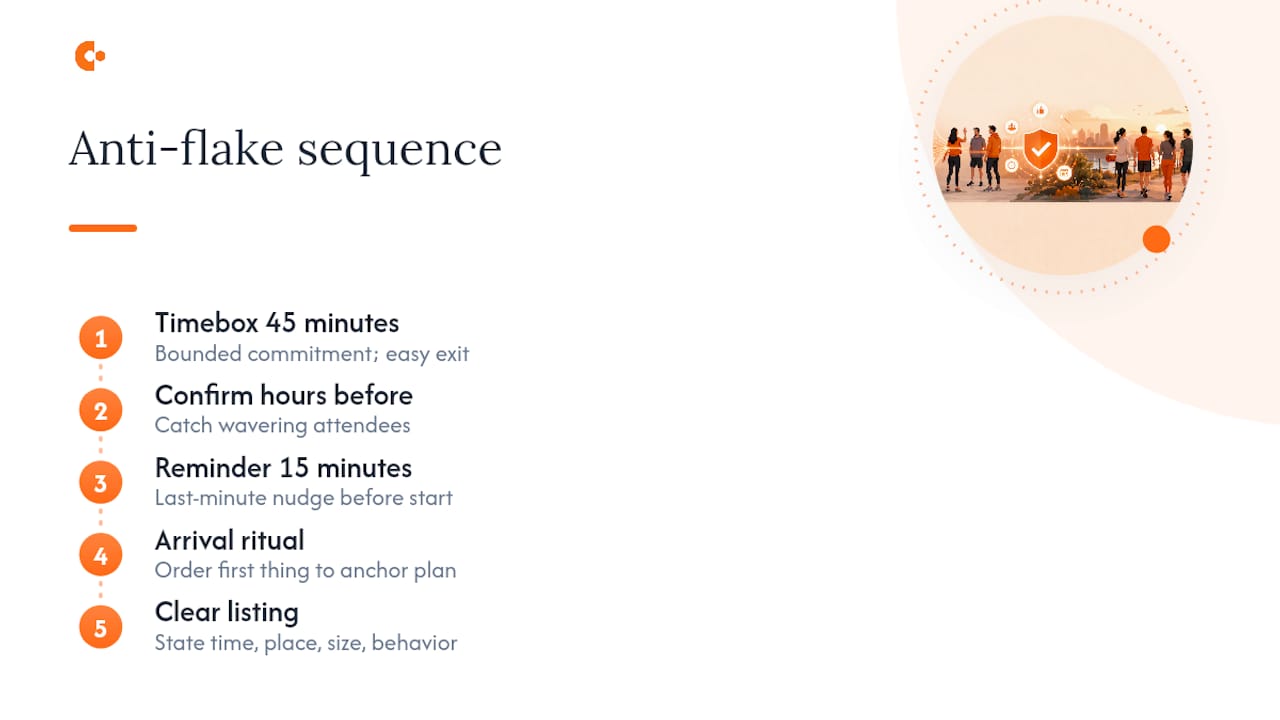
The clearest expectations come from hosts who treat the listing itself as the contract: state the time, the place, the group size, and one behavior note, then hold to it. Attendees who see a well-defined post are more likely to treat the commitment seriously themselves. Loose invites attract loose commitment; specific ones attract people who actually intend to show.
Why Activity-First Meetups Actually Work
Most advice about meeting new people focuses on confidence or conversation skills, as if the hard part is what you say once you're face to face. It isn't. The hard part is the fifteen minutes before anyone agrees to meet at all, and that's where most people give up.
Framing the invite around a shared activity, coffee, a run, a co-working session, solves that problem structurally rather than psychologically. Conppi is built around exactly that logic: activity-first matching, no profiles to swipe through, and privacy settings that only share approximate distance rather than exact location. A user who posted a 45-minute co-working session near a café got two responses within the hour, both from people who'd been putting off finding a work partner but never wanted to send a cold message asking for one. The activity did the inviting; the app just handled the logistics.
That's the part conventional social advice misses: the goal isn't to become a more confident conversationalist. It's to remove the moment where confidence is even required.
— Ilya
Post Your First Meetup With Conppi
This type of app is built for exactly the kind of low-commitment, real-time meetup this guide walks through, activity-first posting, no profile-swiping, and location sharing that only shows approximate distance rather than your exact spot. In-app confirmations and visible host details cut down on the back-and-forth guessing that makes people flake, so the plan you post is the plan that actually happens.
Whether you're looking for someone to grab coffee with this week or a regular tennis partner for Saturday mornings, the setup is the same: name the activity, set the time, pick a public spot, and post it. If co-working sounds more your speed, browse the Activity Partner App to see how the matching works before you post your first listing. Open the app, write your listing using the template above, and see who's nearby and ready to join.
Sources
- International travel information — Netherlands | U.S. Department of State
- How to safely meet someone you met online | Introscape
- Meet people solo travel apps | HerTripGuide