
Start with a short, open-ended preference question, ask one specific follow-up, then share your own answer before you ask anything deeper. That sequence, not the cleverness of the question itself, is what makes strangers relax into a real conversation. What follows are themed lists for openers, humor, deeper rapport, and different settings, plus the pacing that keeps any of them from feeling like an interrogation.
TL;DR:
- Asking open-ended questions about recent positive experiences can deepen connection more effectively than simple facts or preferences.
- Using humor or playful hypotheticals can help relax guarded or nervous individuals, but responses to jokes should be gauged carefully before continuing.
- Progressively deeper questions, answered over multiple exchanges, foster feelings of closeness comparable to long-term acquaintances, especially when responders feel heard.
- Tailoring questions to the setting, such as group choices or online prompts, improves comfort and engagement across different social environments.
- Follow-up questions that explore stories or emotions are more effective at building rapport than generic or superficial inquiries.
Table of Contents
- Icebreaker Questions for New Friends: 25 Easy Starters
- Funny Icebreaker Questions That Take the Pressure Off
- Deeper Questions for Building Real Rapport
- Icebreaker Questions for New Friends in Different Settings
- How to Use These Questions Well
- What Actually Happens When You Ask Well
- Turn These Questions Into an Actual Meetup
- Sources
Icebreaker Questions for New Friends: 25 Easy Starters
Good starters ask for a story, not a fact. "What's your favorite season?" gets you a one-word answer. "What's the best weekend you've had this year?" gets you a conversation. The questions below work as conversation starters for new friends because they stay light, skip anything culturally loaded, and give the other person room to talk about something they actually enjoy.
Favorites and preferences
- What's a small thing that instantly puts you in a good mood?
- If you could only eat one cuisine for the rest of your life, what would it be?
- What's a song you've had on repeat lately?
- Coffee, tea, or something else entirely?
- What's the last show you binged?
Weekend and everyday life
- What does a perfect Saturday look like for you?
- What's something you're looking forward to this month?
- Do you have a go-to spot in this neighborhood?
- What's the most spontaneous thing you've done recently?
- Morning person or night owl, and why?
Travel and curiosity
- What's the last place you visited that surprised you?
- Is there a city you keep meaning to go back to?
- What's on your list for next year?
- Would you rather explore somewhere new or return to a favorite place?
- What's a small travel habit you never skip?
Hobbies and interests
- What's something you got into recently that you didn't expect to like?
- If you had a free afternoon with zero obligations, what would you do?
- What's a skill you're low-key proud of?
- Is there a hobby you'd love to try if you had more time?
- What's the last thing that made you laugh out loud?
Easy warmups for any first meeting
- What brought you to this event or place today?
- What's a good book, podcast, or video you'd actually recommend?
- What's something you're curious about right now?
- What's a food you could eat every day and never get sick of?
- What's the best piece of advice someone's given you recently?
Any of these work within the first few minutes of meeting someone. None require trust you haven't built yet.
Funny Icebreaker Questions That Take the Pressure Off
Humor works because it signals you're not taking the moment too seriously, and that lowers everyone's guard fast. Playful icebreaker questions are especially useful with someone who seems nervous or guarded, since a silly hypothetical gives them permission to be a little ridiculous back.
- Would you rather fight one horse-sized duck or a hundred duck-sized horses?
- What's the most useless talent you have?
- If you had to survive on one snack forever, what would it be?
- Would you rather have the ability to fly or read minds?
- What's a food combination you love that other people find weird?
- If your life had a theme song, what would it be right now?
- Would you rather be famous for something embarrassing or never be famous at all?
- What's the worst gift you've ever received?
- If you could instantly master one useless skill, what would you pick?
- Would you rather always be 10 minutes late or 20 minutes early?
Read the room before you go here. Someone who's giving short, flat answers to your starter questions probably isn't ready for playful weirdness yet, and someone mid vent about a bad day needs a beat of acknowledgment first, not a joke. Keep the humor inclusive: aim at absurd hypotheticals, not at anyone's appearance, background, or choices.
Pro Tip: If a joke lands flat, don't explain it or push harder. Just pivot to your next question like nothing happened. The recovery matters more than the joke did.
Deeper Questions for Building Real Rapport
Depth works on a ladder, not a switch. You don't jump from "what's your favorite snack" to "what's your biggest regret." You climb, and you climb faster when both people are climbing together. Researchers behind the well-known "36 questions" experiment found that pairs who answered progressively personal questions over about 45 minutes reported closeness comparable to people who'd known each other for years, an effect driven largely by feeling heard and responded to, not by any single magic question.
Here are 15 prompts to use once a conversation has some warmth to it already:
- What's something you believed strongly a few years ago that you don't believe now?
- Who's someone who changed how you see things, and how?
- What's a moment you felt genuinely proud of yourself?
- What does a good friendship look like to you?
- What's something you're working on, personally?
- What's a risk you took that paid off?
- What's a lesson you learned the hard way?
- What's something people usually get wrong about you?
- What's a place that feels like home, even if you don't live there?
- What's something you wish you did more of?
- What's a fear you've worked on getting past?
- Who's someone you'd want to thank if you got the chance?
- What's a change in your life you didn't see coming?
- What's something small that means a lot to you?
- What's a question you wish people asked you more?
Share your own answer before you ask, and give it before they answer, not after. Watch for consent signals: leaning in, asking you a follow-up back, or matching your depth means go ahead. Short answers, a topic change, or a joke deflecting the question means back off to lighter ground.
Icebreaker Questions for New Friends in Different Settings
The same question lands differently depending on where you're standing. A one-on-one coffee chat can hold a slower pace than a loud group hangout, and a video call needs prompts that don't depend on shared physical space.
- One-on-one, in person: "What's the story behind that?" works well pointing at something specific, a tattoo, a book, a hoodie from a race. It's concrete and gives an easy entry into a real answer.
- Small groups: Give people a choice instead of putting one person on the spot. "Would you rather live without music or without movies?" lets everyone jump in without waiting to be called on, which reduces pressure and increases autonomy in group settings.
- Online or video chats: Lean on questions that don't need shared context. "What's on your screen right now besides this call?" or "What's the last thing you Googled?" both work because they don't require being in the same room.
Shorten your questions when it's noisy or time is tight, and expand them with a follow-up when you've got a quiet stretch to fill. The setting decides the pace more than the question does.
How to Use These Questions Well
The questions matter less than what you do after someone answers. Asking more questions in a conversation causally increases how much people like you, largely because it invites self-disclosure and a real exchange of information rather than a monologue from either side.
Start light, and only escalate once the other person shows they're leaning in, not pulling back. Two follow-up templates cover most situations:
- "How did that happen?" (great for stories with a clear beginning)
- "What was your favorite part?" (great for anything they mention with enthusiasm)
Listen for energy, not just words. Someone who lights up talking about their job wants a follow-up there. Someone who answers a question and immediately changes the subject is telling you to move on, and pushing past that is the fastest way to kill a good first impression. Experts on conversation generally recommend leaning on what, how, and when questions over early "why" questions, since "why" can come across as a challenge rather than curiosity.
Pro Tip: Model the depth you want back. If you want someone to open up about a hard year, mention something real about your own first, even briefly. People match the vulnerability they're shown.

What Actually Happens When You Ask Well
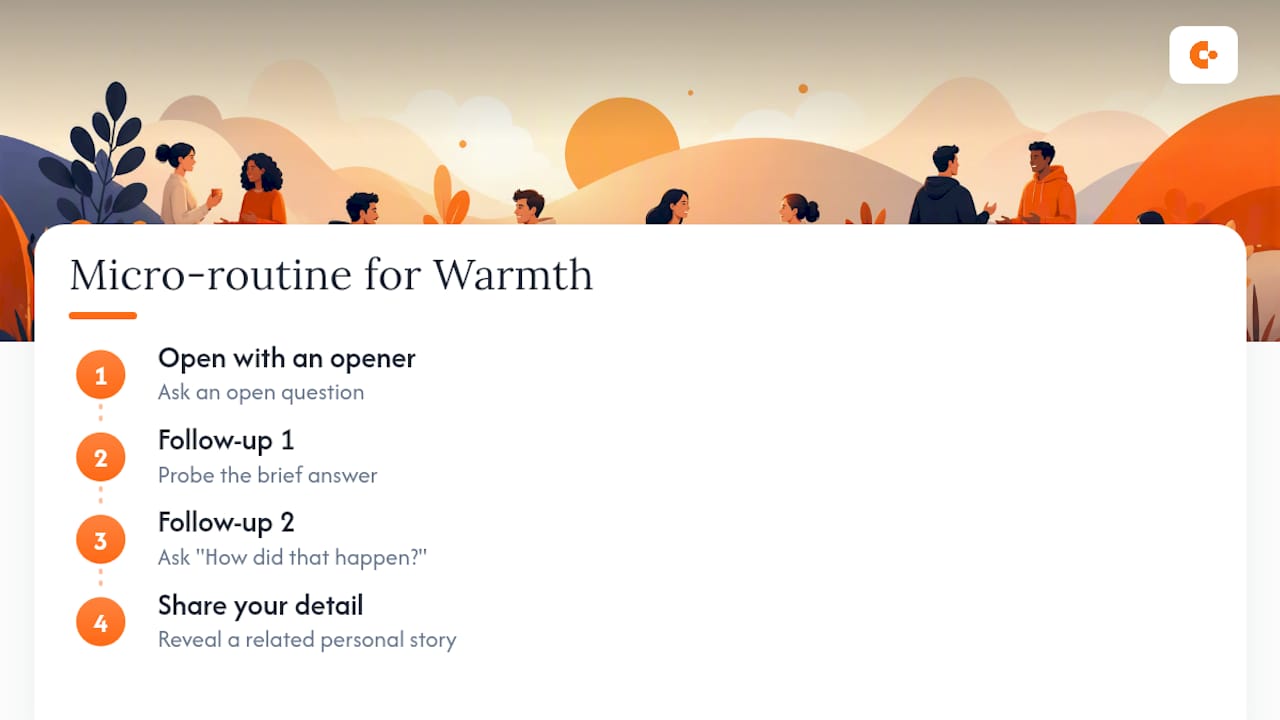
I once watched a coffee meetup go from painfully polite to genuinely warm in about ten minutes, and the shift wasn't a clever question. It was a follow-up. Someone asked "what's the best weekend you've had this year," got a two-word answer about a hiking trip, then asked "how did that happen?" instead of moving on. That second question turned into a real story, and by the time the story ended, both people had shared something they hadn't planned to.
That's the whole routine: one open opener, two follow-ups, then a shared detail of your own. It works better than any list of 50 questions, because it treats the other person's answer as the interesting part, not just a cue for your next line.
— Ilya
Turn These Questions Into an Actual Meetup
Reading a list of questions is one thing. Actually having a coffee, a co-working session, or a tennis match with someone new to try them on is another, and there's an app that matches you in real time with people nearby who want the same thing you do, right now, whether that's a coffee chat, a work session, or a sports partner, without profiles to swipe through or small talk that goes nowhere before you even meet.
Bring a handful of the starters above to a coffee meetup, and they double as a natural way to fill the first five minutes without either person scrambling for something to say. Prefer a shared task over a sit-down conversation? Find a co-working partner and let the questions come up naturally between work stretches. Rather move while you talk? Find a sports partner nearby and skip the awkward standing-around part entirely. Open the Conppi activity partner app and set up your first low-pressure meetup today.
Sources
- Want to Be Close to Someone? Ask These 36 Questions — PsychCentral
- Question-Asking and Liking — Harvard DASH (summary)
- Conversation starters that can lead to friendship — VerywellMind