

The easiest way to open a conversation at a meetup is a short line anchored to whatever you're both already doing, followed by a question that invites a real answer instead of a nod. Skip the résumé questions. Comment on the shared activity, then hand the conversation over with something open-ended. Apps like Conppi help because they match you around a specific activity before you even meet, so the opener is already sitting right in front of you.
TL;DR:
- Using activity-based openers, such as commenting on shared surroundings, significantly increases the chances of a successful first interaction.
- Employing structured frameworks like ARE, FORD, or this-or-that helps maintain natural flow and reduces anxiety during initial conversations.
- Establishing rapport early relies more on nonverbal cues, pacing, and sharing safe personal details rather than complex lines or questions.
- Practicing quick, low-stakes interactions daily over a week enhances confidence and decreases apprehension about talking to strangers.
- Meeting around a shared activity naturally accelerates rapport building, making openers more effective and improving connection quality.
Table of Contents
- Icebreakers for Meetups by Activity Type
- Three Simple Frameworks to Structure Any Opener
- What to Do (and Avoid) in the First Minute
- Copy-and-Adapt Scripts for Common Meetup Moments
- Quick Drills to Build Conversational Confidence
- Why the Activity Comes Before the Conversation
- Find Your Next Activity Partner Before You Need a Perfect Opener
- Research and Reading Behind This Guide
- Sources
Icebreakers for Meetups by Activity Type
Generic small talk fails because it ignores the one thing you and your meetup partner already have in common: the activity itself. Practical conversation guides consistently point back to the shared environment as the strongest source of material, and Calm's advice on starting conversations backs this up: comment on something visible, ask something easy, then listen.
Coffee meetups:
- "This place has a weirdly specific playlist. Do you come here a lot, or is this your first time too?"
- "I always order the same drink out of habit. Are you a creature of habit or an explorer?"
- "What got you into [app/hobby that brought you here] in the first place?"
- Follow-up: "That's interesting. What made you stick with it?"
Sports and fitness partners:
- "How long have you been playing? I'm trying to figure out if I'm about to get destroyed."
- "Warm-up first, or do you just dive in?"
- "Do you play to relax or to compete? I'm genuinely asking because I need to calibrate."
- Follow-up: "What's the most annoying habit you're trying to fix in your game?"
Co-working sessions:
- "What are you working on today, big project or just catching up on emails?"
- "Do you usually work from places like this, or is today an experiment?"
- Follow-up: "What's the ideal work environment for you when you actually get to choose?"
Language exchange:
- "What's a word in your language that just doesn't translate?"
- "Coffee or tea while we do this?" (a quick this-or-that beats a heavier question every time)
- Follow-up: "How did you end up learning [language]?"
Travel and local meetups:
- "What's one thing about this city that surprised you when you moved here or visited?"
- "Local recommendation or tourist trap: what's the best thing you've found so far?"
Notice the pattern: every opener acknowledges the immediate, shared reality rather than reaching for something clever. That approach lines up with what Atlassian's research on icebreaker questions found: this-or-that prompts and open-ended context questions outperform yes/no questions because they don't dead-end the conversation after one word.
Three Simple Frameworks to Structure Any Opener
You don't need a clever line. You need a structure you can run on autopilot when your brain goes blank.
- ARE (Anchor, Reveal, Encourage). Anchor your comment in the shared moment ("this line is taking forever"), reveal a small detail about yourself ("I always forget to bring a book for this"), then encourage them to respond ("what do you usually do while waiting?"). This sequence is what MakeHeadway's conversation guide recommends, and it works because each step lowers the social stakes before raising them slightly.
- FORD (Family, Occupation, Recreation, Dreams). Use this when the conversation has legs and you want a deeper path. It's a fallback menu, not a script. Pull one topic when the activity-based small talk runs dry.
- This-or-that. When time is short or the setting is loud, skip the open-ended question entirely. "Window seat or aisle?" gets an instant, low-effort answer that still tells you something real.
Pro Tip: Pick one framework before you arrive, not during the awkward silence. Deciding in advance removes the pressure of improvising on the spot.
What to Do (and Avoid) in the First Minute
Rapport formed in the first minute of an interaction tends to predict how the rest of the meetup goes, according to research on initial group rapport, so the opening seconds carry more weight than they feel like they should.
- Keep your hands visible and your posture open. Crossed arms and phone-scrolling read as unavailable, even when you're just nervous.
- Match their pace. If they're relaxed and slow, don't fire off three questions in a row.
- Share only your first name and general area, not your exact address or schedule, when meeting an app match for the first time.
- Skip income, relationship status, religion, and politics in the opening minutes. None of that builds rapport quickly, and all of it can shut a stranger down fast.
Copy-and-Adapt Scripts for Common Meetup Moments
Sometimes you just want the exact words. Adjust the tone to fit your voice, but the structure below works across most casual meetups.
Coffee:
- "I'm bad at ordering anything new here. What's actually good?"
- "How was your week, the honest version, not the small-talk version?"
- "What's the last thing that made you laugh out loud?"
Co-working:
- "Is this your regular spot, or are you trying it out?"
- "What's the one app or tool you couldn't work without right now?"
- "Do you take a lunch break, or do you just power through?"
Sports:
- "What position or role do you usually play?"
- "Any pre-game rituals, or are you just here to play?"
- "What's the last sport you tried for the first time?"
Travel or local meetups:
- "What's on your list for this trip that you haven't done yet?"
- "Best meal you've had here so far?"
The active-listening move that makes these land is the follow-up strategies for professional networking. If someone says they're co-working because they hate their home office, don't move to a new topic. Ask what's wrong with the home office. That single follow-up, sometimes called the support shift, does more for rapport than any clever opening line ever will.
Quick Drills to Build Conversational Confidence
Confidence with strangers builds through repetition, not willpower. A week-long intervention built around repeated small interactions measurably reduced people's pessimism about talking to strangers and boosted their conversational confidence for at least a week afterward, according to research published in the Journal of Experimental Psychology: General.
- Run a 7-day mini-experiment. Aim for three low-stakes interactions a day: a comment to a barista, a question to a cashier, a line to a stranger at a bus stop.
- Warm up right before a meetup. Say one sentence out loud to yourself, even in your car or on the walk over, just to get your voice moving.
- Reflect for 60 seconds afterward. What opener worked? What follow-up got the best response? Note it and reuse it next time.
Why the Activity Comes Before the Conversation
Most advice about talking to strangers treats the opener as the hard part. It isn't. The hard part is the follow-up, and most people skip straight past it because they're too busy rehearsing their next line instead of listening to the answer they just got.
What actually changes outcomes is context. Strangers meeting around a shared activity tend to build rapport faster than old friends catching up over coffee, because the activity does the conversational work that small talk usually has to fake. That's backed by research on interpersonal coordination in naturalistic settings, and it's the entire premise behind Conppi's activity-first matching: filters for sport, skill level, and timing exist so two strangers arrive already holding a shared topic. The approximate-distance privacy setting removes another layer of first-meeting anxiety, since neither person has to reveal an exact address to show up.
— Ilya
Find Your Next Activity Partner Before You Need a Perfect Opener
Every icebreaker in this article works better when there's already a shared reason to talk, and that's exactly what Conppi builds in before you show up. Instead of scrolling profiles or guessing who's actually free this weekend, you get matched with people nearby who want the same activity at the same time, so the opener is already sitting on the table when you arrive.
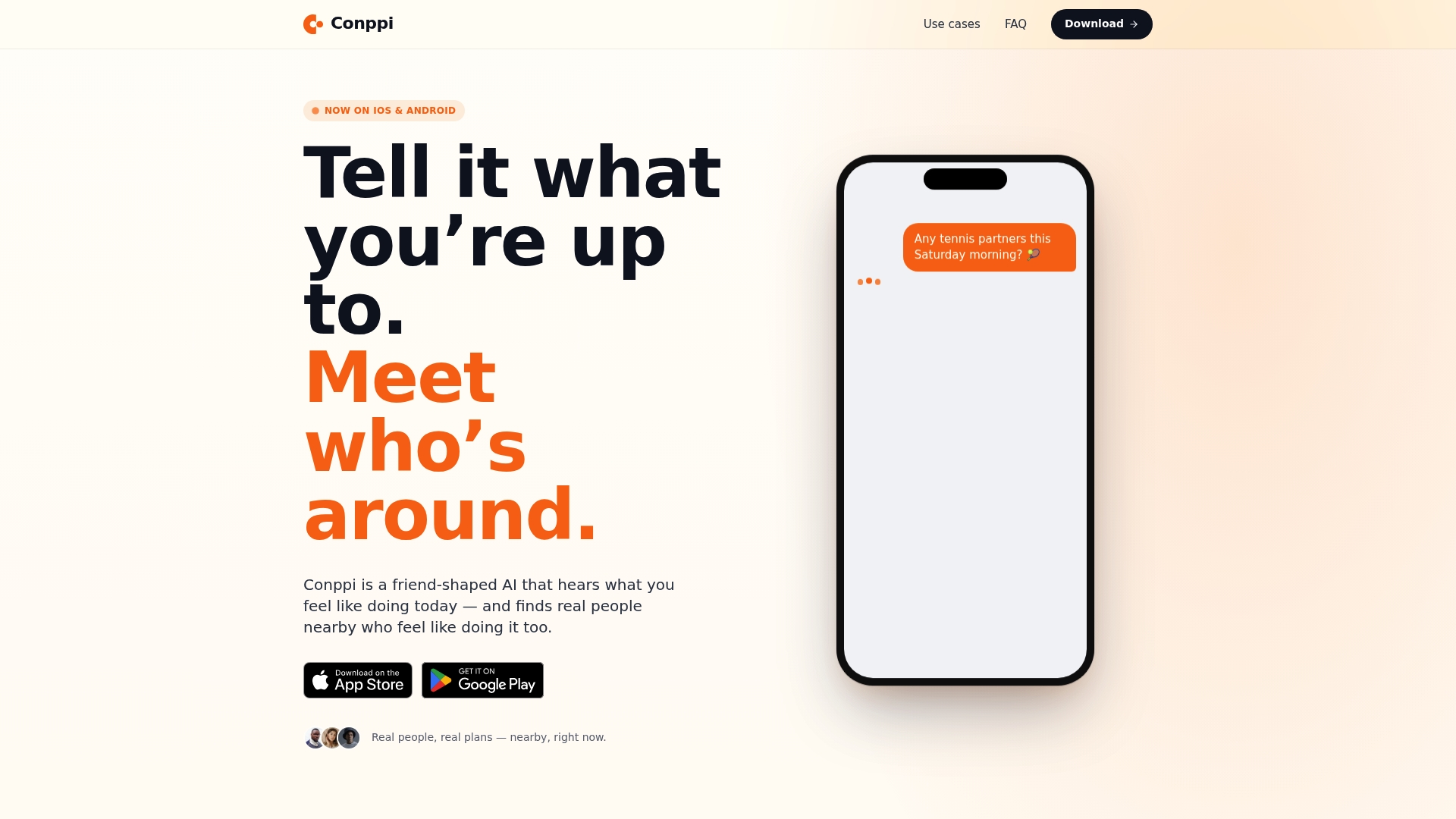
Looking for a hitting partner, someone to split a co-working afternoon with, or just company for coffee? The activity partner app matches you by interest and timing first, not by profile browsing. If sports partners are the goal, check Conppi's sports partner matching directly. Download Conppi, set your activity and availability, and see who's nearby right now.
Research and Reading Behind This Guide
- Atlassian's icebreaker research, supporting this-or-that prompts over yes/no questions.
- Macquarie University's coordination research, on why shared activities speed up rapport.
- Journal of Experimental Psychology: General, on repeated-exposure drills reducing stranger anxiety.
- CHI proceedings on socio-spatial interfaces, on structured tools aiding emergent rapport.
- Study on first-minute rapport, linking early rapport to later bonding.
- MakeHeadway's conversation guide, source of the ARE framework.
Sources
- Icebreaker questions that start better conversations — Atlassian blog
- Relational context shapes interpersonal coordination in naturalistic settings — Macquarie University (research page)
- Hello, stranger? Pleasant conversations are preceded by concerns about starting one — Journal of Experimental Psychology General (2021 study/DOI)