

If you're an introvert, the fastest reliable way to make friends is to join structured shared-interest settings and show up regularly, then convert those group contacts into low-pressure one-on-one meetups. This works because it removes the two things that exhaust introverts most: small talk and unpredictability. Harvard clinicians back this exact approach, and the payoff is real: close friendships measurably lower blood pressure and cut dementia and depression risk. None of it requires becoming someone you're not.
TL;DR:
- Joining low-pressure, recurring activity groups like book clubs or sports teams helps introverts build friendships while conserving energy.
- Consistent follow-up with specific, small invites within a week deepens connections more effectively than occasional contact.
- Using curiosity-based questions about shared activities creates genuine conversations that avoid draining small talk.
- Setting fixed social limits and scheduling recovery time ensures introverts maintain energy without avoiding socializing entirely.
- Digital tools like Conppi facilitate finding nearby activity partners, but meaningful friendships still rely on in-person, repeated contact.
Table of Contents
- Introvert Making Friends: An 8-Step Checklist To Start This Week
- Choosing Environments Where Friendships Actually Form
- Turning Group Acquaintances Into Real Friends
- Conversation Starters That Don't Feel Like Small Talk
- Protecting Your Energy While Building Friendships
- When It's Anxiety, Not Introversion, Holding You Back
- How Activity-Based Tools Fit Into This Playbook
- Your Strengths Are the Point, Not the Problem
- Not All Friendships Need To Look The Same
- Finding the Right Mix of Online and Offline Connection
- What Actually Worked, and What Took Longer Than Expected
- Meet Activity Partners Near You With Conppi
- Sources
Introvert Making Friends: An 8-Step Checklist To Start This Week
You don't need a personality transplant. You need a plan that respects your energy limits and gives you a reason to show up more than once.
- Pick one recurring setting tied to something you already enjoy, not something you think you "should" do.
- Commit to attending twice before deciding whether it's a fit. One visit tells you nothing.
- Introduce yourself with a comment about the activity itself, not your job title or small talk.
- Follow up within a week with a specific, low-stakes invite instead of a vague "we should hang out."
- Set a weekly or monthly social energy budget and treat it as fixed, not flexible.
- Schedule recovery time after any social event, the same way you'd schedule a workout.
- Keep a short mental script ready for follow-ups so you're not improvising under pressure.
- Save deeper personal sharing for one-on-one time, once trust has had a chance to build.
Notice what's missing from this list: forcing yourself to be the loudest person in the room. That's not the goal, and it never was.
Choosing Environments Where Friendships Actually Form
Structured settings work for introverts because they hand you a built-in reason to be there. Harvard Health's guide to socializing points out that shared activities act as a social anchor, so you're not stuck generating conversation from nothing. The activity does that work for you.
Some environments consistently outperform others for introverts specifically:
- Book clubs or discussion groups, where the topic is pre-set and everyone has something to react to
- Language exchanges, which naturally structure turn-taking
- Co-working spaces with a regular schedule, where you become a familiar face without needing to perform
- Small sports groups like padel, tennis, or running clubs, capped at four to eight people
When you're sizing up a new group, check four things: how often it meets, how many people typically show up, how loud the room gets, and whether the facilitator (if there is one) pushes forced interaction or lets it happen naturally. A weekly group of six in a quiet co-working space beats a monthly meetup of forty in a bar, every time, for an introvert's purposes.
Pro Tip: Test two related activities in the same month, like a running club and a cycling meetup, before locking into one. You'll learn faster which format fits your energy by comparing than by committing blind.
Turning Group Acquaintances Into Real Friends
This is the step most people skip, and it's the one that actually matters. Repeated, low-stakes exposure to the same people is what psychologists call the slow burn, and Harvard Health identifies it as the most sustainable route to deep friendship for people who find constant novelty exhausting. Each repeat interaction lowers the emotional stakes of the next one.
Here's how the follow-up actually plays out:
- Within a week of a group meetup, send a short message referencing something specific from that session.
- Suggest one modest next step: a coffee, a walk, or the next scheduled version of the same activity.
- Keep the ask small on purpose. "Want to grab coffee after next week's session?" beats "We should get dinner sometime."
- Maintain momentum between meetups with brief check-ins rather than long messages you feel obligated to craft perfectly.
Becoming a familiar face in the same room matters more than any single dazzling conversation.
Conversation Starters That Don't Feel Like Small Talk
Small talk drains introverts because it has no destination. Curiosity-based questions fix that by giving the conversation somewhere to go.
Try this formula: make an observation about the activity, then ask a genuine question tied to it. "You've got the same running shoes I've been eyeing, how do they hold up on longer distances?" does more work than "How's it going?"
Three question formulas that consistently open real conversation:
- "What got you into [activity]?" followed by "What keeps you coming back?"
- "What's the hardest part of this for you?" followed by "How'd you figure that out?"
- "Any recommendations for someone newer to this?" followed by a specific detail you'll actually use
For the first follow-up message, keep it short: "Great running into you Tuesday. I'm heading back next week, want to grab coffee after?" Do ask specific questions. Don't fill silence with rapid-fire personal questions that feel like an interview.
Protecting Your Energy While Building Friendships
Friendship building only works long term if it doesn't wipe you out. Set a weekly or monthly limit on social commitments and hold that line the way you'd hold a budget.
Short, defined formats help more than open-ended ones. A 45-minute coffee has a natural exit. A three-hour dinner doesn't. Try phrasing like, "I've got about 45 minutes, want to grab a quick coffee?" It sets expectations up front and nobody feels short-changed when you leave on time.
Recurring meetups also cut down on the mental load of constant social decisions. Once Tuesday coffee after your running group becomes a standing thing, you're no longer negotiating it each week. That predictability is exactly what Harvard clinicians recommend for people who find spontaneous plans draining.
When It's Anxiety, Not Introversion, Holding You Back
There's a real difference between preferring less social contact and dreading it. If the idea of talking to a stranger triggers racing thoughts, physical symptoms, or a strong urge to cancel plans you actually wanted to keep, that's closer to social anxiety than introversion.
A useful screening question: do you avoid social situations because you'd rather be doing something else, or because you're afraid of how you'll be judged? The first is introversion. The second deserves attention.
Micro-exposure helps either way: set a tiny, repeatable goal, like saying one sentence to a stranger, before raising the stakes. If avoidance is running your calendar rather than your preferences, a therapist trained in cognitive behavioral techniques can help you build tolerance gradually and safely.
How Activity-Based Tools Fit Into This Playbook
Finding the right recurring setting is the hardest part of this whole approach, and that's exactly where Conppi earns its place. The app matches you with people nearby who want the same activity right now, using filters for time and skill level so you're not guessing whether someone's a fit before you show up.
Say you want a standing padel game every Thursday: Conppi connects you with a nearby partner at your level, without profiles or swiping to wade through. The same goes for co-working sessions or a coffee catch-up after class. Distance shown is approximate only, so you're never handing over more location detail than you're comfortable with. It's a straightforward way to build the recurring contact this whole strategy depends on.
Your Strengths Are the Point, Not the Problem
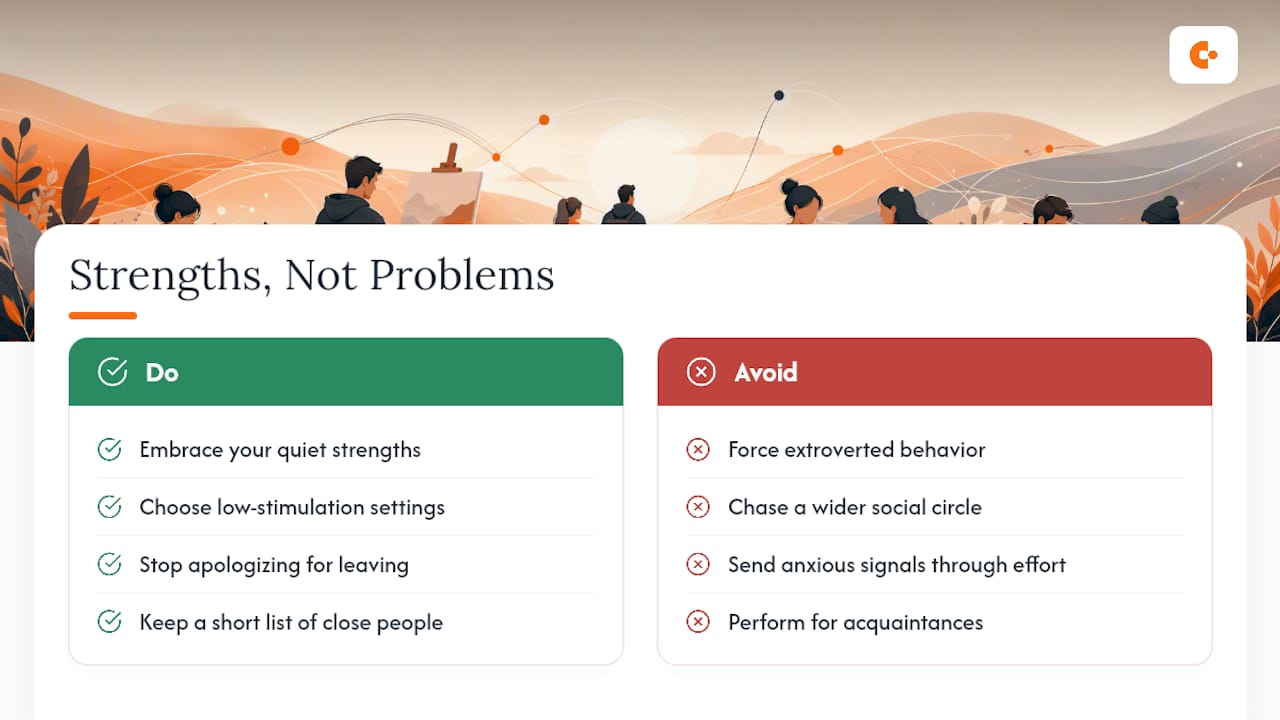
Confidence for introverts rarely comes from acting more extroverted. It comes from recognizing that your default mode, listening closely, thinking before speaking, preferring depth over breadth, is a genuine asset in friendship, not a flaw to manage around.
Psychologist Laurie Helgoe frames introverts as people who process internally rather than externally, which reframes quietness as a working style rather than a deficiency. That distinction changes how you show up socially. You're not "bad at parties." You're someone whose brain does its best work in lower-stimulation settings, and friendship built there tends to run deeper anyway.
This matters practically because self-acceptance changes your behavior in small but real ways. When you stop apologizing for leaving early or needing a quiet night before a big social commitment, you stop sending anxious signals that make interactions feel forced. People pick up on ease faster than they pick up on effort.
It also changes who you're drawn to. Introverts often build their best friendships with people who don't need constant stimulation either, people who are comfortable with a quiet dinner, a long walk with real gaps in conversation, or an afternoon spent doing separate things in the same room. Chasing a wider social circle because it looks impressive on paper usually backfires. A short list of people who genuinely get how you operate will serve you better than a long list of acquaintances you're performing for.
Not All Friendships Need To Look The Same
One mistake that trips up a lot of introverts: expecting every friendship to reach the same depth as their closest one or two relationships. That's not how friendship actually works for most people, introvert or not.
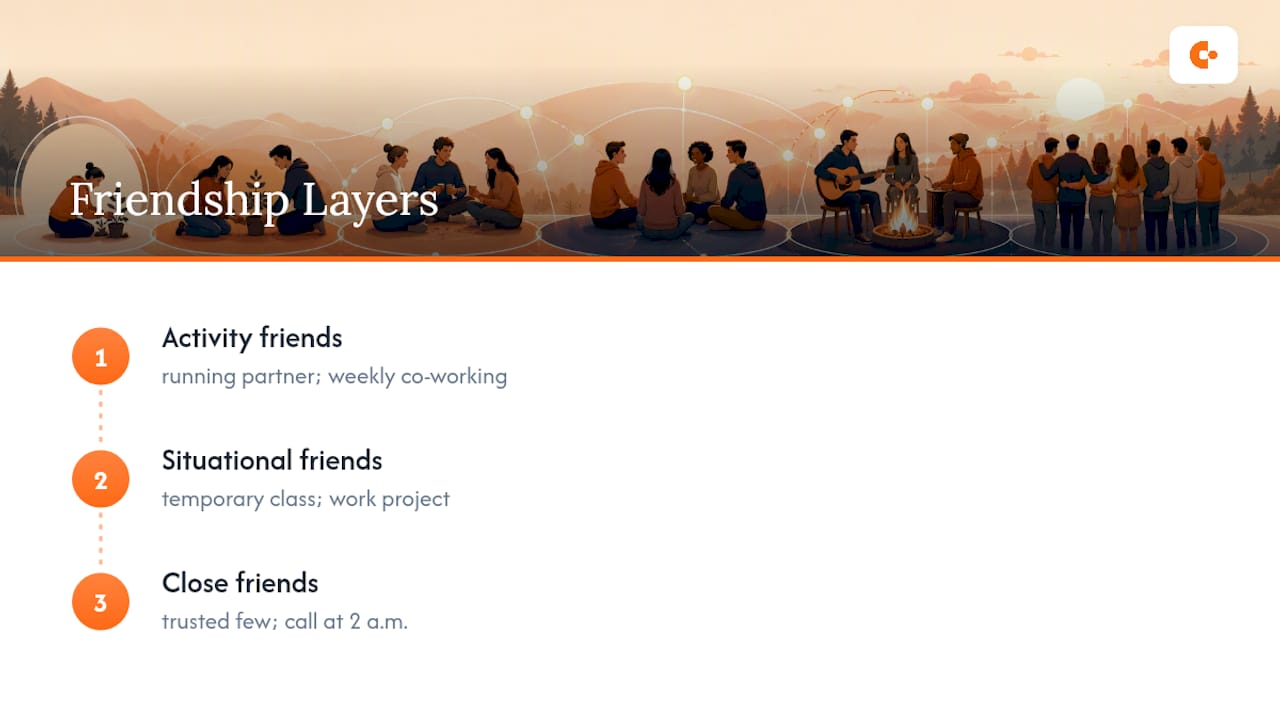
Think of it in layers. You've got activity friends, the running partner or co-working regular you see weekly but rarely outside that context. You've got situational friends, people tied to a specific season of life, like a work project or a temporary class. And you've got close friends, the small handful you'd call at 2 a.m. Each layer serves a different purpose, and trying to force an activity friend into a close-friend role usually just creates pressure neither of you asked for.
Managing expectations here means not judging a friendship's value by how deep it goes. A padel partner who shows up every Thursday and makes you laugh for an hour is providing something real, even if you never learn their middle name. The Surgeon General's advisory on social connection notes that even lighter-touch social ties contribute meaningfully to well-being, not just the deepest bonds. Trying to skip straight to intimacy with someone you just met at a co-working space tends to feel forced to both people. Let the layer match the relationship's actual history, and upgrade only when it happens naturally.
Finding the Right Mix of Online and Offline Connection
Digital tools are useful for introverts specifically because they remove the ambush factor of unplanned social contact. You can scan a group's vibe, check the schedule, and decide when to show up, all without the anxiety of a cold walk-in.
But the research is consistent on one point: online contact supplements offline friendship, it doesn't replace it. A running group chat is great for logistics and quick encouragement between sessions, but the friendship itself deepens through the actual runs, not the messages about them. Reporting on introverts and friendship in the New York Times points to a similar pattern: introverts do best when they control the environment, using tools to set up predictable, low-pressure contact rather than defaulting to constant digital availability.
A workable split looks like this: use apps and group chats to find settings, confirm plans, and send those short follow-up messages between meetups. Reserve actual bonding, the kind that turns an acquaintance into a friend, for in-person time, even if that time is short. Forty-five minutes of coffee after your Tuesday run does more for a budding friendship than a week of back-and-forth texting ever will.
What Actually Worked, and What Took Longer Than Expected
A standing Tuesday coffee after a running group is a small thing on paper. It took about six weeks of consistent attendance before it turned into an actual friendship rather than a friendly nod. That timeline tracks with what the research suggests: weeks to months, not days, and mostly through unremarkable repetition rather than any single great conversation.
The energy management piece matters just as much as the showing up. Skipping a week when you're depleted doesn't undo the progress, as long as you come back.
— Ilya
Meet Activity Partners Near You With Conppi
Everything in this guide points to the same conclusion: friendships form through recurring, low-pressure contact around something you actually want to be doing. Conppi is built around exactly that, matching you in real time with people nearby who want the same activity, whether that's a Thursday padel game, a co-working afternoon, or a coffee after class, filtered by time and skill level so you're not guessing at compatibility beforehand.
There's no profile-scrolling and no swiping, just a way to find someone ready to show up for the same thing you are. If a standing sports game or a recurring coffee meetup is the kind of low-pressure contact you've been missing, find an activity partner near you and set up your first meetup this week.
Sources
- How to make friends—even if you're an introvert - Fast Company
- An introvert's guide to socializing - Harvard Health (blog)
- I Love You, Now Leave Me Alone: What Friendship Means to an Introvert - NYTimes