

This page gives you a categorized bank of language exchange topics and ready-to-use starters, sorted from beginner to advanced. Prepare 3 to 5 topics before each session, split your talking time 50/50 with your partner, and keep a few rescue phrases on hand for when you get stuck. Each category below is labeled by difficulty so you can match questions to where you actually are, not where you wish you were.
TL;DR:
- Planning 3 to 5 open-ended topics and splitting conversation time evenly prevents early exchange stalls and makes sessions more productive.
- Asking follow-up questions and avoiding closed inquiries like "Where are you from?" deepen conversation and improve fluency.
- Using age-appropriate and CEFR-level matching topics maintains motivation and ensures achievable challenges for all learners.
- Preparing rescue phrases such as "Can you say that more slowly?" helps maintain flow and reduces anxiety during delays or misunderstandings.
- Genuine interest and engagement in topics, especially debates or stories, lead to better grammar practice than superficial or overly academic questions.
Table of Contents
- Icebreaker Language Exchange Topics to Start Any Session
- Talking About Daily Life, Your City, and Cultural Habits
- Hobbies, Music, Movies, and What You're Into
- Work, Education, and Long-Term Goals
- Travel Stories and Trip-Planning Roleplay
- Food, Cooking, and Comparing Cuisines
- Discussing Current Events Without the Awkwardness
- Hypotheticals, "Have You Ever?" and Quick Roleplays
- How to Structure a Session So Both Partners Actually Benefit
- CEFR-Aware Starters: Matching Topics to Your Level
- Keeping the First Session From Going Quiet
- What Years of Topic Variety Taught Me About Real Fluency
- Find Real Language Exchange Partners Nearby With Conppi
- Sources
Icebreaker Language Exchange Topics to Start Any Session
The first five minutes set the tone. Most language exchange questions fail here because they're closed questions that die after one answer ("Where are you from?" gets you a city name and silence). Better icebreakers ask for a reason, a story, or a comparison, which forces your partner into longer, more complex sentences.
Start with a short self-introduction script: your name, where you're from, and why you're learning the language. That third part matters most, because "why" answers pull out subordinate clauses and give you real material to respond to.
- "What's the story behind you learning this language?" (practices past simple and reason clauses, "because," "so that")
- "What was the hardest part of learning it so far?" (present perfect, "have found," "has been")
- "If you could master one skill in this language overnight, what would it be?" (second conditional)
- "What's a word in your language that doesn't translate well?" (descriptive vocabulary, comparatives)
- "How did you two decide to start doing a language exchange?" (past simple narrative)
- "What's something people always get wrong when they meet you?" (present simple habits, third person)
Ask a follow-up on every answer. If your partner says "I started because of a TV show," don't move to the next question. Ask which show, what happened in it, whether they still watch it. That single follow-up habit does more for fluency than any list of questions.
Talking About Daily Life, Your City, and Cultural Habits
Daily-life questions are the workhorse of any exchange because they force you to use time expressions, sequencing words, and everyday vocabulary you'll actually need outside the session. "First," "then," "after that," and "usually" all show up naturally when someone describes a Tuesday.
Neighborhood and transport questions work well because they surface concrete nouns you might not know in your target language: sidewalk, roundabout, corner store, commute. Ask your partner to describe their walk to work or their favorite coffee spot, and you'll both learn vocabulary a textbook skips.
- "Walk me through your typical morning, from waking up to leaving the house." (present simple, sequencing adverbs)
- "What does your neighborhood look like? What's within walking distance?" (place vocabulary, descriptive adjectives)
- "How do people usually get around where you live: car, bike, public transit?" (comparative structures)
- "What's a habit in your country that surprises visitors?" (cultural comparison, present simple)
- "Is there a custom in your culture you think outsiders misunderstand?" (hedged opinion language)
Cultural comparison questions can go sideways fast if they're phrased as judgments rather than curiosity. "Why do people in your country do X?" can land as an accusation. "How is X usually handled where you're from?" gets the same information without the edge. Collections of intercultural conversation starters built for exchange programs are designed around exactly this kind of respectful phrasing, and borrowing that tone is worth it.
Hobbies, Music, Movies, and What You're Into

Hobby talk is where most people naturally speak the most, because they already have opinions loaded and ready. That makes it perfect for practicing frequency adverbs (always, rarely, once a week) and likes/dislikes structures that vary by language in ways textbooks rarely explain well.
Entertainment topics push learners toward adjectives and storytelling, which is a different muscle than describing routines. Ask someone to describe a movie scene or a concert they went to, and you'll hear past continuous, sequencing, and evaluative language all in one answer.
- "What do you do in your free time, and how often?" (frequency adverbs: usually, occasionally, rarely)
- "What's a song or album that means something to you? Why?" (present perfect, emotional adjectives)
- "Describe a movie scene that stuck with you, in as much detail as you can." (past continuous, descriptive detail)
- "Have you been to a concert or live show recently? What was it like?" (present perfect + past simple mix)
- "What's a hobby you gave up? Would you go back to it?" (past simple + second conditional)
- "Books or shows: which one do you actually finish more often, and why?" (comparatives, habitual present)
For a longer activity, try trading a two-minute description of a favorite film scene, then have your partner guess the movie. It forces precise vocabulary instead of vague summaries.
Work, Education, and Long-Term Goals
Professional and academic topics push you into more formal registers and technical vocabulary you won't get from casual chat. They're also where future tenses and modal verbs get real use: "I'm planning to," "I might," "I should probably."
Ask your partner to describe their job or studies in a way a stranger would understand, not shorthand for someone in the same field. That constraint forces clearer, more basic vocabulary choices, which is usually harder than it sounds and genuinely useful practice.
- "What does a normal day at your job or school actually look like?" (technical vocabulary, present simple)
- "Where do you see yourself professionally in five years?" (future forms: will, going to, plan to)
- "What's one skill you're hoping to develop this year?" (modal verbs: should, need to, want to)
- "How is the school or work culture different from what you'd expect elsewhere?" (comparative structures)
If your exchange partner is a student, comparing university application systems or academic calendars can be genuinely interesting territory, especially since processes like the ones outlined by Eduvos program guides differ quite a bit from country to country and give you real material to compare rather than invented hypotheticals.
Travel Stories and Trip-Planning Roleplay

Travel topics are built for past narrative tenses, because a good travel story rarely happens in a single moment. It has a beginning, a complication, and usually a twist, which means past simple, past continuous, and past perfect all show up naturally.
Ask about a favorite trip and push for detail: what went wrong, what surprised them, what they'd do differently. Vague answers ("it was nice") are a sign to ask a sharper follow-up, not to move on.
- "What's the best trip you've ever taken, and what made it memorable?" (past simple narrative)
- "Have you ever had a travel plan completely fall apart? What happened?" (present perfect, past perfect)
- "What's a place near you that tourists never find but locals love?" (descriptive language, place vocabulary)
For a change of pace, try a short roleplay: one partner plans a day trip and pitches it, the other asks questions and negotiates the itinerary. It's a natural way to rehearse suggestion language ("What if we…", "I'd rather…") in a low-stakes format.
Food, Cooking, and Comparing Cuisines
Food conversations are sensory by nature, which means they're excellent for practicing adjectives you don't reach for otherwise: bitter, tender, overcooked, bland. Describing a recipe step by step also forces sequencing and imperative verb forms, since recipes are basically instructions.
- "Describe how to make a dish from your culture, step by step." (imperatives, sequence words: first, next, then finally)
- "What's a food from another culture you didn't expect to like?" (past simple, evaluative adjectives)
- "Is there a dish from my culture you'd want to try or never touch?" (conditional, polite disagreement phrasing)
Disagreeing about taste is a good place to practice softening language: "I'm not sure that's for me" lands very differently than a flat "I don't like that."
Discussing Current Events Without the Awkwardness
News and current events make for genuinely useful practice because they demand hedging language: "It seems like," "I could be wrong, but," "From what I've read." Those phrases are hard to pick up from a textbook and easy to pick up from real conversation.
Stick to lower-stakes categories: new technology, streaming trends, sports, city development projects. Save hot-button political and religious topics for later sessions, if ever, once you know your partner's comfort level.
- "Have you seen anything in the news lately that surprised you?" (present perfect, hedged opinion)
- "What do you think about how [a piece of new technology] is changing daily life?" (present continuous, opinion phrases)
- "Is there a local development or change in your city people are talking about?" (present simple, place vocabulary)
Pro Tip: Practice hedging phrases on purpose: "It seems like," "I might be wrong, but," and "From what I understand" all soften an opinion and buy you thinking time mid-sentence.
Hypotheticals, "Have You Ever?" and Quick Roleplays
Hypothetical questions are the fastest route to conditional practice, and "have you ever" questions are the cleanest way to drill present perfect without it feeling like a grammar drill.
- First conditional practice: "If you had a free week next month, what would you do with it?"
- Second conditional practice: "If you could live in any country for a year, where would you go?"
- Third conditional practice: "If you hadn't started learning this language, what do you think you'd be doing instead?"
- "Have you ever" prompts: "Have you ever gotten completely lost somewhere and had to ask for help?"
- Roleplay drill: Practice a three-minute transactional scene, ordering food, checking into a hotel, or asking for directions, then swap languages and repeat.
Roleplay scenarios like these are particularly good for transactional language practice because they mirror real situations you'll actually face rather than abstract conversation.
How to Structure a Session So Both Partners Actually Benefit
The single biggest reason language exchanges fizzle out isn't a lack of topics. It's uneven time. One partner dominates in their stronger language, the other nods along, and nobody leaves having practiced much of anything.
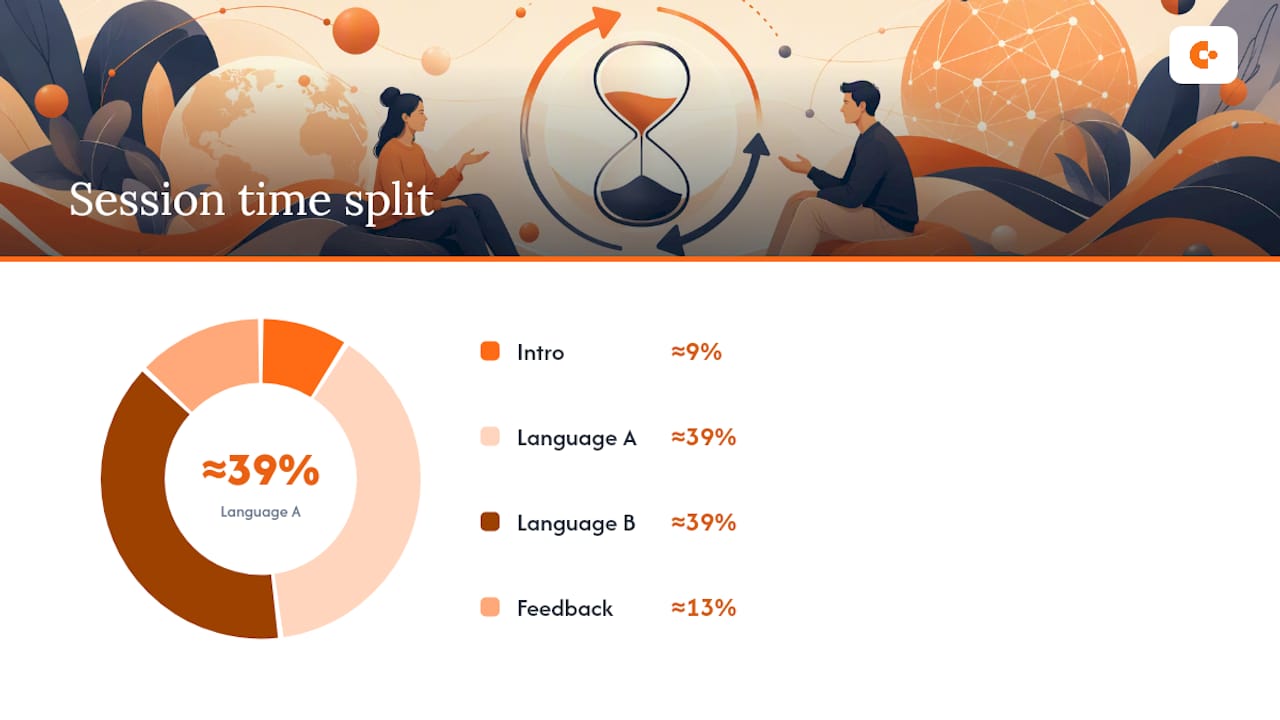
Experienced practitioners recommend preparing 3 to 5 open-ended topics before you even sit down, and agreeing on a time split upfront so neither person has to awkwardly interrupt to claim their turn. That single habit, preparing topics and splitting time in advance, solves most of what makes early exchanges feel stilted.
A simple template that works for a one-hour session:
- 5 minutes: casual intro and catch-up in whichever language feels natural
- 20 to 25 minutes: conversation in language A, with the native or stronger speaker helping
- 20 to 25 minutes: conversation in language B, roles reversed
- 5 to 10 minutes: quick feedback, useful corrections, and picking topics for next time
Adjust the timings to whatever total length you've got. What matters is that the split exists at all and both people know it going in.
Keep a short rescue-phrase list visible during the session so you're not scrambling mid-sentence:
- "Can you say that more slowly, please?"
- "What does [word] mean?"
- "How do you spell that?"
- "Is there another way to say that?"
- "Sorry, can you repeat that?"
These aren't signs of weakness. They're the exact clarification phrases experienced exchange partners recommend preparing in advance, because fumbling for "what do you mean" in a language you're still learning defeats the purpose.
CEFR-Aware Starters: Matching Topics to Your Level
Not every topic belongs at every level, and forcing an A2 learner into a C1 debate about economic policy just breeds frustration on both sides. Long-form question banks that label prompts by estimated difficulty, like the CEFR-labeled question list Hilokal publishes, exist for exactly this reason: matching challenge to ability keeps both partners engaged instead of one person checking out.
A1 (beginner): Keep it to present tense and short answers.
- "What's your name and where are you from?"
- "What do you do on the weekend?"
- Script to try: "Hi, I'm [name]. I'm learning [language] because I want to [reason]. Can you help me practice?"
A2 (elementary): Introduce past simple and simple future.
- "What did you do yesterday?"
- "What are your plans for this weekend?"
B1 (intermediate): Add opinions and comparisons.
- "What do you think is the biggest difference between our two countries?"
- "Would you rather live in a big city or a small town? Why?"
B2 (upper intermediate): Push into hypotheticals and hedged opinion.
- "If you could change one law in your country, what would it be?"
- "What's a common misconception about your culture that bothers you?"
C1 (advanced): Abstract and nuanced topics.
- "How do you think technology is reshaping the way your generation communicates?"
- "What's a belief you've changed your mind about in the last few years?"
| CEFR level | Grammar focus | Sample starter |
|---|---|---|
| A1 | Present simple, basic questions | "What do you do on the weekend?" |
| A2 | Past simple, simple future | "What did you do yesterday?" |
| B1 | Comparatives, simple opinions | "Would you rather live in a big city or a small town?" |
| B2 | Hypotheticals, hedged opinions | "If you could change one law, what would it be?" |
| C1 | Abstract reasoning, nuance | "What's a belief you've changed your mind about?" |
To make any prompt easier, strip it down to present tense and a yes/no frame. To make it harder, add "why," "what if," or ask for a comparison instead of a description.
Keeping the First Session From Going Quiet
Your first exchange with someone new is where nerves do the most damage. Walk in with a short intro script memorized, 3 to 5 topics jotted down, and five rescue phrases ready, so you're never sitting in silence trying to think of what to say next.
End sessions on a clear note rather than letting them trail off: thank your partner, mention one thing you learned, and suggest a specific day for the next one. If your levels don't match well, the stronger speaker should slow down and simplify vocabulary rather than switching entirely into the weaker partner's native language, which defeats the point for both of you.
Pro Tip: If a silence stretches past a few seconds, don't panic. Ask "What made you think of that?" about the last thing either of you said. It almost always restarts the conversation.
What Years of Topic Variety Taught Me About Real Fluency
The best exchange I ever had wasn't planned around grammar at all. My partner and I spent forty minutes arguing about whether subtitles ruin movies, and I used more subjunctive mood correctly in that argument than in three months of textbook drills, because I actually cared about winning the point.
The pattern holds: topics you're genuinely invested in produce better grammar than topics chosen for their grammar value. My rule now is simple. Prepare structured topics as a safety net, but chase a real disagreement or a good story whenever one shows up, and don't cut it short just because it wasn't on the list.
— Ilya
Find Real Language Exchange Partners Nearby With Conppi
A topic list only works once you actually have someone sitting across from you. Conppi solves the harder problem: finding a language exchange partner nearby, right now, without building a profile or swiping through matches that go nowhere. You set what you're looking for, an activity, a time window, a general area, and Conppi surfaces people nearby who want the same thing.
Create a language exchange activity in the app, pick your target language and a rough time, and Conppi matches you with people close by who are looking to do the same thing, whether that's a recurring coffee-shop exchange or a one-off practice session before a trip. The app only shares approximate distance, so you get real matches without giving up your exact location. If you're traveling and want to meet locals wherever you land, the same matching works for that too.
Open the Conppi activity partner app, set up your first language exchange activity, and see who's nearby looking to practice this week.