

Pick one recurring activity this week and invite someone in it to a low-pressure hangout within seven days. That single move creates the repeated contact friendship actually depends on, and it usually takes weeks or months, not one good conversation, to pay off. An app like Conppi can speed up finding the right activity partner, but the habit matters more than the tool.
TL;DR:
- Building a friendship requires at least 40 to 60 hours of shared activity, with closer ties forming after 80 to 100 hours and over 200 hours for deep friendships.
- Consistent scheduled interactions, like weekly classes or sports, accelerate friendship development by providing repeated contact and vulnerability.
- Following up quickly after conversations and proposing specific plans increase the likelihood of maintaining a connection without relying on luck.
- Maintaining friendships relies on regular check-ins and low-cost rituals, while setting clear boundaries prevents burnout and resentment.
- Using activity-matching apps like Conppi can streamline finding compatible activity partners and support consistent, low-pressure relationship building.
Table of Contents
- How Do You Actually Make Friends as an Adult This Week?
- Where Should You Go to Meet New Friends?
- What Do You Say to Someone You Want to Befriend?
- How Long Does It Really Take to Become Friends?
- How Do You Keep a New Friendship From Fading?
- How Does Conppi Support This Whole Process?
- How Do You Handle Rejection When Making Friends?
- How Do You Manage Social Anxiety While Trying to Connect?
- How Do You Set Healthy Boundaries With New Friends?
- How Do You Balance New Friends With the Life You Already Have?
- What I've Learned About Sticking With This Long Enough to Work
- Ready to Find Your Next Activity Partner?
- Sources
How Do You Actually Make Friends as an Adult This Week?
Making friends as an adult stops being abstract the moment you attach it to a calendar. Skip the vague goal of "meet new people" and replace it with a short list of tasks that have deadlines.
Here's a plan you can run in the next seven days:
- Sign up for one recurring activity today. A weekly class, a rec league, a co-working space, a language exchange. Pick something that repeats on its own schedule so you don't have to keep re-inviting yourself.
- Show up twice this month, minimum. One appearance tells people you exist. A second one tells them you're not a tourist.
- Talk to the same person twice. Not everyone in the room. One person, twice, beats ten people once.
- Follow up within 24 to 48 hours of a good conversation. Send something specific, not "we should hang out sometime."
- Propose a concrete plan within two weeks. Coffee, a walk, a second class together. Vague intentions die quietly.
A follow-up text might read: "Hey, it was Marcus from the Tuesday run club. Good chatting about the marathon training. There's a coffee spot near the park I've been meaning to try. Want to grab one Saturday morning before the run?" Specific, low stakes, and it names a next step.
If your schedule is packed, batch this: pick your recurring activity on Sunday, send any follow-up texts Monday morning, and treat it like a five-minute task, not an emotional event.
Pro Tip: Send the follow-up message before you second-guess it. Most people wildly underestimate how much others enjoyed talking to them, a pattern researchers call the "liking gap," and that hesitation is what kills momentum.
Where Should You Go to Meet New Friends?
Not every social setting produces friendships. The ones that work share three traits: proximity, repeated contact, and a reason to be a little vulnerable in front of each other. A one-off networking mixer fails on the second point. A weekly pottery class hits all three.
Strong options worth prioritizing:
- Recurring classes or clubs (pottery, cooking, book clubs) that meet on a fixed schedule.
- Organized sports like tennis or padel, where side-by-side effort naturally produces conversation.
- Volunteering, which adds a shared sense of purpose on top of repetition.
- Co-working spaces, especially if you claim the same desk or table regularly.
- Interest-based meetups tied to a hobby you'd do anyway.
- Neighborhood groups, from tenant associations to local sports leagues.
Before committing to any of these, run it through a quick filter: will you see these same people again in the next two weeks, and will the setting give you something to talk about besides small talk? Shared activities create the vulnerability that pure proximity doesn't. This is also where activity-based apps earn their keep. Instead of guessing which class has compatible people, matching by activity and interest narrows the search before you ever show up.
What Do You Say to Someone You Want to Befriend?
The opener matters less than the follow-up. Most people freeze on what to say first and then let a great conversation evaporate because they never mentioned meeting again.
Match the opener to the setting. In a class: "Are you also confused about the third step, or is it just me?" On a sports team: "How long have you been playing? I'm still figuring out my backhand." At a co-working space: "Mind if I sit here? I've seen you a few times and never introduced myself."
Once the conversation lands, here's the sequence that actually converts strangers into people you see again:
- Notice if the conversation had energy. Laughing, tangents, questions back and forth. That's your signal to act.
- Follow up within 24 to 48 hours. Waiting longer lets the moment go cold; the 24 to 48 hour window still catches people while the interaction is fresh.
- Move from group to one-on-one gradually. If you met in a class of twelve, invite them (just them) to grab coffee before or after the next session.
- Switch the setting. Meeting somewhere new, outside the original context, deepens the connection faster than staying in the same room every week.
- If they don't respond, wait one week and send one more low-pressure message. After that, let it go. Not everyone becomes a friend, and that's fine.
Pro Tip: Assume they liked talking to you more than you think they did. That assumption alone will make you send more follow-up texts, and volume is what actually produces friendships.
How Long Does It Really Take to Become Friends?
Here's the number most people never hear until it's too late to be useful: it takes roughly 40 to 60 hours together to move from acquaintance to casual friend, 80 to 100 hours to become real friends, and over 200 hours to reach close or best-friend territory, according to research from Jeffrey Hall at the University of Kansas.
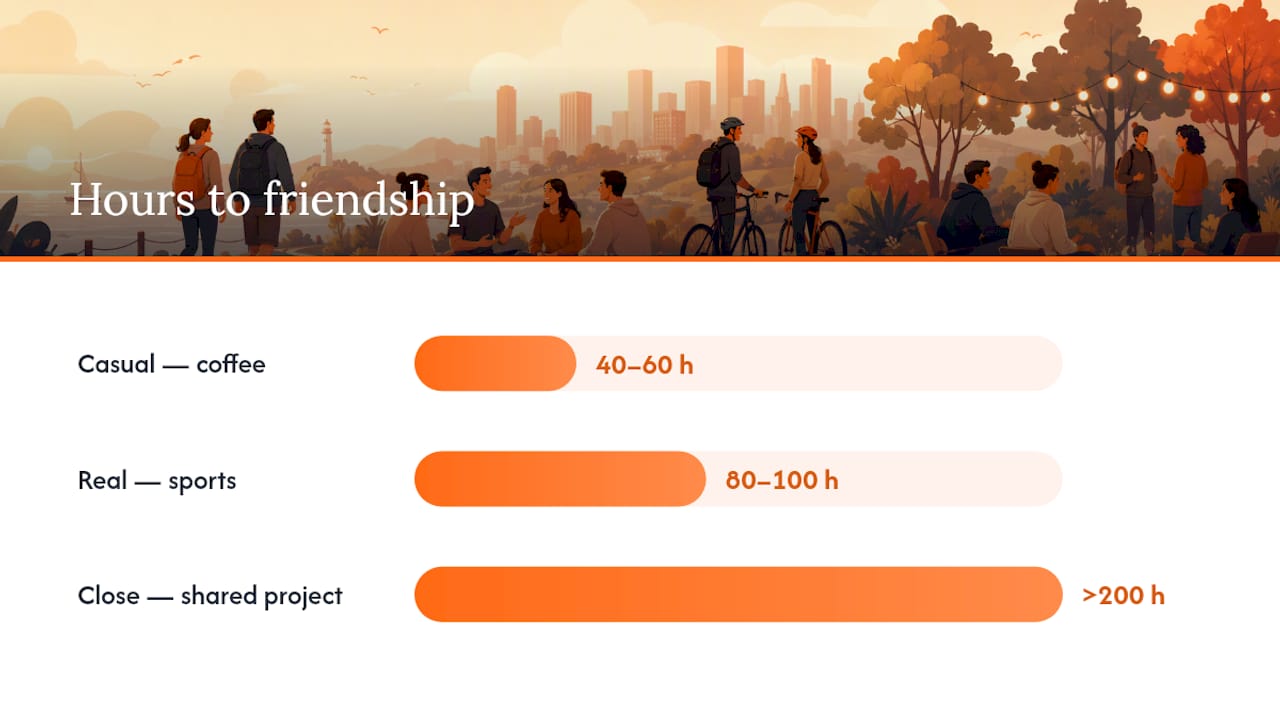
That number should change how you plan. A single coffee doesn't get you there. A weekly pickup basketball game for four months might.
Not all hours count equally. Side-by-side activities, cooking, sports, working on a shared project, build closeness faster than hours spent merely co-present, like sharing an office without talking. Switching contexts (moving from the gym to a dinner) accelerates things further because it forces new kinds of conversation.

Track progress with three markers instead of a vague feeling: how many times you've hung out, how many different settings you've shared, and whether conversations have moved past logistics into anything personal. If all three are moving, the friendship is progressing even if it doesn't feel "close" yet.
How Do You Keep a New Friendship From Fading?
New friendships die from neglect more often than conflict. The fix is unglamorous: put it on a schedule.
- Make it a standing plan. A monthly dinner or a weekly run beats "let's hang out soon," because it removes the negotiation every single time.
- Practice small reciprocity. Remember a detail they mentioned, check in when something's happening in their life, return the invitation instead of always waiting for one.
- Notice when the effort is lopsided. If you're the one initiating every single time, say something light like "I feel like I'm always the one texting first, everything good?" rather than quietly resenting it.
- Build a low-cost ritual. A recurring trivia night, a shared cooking project, a running streak you track together. Rituals create momentum that individual plans don't.
- Treat rusty social skills like a muscle. If maintaining friendships feels awkward, structured programs built around group activities can rebuild that comfort faster than willpower alone.
Pro Tip: Pick one friendship each month and initiate the plan yourself, even if it's not "your turn." Reciprocity evens out over months, not over every single hangout.
How Does Conppi Support This Whole Process?
Everything above works better with the right tool for finding people in the first place. Conppi matches you with people nearby who want the same activity, right now, without profiles to browse or swipes to sort through.
- Activity-specific filters (time, skill level, sport) mean you're matched with someone actually available for a padel game or a co-working session today, not someone theoretically interested.
- Distance-based privacy shows only approximate proximity, so you get local matches without exposing your exact location.
- Built for recurring use, whether that's a weekly running partner, a regular co-working companion, or someone to grab coffee with on a Tuesday.
- Works for travelers, too, connecting you with locals or fellow travelers instead of leaving you to wander alone in an unfamiliar city.
The app removes the guesswork of where to find a compatible partner. The follow-up and consistency still come from you.
How Do You Handle Rejection When Making Friends?
Getting ignored, turned down, or ghosted after a good conversation stings, and it happens to everyone trying to build a social life as an adult. The instinct is to read it as a verdict on your likability. It usually isn't.
People don't respond for reasons that have nothing to do with you: they're overwhelmed, they misread the message, they're dealing with something unrelated. Psychological research on social initiative points out that fear of rejection is one of the biggest reasons adults stop trying after a single setback, even though most rejections are situational, not personal.
The practical fix is to lower the stakes of each individual attempt. Don't treat one invitation as your only shot at a friendship; treat it as one data point in a pattern you're building over months. If someone declines or doesn't respond, send one more low-key message a week later, and if that goes nowhere, move on without rewriting your self-worth around it.
Volume protects you here. If you're only reaching out to one person, a single rejection feels catastrophic. If you're maintaining contact with five or six people across two or three activities, one non-response barely registers. Spread your effort, and rejection stops being a referendum on whether you're likable and starts being what it actually is: a normal, boring part of meeting people.
How Do You Manage Social Anxiety While Trying to Connect?
Social anxiety doesn't disappear before you make friends. It fades gradually, after you've had enough low-stakes reps to prove to yourself that most interactions go fine. Waiting to feel confident before you try gets the order backward.
Structure helps more than willpower. A recurring class or league gives you a built-in script, you already know why you're there and what to talk about, which removes the blank-page anxiety of small talk with no context. That's part of why proximity and repeated interaction work better than forcing yourself into a room full of strangers with no shared reason to be there.
Lower the bar for what counts as a win. Showing up counts. Saying one sentence to someone counts. You don't need a great conversation every time; you need enough repetition that your nervous system stops treating the room as a threat. Confidence in social settings tends to build the same way physical stamina does: through repeated, moderate exposure, not through a single leap.
If anxiety consistently stops you from following through on plans you've made, it's worth naming that pattern honestly rather than assuming a personality flaw. Structured group programs designed to rebuild social connectedness exist for a reason: a repeatable framework removes decisions that anxiety otherwise hijacks, like what to say or whether you're allowed to sit down.
How Do You Set Healthy Boundaries With New Friends?
A new friendship can tip from energizing to draining fast if nobody names what they need. Boundaries aren't a sign the friendship is failing; they're what makes it sustainable past the first few months.
Notice the early signs before they turn into resentment: you're always the one initiating, conversations stay one-sided, or someone expects a response speed you can't sustain alongside work and family. None of that makes someone a bad friend. It usually just means expectations were never discussed.
Say the boundary plainly instead of hoping it resolves itself. "I love our Sunday runs, but I can't do a group chat that pings all day, can we keep check-ins to a couple times a week?" costs you an awkward thirty seconds and saves months of quiet frustration. Most people respect a clear, kind boundary far more than they'd guess, and most friendships survive one far better than they survive months of unspoken irritation.
Boundaries also apply to pace. If a new friend wants daily contact and you want weekly, that gap isn't a compatibility failure. It's information. Some friendships settle into a rhythm that fits both people once you've actually said what that rhythm looks like out loud.
How Do You Balance New Friends With the Life You Already Have?
Chasing new friendships can quietly crowd out the relationships and the downtime that were already working. That trade-off is real, and ignoring it burns people out on the whole project within a few months.
Treat new friendships as additions to a limited weekly budget, not as a replacement for existing plans. If you already have a standing dinner with your partner or a weekly call with a sibling, protect those first, then look for where a new recurring activity actually fits, rather than stacking everything into an already full week.
Existing friends and family sometimes register new social effort as distance, even when that's not the intent. A quick, honest heads up ("I'm trying to build out my social circle here, still want our Thursday thing") prevents the quiet resentment that builds when people feel deprioritized without explanation.
Personal time matters too. Introverts especially tend to over-schedule when they're motivated to fix loneliness, then burn out and retreat entirely for a month. Better to commit to one or two recurring activities you can sustain indefinitely than five you'll abandon by week three. Consistency beats intensity here, the same way it does everywhere else in this process.
What I've Learned About Sticking With This Long Enough to Work
The advice in this article is simple. Following it for the full 40, 80, or 200 hours is the part that actually separates people who build a social life from people who give up after two disappointing meetups.
What surprised me most in researching this is how mechanical friendship formation actually is. It's not about charisma or luck; it's about showing up on a schedule and sending the follow-up text you're tempted to skip. Track your hours and your repeat interactions the way you'd track a habit you're trying to build, and treat every small win, a second hangout, a returned text, a slightly longer conversation, as real progress, because it is. The plan in this article works when you rerun it, not when you run it once and wait to feel different.
— Ilya
Ready to Find Your Next Activity Partner?
Everything above depends on finding compatible people to actually do the recurring activity with, and that's the exact gap Conppi closes. Instead of scrolling a general social app hoping someone nearby also plays padel or wants a Tuesday co-working buddy, Conppi matches you in real time with people who want the same activity, right now, filtered by skill level and timing, with no profile-building or swiping required. It works whether you're hunting for a regular tennis partner, a coffee meetup, or someone to share a co-working table with this week. Download the app and set up your first activity match today.