

Yes, you can make friends without dating apps, and the fastest reliable route is showing up to the same shared-interest activity on a repeated basis while using a few low-stakes conversation habits to break past small talk. Expect real friendship to take weeks to months of consistent contact, not one lucky conversation. An app can serve as a lightweight bridge when you want to find an activity partner faster than cold-walking into a room alone.
TL;DR:
- Participating regularly in activities like sports, classes, or volunteering helps build friendships through repeated exposure and shared purpose.
- Initiating conversations by commenting on the environment and asking open-ended questions fosters genuine connections beyond small talk, especially using the IC method.
- Following up within a few days and establishing recurring commitments are key steps in turning initial chats into lasting friendships.
- Reducing social anxiety by lowering the stakes and practicing small interactions increases the likelihood of showing up and forming bonds.
- Using apps like Conppi can help find activity partners quickly, turning casual plans into ongoing relationships through consistent scheduling.
Table of Contents
- Where to Actually Meet People Without Dating Apps
- How to Start a Conversation That Isn't Small Talk
- Turning a Good Chat Into a Real Friendship
- Lowering the Bar So You Actually Show Up
- Using Conppi as a Bridge From Advice to Action
- Keeping Friendships Alive After the First Few Meetups
- Reading the Room: Boundaries and Social Cues
- Getting Past Social Anxiety and the Excuses That Keep You Home
- My Take: The One-Week Challenge
- Ready to Find Your First Activity Partner?
- Sources
Where to Actually Meet People Without Dating Apps
Recurring activities beat one-off events almost every time, because they give you built-in reasons to talk to the same faces week after week. A relationship coach interviewed by CNBC points to the mere-exposure effect as the mechanism: the more often you're in the same room as someone, the more comfortable and likable they start to feel, even before you've said much to them.
Pick from categories that force repetition:
- Recreational sports leagues. Rec soccer, volleyball, or padel gives you a team, a schedule, and a shared goal, all in one package.
- Weekly classes. Pottery, language exchange, or improv works because you're learning alongside people, and shared struggle is a fast bonding agent.
- Third places. The same coffee shop, coworking space, or Saturday farmers market, visited on a fixed schedule, turns strangers into familiar faces.
- Volunteering. Food banks, trail cleanups, and mutual aid groups tend to attract people who already share your values, which cuts out a lot of small talk.
When choosing, run each option through four filters:
- Does it match something you're genuinely interested in, not just tolerant of?
- Does it repeat weekly or biweekly, rather than being a one-time event?
- Is the cost sustainable for months, not just one visit?
- Is it newcomer-friendly, with a low bar to walk in and immediately participate?
Psychology Today notes that friendship forms most easily when a shared interest does the heavy lifting. You're not performing small talk. You're both just there for the pottery, the goal kicks, or the trail cleanup, and the conversation grows out of that.
How to Start a Conversation That Isn't Small Talk
The IC method, short for "in common," works because it points both people at something real instead of the weather. You comment on the shared environment first, then follow up with a question about feelings, goals, or process. Psychology Today frames this kind of follow-up questioning as the fastest way to move a conversation past surface pleasantries.
A few situational openers you can adapt on the spot:
- At a class: "This is way harder than it looked online. How long have you been coming?"
- At the gym: "I always struggle with this machine. Do you have a trick for it?"
- At a coffee shop: "Are you a regular here too? I've started coming every Tuesday."
- On a volunteer shift: "What made you want to do this one specifically?"
- In your building or neighborhood: "I keep seeing you walk this route. Same time every day?"
Once you've opened, try the two-headlines technique: offer two small, unrelated facts about yourself and let the other person pick which one to ask about. "I just moved here from Chicago, and I'm terrible at this sport" gives someone two doors instead of one. From there, BetterUp's research on connection backs a simple habit: listen for one detail, then ask a deepening follow-up about it rather than jumping to your own story.
Pro Tip: If a conversation stalls, exit gracefully instead of forcing it. "I should get back to this" or "Good talking to you, see you next week" costs you nothing and keeps the door open for next time.
Turning a Good Chat Into a Real Friendship
A single good conversation doesn't make a friend. It makes a candidate. What happens in the next two weeks decides whether it goes anywhere.
- Ask in the moment with two options. "Coffee Wednesday or Saturday?" removes the awkward open-endedness of "we should hang out sometime" and gives a concrete yes or no.
- Follow up within 48 to 72 hours. A short text referencing something specific from your talk, plus one proposed plan, keeps momentum before the memory fades.
- Lean on recurring commitments. A weekly class or a regular volunteer shift does the reminding for you, since research on connection shows repeated, low-effort contact builds familiarity faster than occasional big hangouts.
A rough benchmark for progress is that over several weeks to months, you exchange contact information, meet outside the original activity, and gradually make plans more naturally. If such progress doesn't happen, it's acceptable to let the connection fade and focus on others instead.
Lowering the Bar So You Actually Show Up
Most advice about meeting people assumes you're already comfortable walking into a room of strangers. Most people aren't. The fix isn't more confidence. It's smaller stakes.
- Try one short interaction per visit, not five. A single "hey, mind if I join?" counts as a win.
- Structured roles help enormously if you're anxious or neurodivergent. Volunteering as a shift lead, a class assistant, or a team's informal organizer gives you a clear job, which removes the ambiguity of "what am I supposed to say right now."
- Budget for cost. Library programs, community center classes, and sliding-scale studios exist in most cities and remove the money excuse entirely.
- Stay aware of basic safety. Meet new people in public spaces first, tell someone your plans, and trust your gut if something feels off.
Pro Tip: Treat a flat conversation as data, not rejection. One awkward exchange tells you nothing about your worth. It tells you that specific approach didn't land, which is useful information for next time.
Reducing loneliness often comes down to small, repeatable habits rather than one dramatic fix, a point echoed in this guide to cutting loneliness at home. Structured, low-pressure participation tends to work better than waiting until you feel fully ready.
Using Conppi as a Bridge From Advice to Action
Advice is only useful once you act on it, and that's the gap Conppi is built to close. Some apps match you with people nearby who want the same activity right now, whether that's a tennis partner, a coworking companion, or someone for coffee, using filters for time and skill level so you're not stuck asking a stranger cold.
A simple sequence to try:
- Open the app and find a match for an activity you already chose from this guide.
- Suggest a specific time and a public meeting place.
- Confirm the plan the same day, before either of you forgets.
- Follow up afterward if you want to make it recurring.
Treat any new contact with the same public-first safety habits covered above, whether you met them through an app, a class, or a volunteer shift.
Keeping Friendships Alive After the First Few Meetups
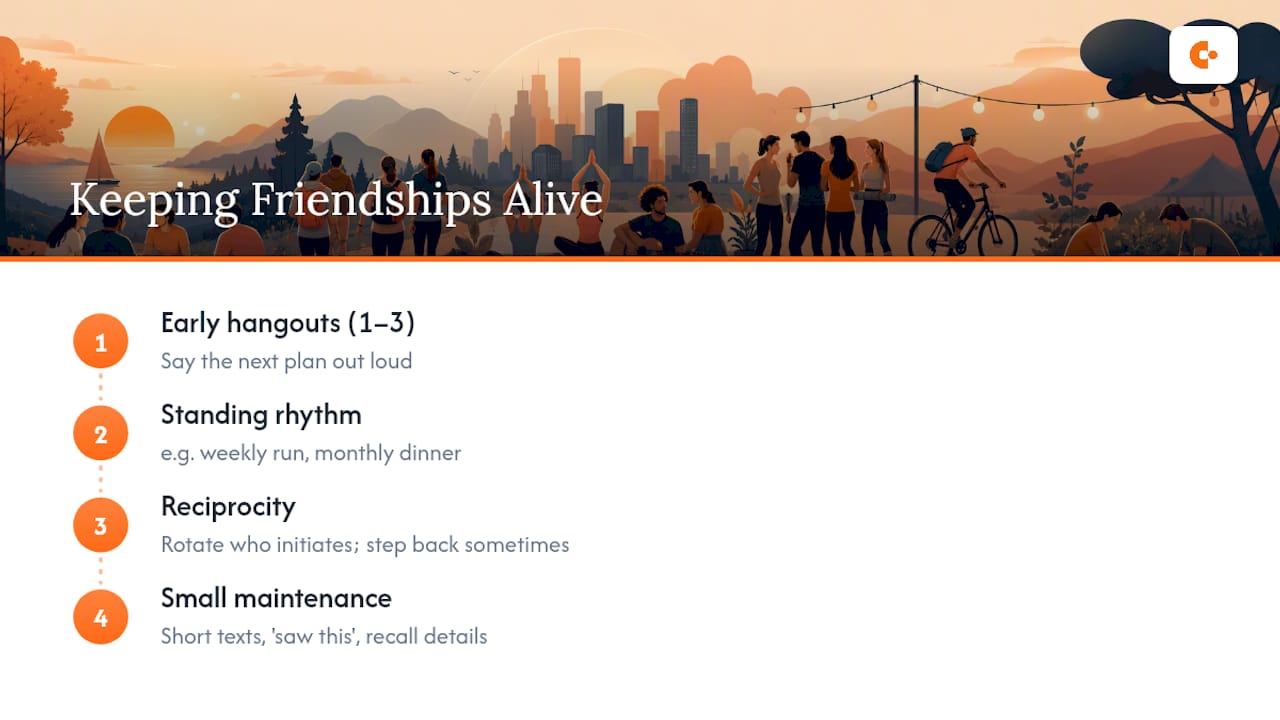
The first three hangouts are the hardest, and also the most fragile. Momentum fades fast if nobody makes the next move, so the habit that keeps a new friendship alive is simple: whoever thinks of a plan next says it out loud instead of waiting for the other person to bring it up.
Once you've met a handful of times, shift from planning every hangout individually to building a standing rhythm. A recurring Sunday run, a monthly dinner rotation, or a shared group chat that pings when someone's free does more for a friendship's longevity than a string of one-off invites. Standing plans remove the negotiation cost that quietly kills a lot of adult friendships.
Reciprocity matters too, but not in a transactional, tit-for-tat sense. It's about noticing when you've been the one always initiating and deliberately stepping back to let the other person carry a plan. If that never happens, it's a signal about how much the other person is actually investing, not necessarily a reason to write them off immediately.
Long-term friendships also survive on small maintenance, not just big events. A text when you think of them, a "saw this and thought of you" message, or remembering a detail from a past conversation and bringing it up later all count as deposits. None of this requires grand gestures. It requires noticing, and then following through on what you noticed, even when the moment feels small enough to skip.
Reading the Room: Boundaries and Social Cues
Comfortable interactions depend on reading two things accurately: how much someone wants to engage right now, and how much they want to engage with you specifically over time. Both take practice to read, and both matter.
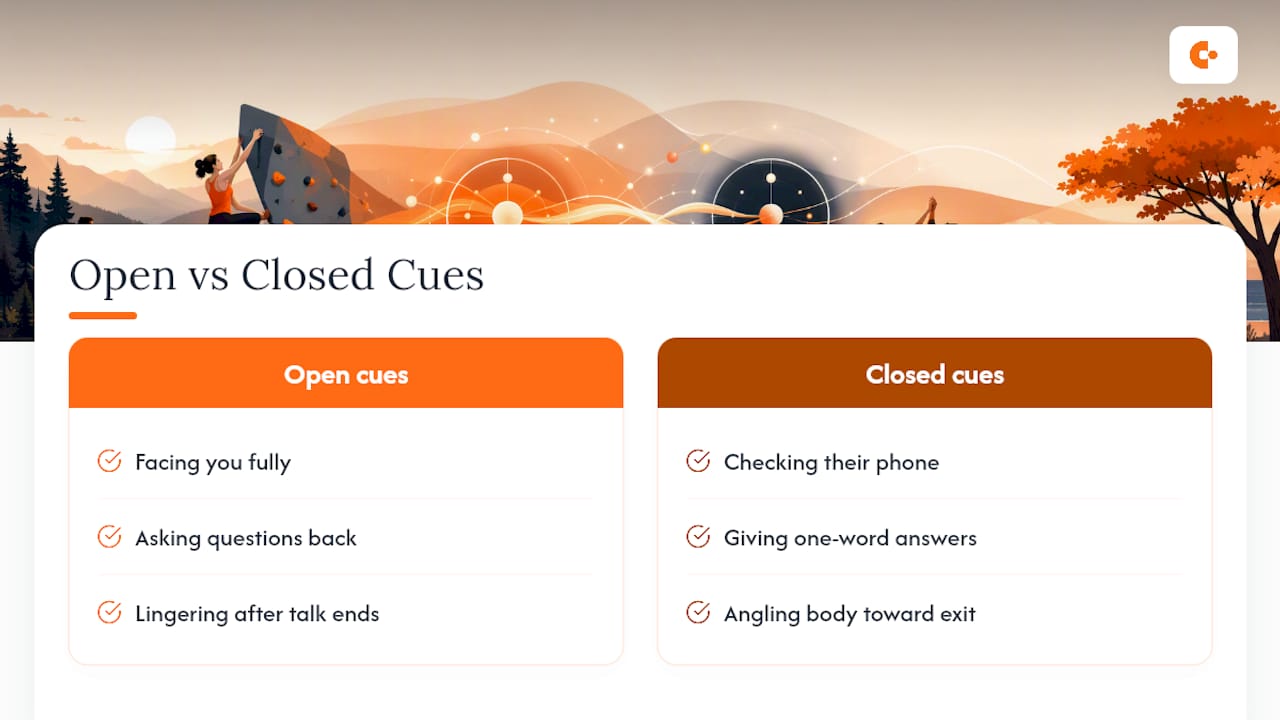
In the moment, watch for open versus closed body language: someone facing you fully, asking questions back, or lingering after the "official" reason for talking has ended is signaling interest. Someone checking their phone, giving one-word answers, or angling their body toward an exit is telling you the conversation has run its course. Respecting that exit cue, rather than pushing past it, is what makes you someone people feel safe talking to again.
Over the longer arc of a budding friendship, boundaries show up as pacing. If someone consistently takes a day or two to respond, or declines plans twice before accepting a third, that's not necessarily rejection. It might just be their pace. Matching someone's cadence instead of escalating past it, texting daily when they text weekly, tends to read as pressure rather than warmth.
It also helps to ask directly when you're unsure, rather than guessing. "Are you up for hanging out more regularly, or is this more of a see-each-other-at-class thing?" feels blunt on paper, but most adults appreciate the clarity far more than the ambiguity.
Getting Past Social Anxiety and the Excuses That Keep You Home
Social anxiety rarely announces itself as fear. It shows up as reasons: you're tired, the timing's off, you'll go next week instead. Recognizing that pattern is the first step to interrupting it.
Lowering the stakes of each individual attempt helps more than trying to feel confident before you go. The Guardian's account of practicing conversations with strangers makes the same point: treating a conversation as a low-cost experiment, rather than a referendum on your social worth, makes people far more willing to attempt it again after an awkward one.
A few concrete barriers worth naming directly. If you're worried about rejection, remember that most people forget an awkward interaction with a stranger within the hour, so the cost of trying is lower than it feels. If you're worried about not having anything to say, the IC method above gives you a script so you're never starting from a blank page. If you're worried about looking desperate for showing up to the same place repeatedly, flip that logic: regulars are the people everyone else in the room already trusts a little, simply because they've seen them before.
My Take: The One-Week Challenge
Most people don't lack advice on meeting people. They lack a reason to try this week instead of someday. So here's a small assignment: pick one activity from this guide and go once, this week, with the only goal being one short conversation using the IC method.
Track it loosely, a note in your phone works fine, and don't judge the outcome by whether you made a friend on day one. A slightly awkward but completed attempt still counts as a win, and it's the only kind of win that compounds.
— Ilya
Ready to Find Your First Activity Partner?
Everything in this guide works better with someone to do it alongside you, and that's exactly the gap Conppi is built to close. Instead of hoping the right person shows up at your pottery class or rec league, you can search directly for someone nearby who's free for the same activity, the same week.
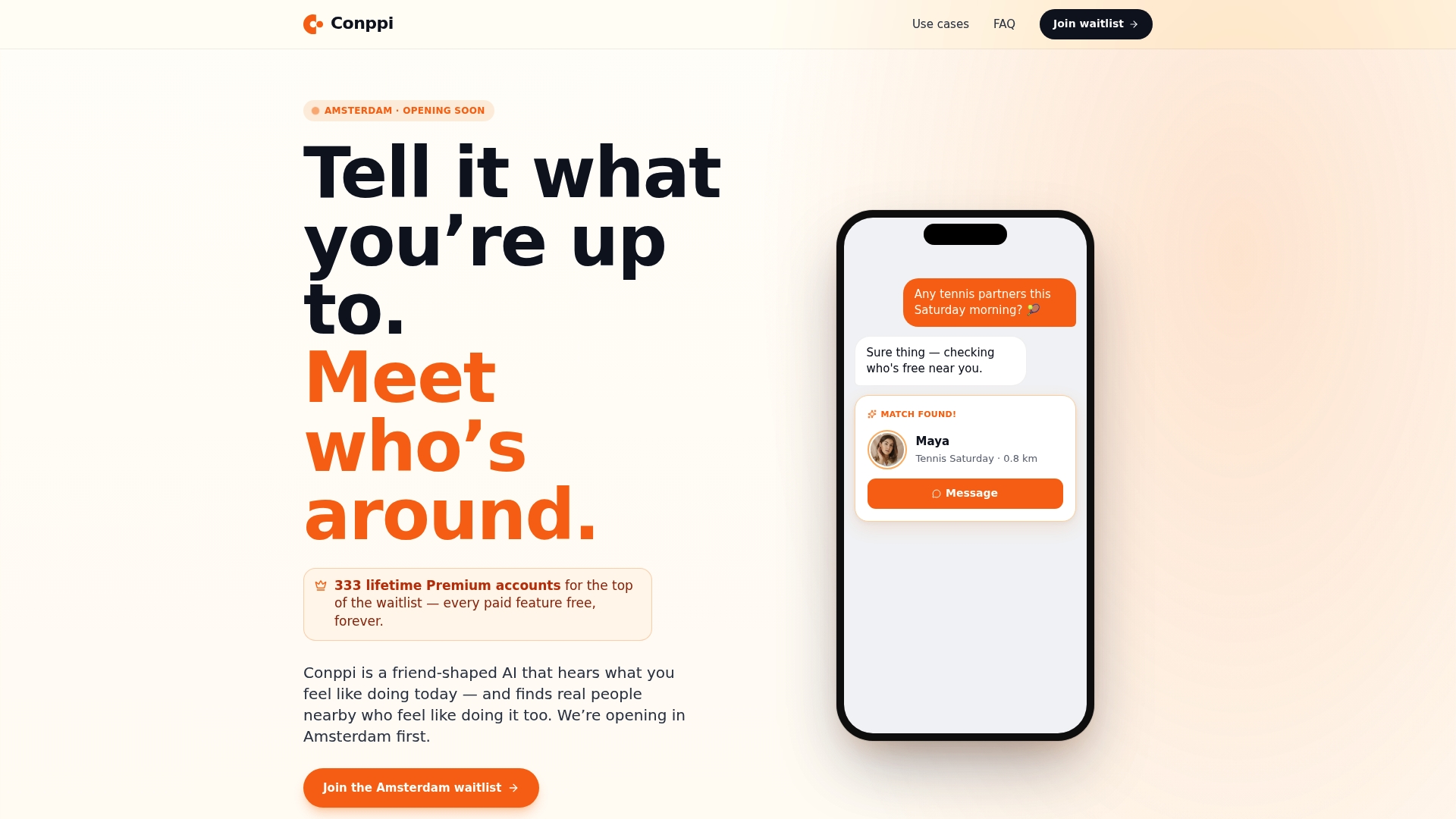
If you've been eyeing a recreational sports partner, Conppi's sports partner search lets you find someone at your level without waiting for a league to fill a roster. Prefer something lower key? The coffee meetup feature turns "we should get coffee sometime" into an actual scheduled plan with someone nearby right now. Open the Conppi app and post what you're looking for today. The activity you pick this week could be the one that turns into a standing plan by next month.
Sources
- The easiest path to friendship starts by doing what you love — Psychology Today
- How to meet people without dating apps, according to a relationship coach — CNBC
- How to connect with people: 10 surefire ways — BetterUp