
The fastest way to meet people in Amsterdam after 30 is to combine a few proven channels at once: join a recurring sports or exercise group, sign up for one volunteer shift through Vrijwilligers Centrale Amsterdam, try a language café, visit a neighborhood hub, and keep an activity-matching app like Conppi running in the background for spontaneous plans. Most of these options are free or cost very little, and nearly all of them are available every week somewhere in the city.
TL;DR:
- Combining recurring activities with spontaneous outings accelerates social connections for people over 30 in Amsterdam, especially with two or more overlapping options.
- Attending the same group twice and following up within 48 hours significantly increases chances of turning brief encounters into ongoing plans.
- Most activities, including volunteering and neighborhood hubs, are low-cost or free, making consistent participation feasible for many budgets.
- Real-time activity-matching apps like Conppi are effective for quick, location-based plans when regular partners cancel or last-minute opportunities arise.
- Focusing on specific, interest-based activities such as sports, culture, or language exchanges enhances natural conversations and better matches personal preferences.
Table of Contents
- The best ways to meet people in Amsterdam after 30
- How to get started this week
- Local programs worth joining in Amsterdam
- Activities that match your interests
- Amsterdam etiquette and staying safe
- Why Conppi fits into this routine
- A short word on making the first move
- Try Conppi in Amsterdam this week
- FAQ
- Sources
The best ways to meet people in Amsterdam after 30
Different approaches work for different moods and schedules, so it helps to know when each one actually delivers.
- Meetup and recurring social nights work well for internationals and anyone free on weekday evenings or weekends, since the same group often returns week after week.
- Team sports and exercise groups build quick rapport fast because you are working toward something together instead of making small talk from scratch.
- Volunteering through programs such as Serve the City or VCA tends to produce deeper, longer-lasting connections than one-off social events.
- Language exchanges and Koentact-style classes are built for people who want a steady circle rather than a single night out.
- Neighborhood hubs and brown cafés offer low-pressure socializing with no RSVP required, perfect for a spontaneous evening.
- Event nights aimed at 30+ or 40+ crowds, including singles mixers and themed parties, give you a room full of people in a similar life stage.
Pick two of these to try in the same month. Overlapping routes means more chances for a single good conversation to turn into a standing plan.
How to get started this week
Momentum beats planning. A short, concrete sequence gets you from intention to an actual conversation within days.
- Pick one goal, such as "join a recurring group" or "attend one mixer," and commit to trying it within seven days.
- Find two or three options using Meetup, VCA's volunteer listings, neighborhood activity calendars, or an event platform, then choose the one with the lowest barrier to entry (free, no registration, close to home).
- RSVP the same day you find it. Delaying gives hesitation time to win.
- Show up with a simple opener: "First time here, is this your regular spot?", "What got you into this group?", or "Mind if I join in?"
- Send one follow-up message within 48 hours: "Good meeting you, want to grab coffee or do this again next week?"
- Propose a low-stakes second meet, like a coffee or a canal walk, rather than a full evening out. Short, specific plans get accepted more often than open-ended ones.
Pro Tip: Treat the first meetup as a trial, not a verdict. Going twice tells you far more about a group than going once.
Budget for the week: expect to spend little to nothing if you stick with volunteering, free sport sessions, or a neighborhood hub visit, and a modest amount for a café meetup or ticketed mixer.
Local programs worth joining in Amsterdam
A handful of Amsterdam institutions exist specifically to connect residents, and they are worth knowing by name.
- Vrijwilligers Centrale Amsterdam (VCA) runs the city's largest volunteer vacancy database, making it the easiest starting point for finding a role that puts you alongside the same people regularly.
- Huis van de Wijk and De Wachter run neighborhood activities such as singing groups, community meals, and aerobics sessions, built specifically so residents meet each other.
- Team Fit offers free, guided exercise sessions in West, with separate groups for mixed and women-only sessions, and no membership fee required.
- Age-targeted mixers, including daytime clubbing and 30s-focused events, typically run on free to moderate ticket pricing and are easy to find through local event listings.
None of these require a big commitment. A single session at De Wachter or one Team Fit class is enough to see whether the group suits you.
Activities that match your interests
Matching an activity to your actual interests makes the social part feel incidental rather than forced.
- Sports: running clubs, ad-hoc padel or tennis partners, and evening bootcamps are easy to find through city listings or a quick search for your neighborhood's running group.
- Culture and classes: museum late nights, cooking classes, and photography walks pair structured learning with natural conversation breaks.
- Language exchanges: Koentact-style meetups and language cafés mix internationals and locals over shared lessons and occasional field trips. If you'd rather arrange something one-on-one first, vetting a language exchange partner online before meeting in person is worth doing.
- Casual social: brown cafés, canal-side terraces, and day tours give you low-commitment ways to strike up conversation in daylight hours.
- Weekend day trips and small-group tours compress bonding time into a single outing, often producing faster friendships than several short meetups spread over weeks.
Try picking one activity from each category over a month rather than repeating the same one. Variety surfaces the groups that actually fit your schedule and personality.
Amsterdam etiquette and staying safe
Dutch directness can read as blunt to newcomers, but it is rarely personal: a short "no thanks" or a flat opinion usually means exactly that and nothing more, so take it at face value and move on. In brown cafés, asking the bartender about a local beer or the café's history is a normal, welcomed opener, while hovering silently near a group is not. For safety, meet first-time contacts in public spots, tell a friend your plans, and map your route home before you go. If your Dutch is limited, lead with English. Most Amsterdammers switch comfortably, and many meetups, especially Meetup groups and language cafés, run primarily in English anyway.

Why Conppi fits into this routine
This app works as an activity-first layer underneath other options: it matches you with people nearby who want to do the same thing right now, without profiles or swiping, and it only shares approximate distance to keep things private. It's useful in a few specific moments: when your regular tennis partner cancels and you need a replacement within the hour, when you want a standing Tuesday running partner rather than a one-off group run, or when you're working from a café and would rather co-work next to someone than alone. We built Conppi to complement other social activities rather than replace them, filling the gaps between scheduled events with spontaneous, activity-specific plans.
A canceled tennis partner and a free Tuesday evening are enough to turn a quiet week into a social one, if the right match is nearby and easy to find.
A short word on making the first move
Most hesitation before a first meetup comes from imagining the whole evening instead of just the next five minutes. A single good exchange at a Team Fit session once turned into a standing Thursday run for me, started from nothing more than asking who was next in line to stretch. Three habits build momentum: show up to the same thing twice before judging it, follow up once within two days, and always offer one small, specific next step instead of a vague "let's hang out sometime."
— Ilya
Try Conppi in Amsterdam this week
If you want a local, activity-first way to fill the gaps between scheduled meetups and volunteer shifts, Conppi gives you real-time matching for sports, co-working, coffee, and casual activities with people nearby, without the overhead of building a profile or swiping through strangers. It works especially well for anyone who already has a packed Amsterdam calendar but keeps losing activity partners to last-minute cancellations.
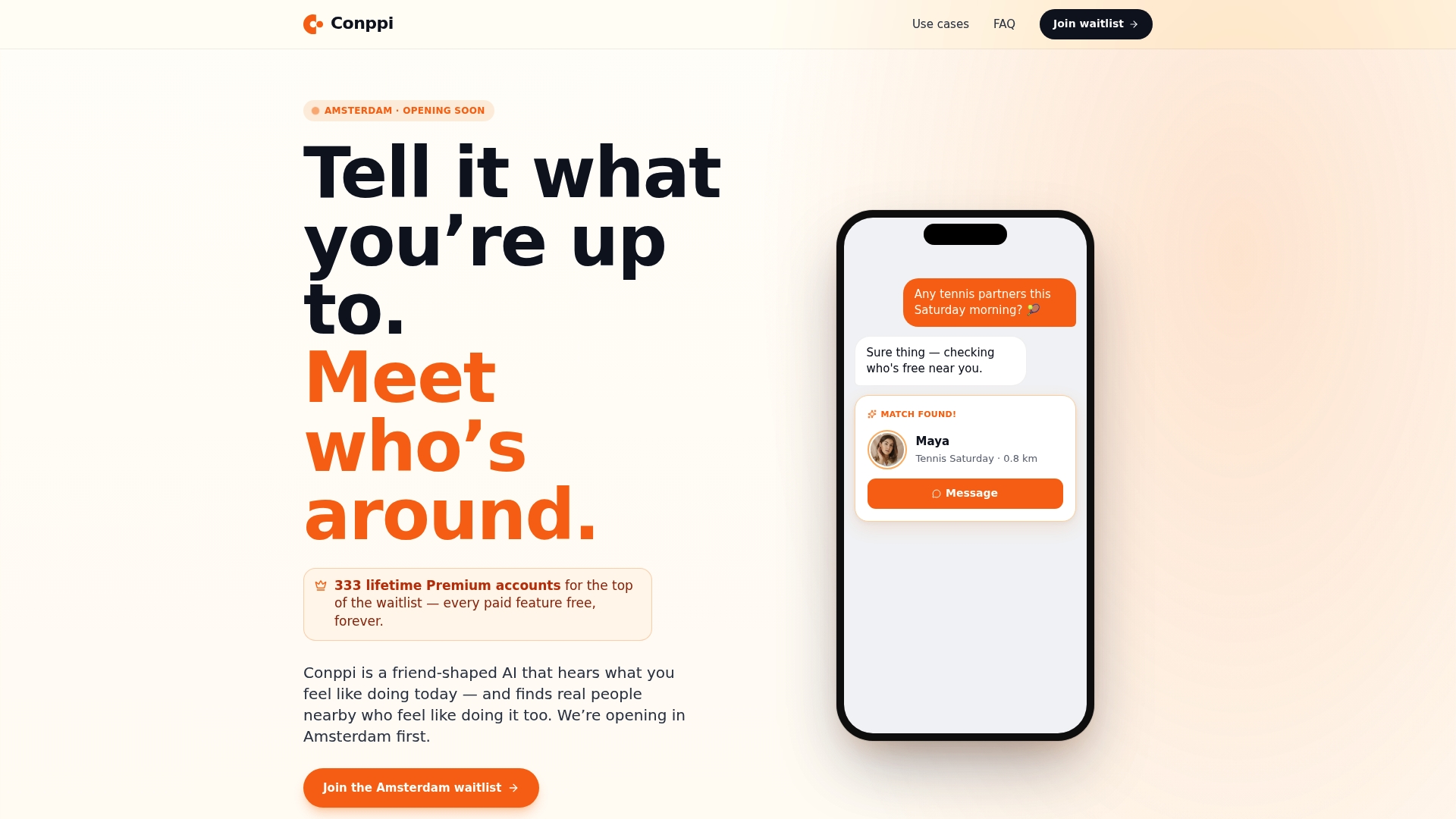
- Visit the activity partner app page to see how matching works before you download anything.
- Set up one activity, a run, a coffee, a co-working session, within the next two weeks to see what a first match feels like.
- Expect only approximate distance to be shared with matches, never your exact location.
FAQ
What's the fastest way to meet people in Amsterdam after 30?
Combining a recurring activity, such as a sports group or volunteer shift, with a spontaneous option like a language café or an activity-matching app tends to work fastest. Showing up to the same group twice builds familiarity much quicker than attending many different one-off events.
Are there free ways to socialize in Amsterdam?
Yes, Team Fit offers free guided exercise sessions, and neighborhood hubs like De Wachter run low-cost or free community activities such as singing groups and shared meals. Volunteering through VCA is also typically unpaid for the volunteer and free to join.
Does volunteering actually help with loneliness?
A large Dutch cross-sectional study of 26,342 adults found that loneliness prevalence varies by age group and that volunteer work showed a protective association with loneliness in some of those cohorts. It is not a guarantee, but it is one of the more consistently supported routes to building social ties.
How is Conppi different from a dating app?
Conppi matches people for shared activities like sports, co-working, or coffee rather than romantic connections, and it skips profiles and swiping in favor of real-time, activity-specific matching. It also only shares approximate distance between matched users, not an exact location.
Where can I find events specifically for people in their 30s or 40s?
Local event listings regularly feature mixers and themed parties aimed at 30s and 40s crowds, often with free to moderate ticket pricing. Checking these listings weekly tends to surface new options since many run on a rotating schedule.