

If you want nearby companions for shared activities without swiping, the fastest route is activity-first groups and real-time matching apps like Conppi that connect people by interest and availability instead of profiles. This works because recurring, activity-based contact builds trust faster than curated photos ever could, and it sidesteps the fatigue that more than 75% of Gen Z users have burned out on swipe apps.
TL;DR:
- Activity-focused apps prioritize real-time matching over profiles, making connections based on shared interest and availability instead of swipes.
- Joining recurring groups like run clubs or hobby meetups that meet weekly and in public places helps build familiarity and trust faster.
- Setting specific, time-bound meetup plans and following up within 48 hours significantly increases the chances of forming ongoing activity partnerships.
- Safety can be maintained by meeting in public, sharing only approximate location, and informing someone of your plans before first encounters.
- These activity-first spaces create more genuine, low-pressure connections that reveal compatibility through behavior rather than curated profiles.
Table of Contents
- Where to Find People for Activities Near You
- How Real-Time, Non-Swipe Matching Actually Works
- A Simple Plan to Turn One Meetup Into a Regular Partner
- Safety, Privacy, and Basic Meetup Etiquette
- How to Start a Conversation Without a Screen to Hide Behind
- Spotting the Right Person in a Group Setting
- Getting Past the Hesitation to Show Up Alone
- Why Activity-First Connection Feels More Honest
- Try Conppi for Activity-First Matching, No Swiping Required
- Sources
- FAQ
Where to Find People for Activities Near You
Run clubs, sports meetups, co-working sessions, and hobby groups work because they give you something to do together before you have to figure out what to say; for example, the Coffeeride Club connects coffee and cycling groups as a hobby-based, IRL meetup community. The activity does the icebreaking. You show up, you run or play or type, and conversation happens as a byproduct instead of the whole point of the interaction.
Journalists have been tracking this shift for a while now. Instead of opening a dating app, people are increasingly meeting through run clubs, book clubs, and hobby communities that were never built for romance in the first place. These spaces create repeated, low-pressure contact, which is exactly the ingredient swipe apps struggle to manufacture.
Fitness communities show this pattern especially clearly. Run clubs and similar recurring groups get used explicitly by young adults looking to meet new people, precisely because a Tuesday night 5K creates the same faces, the same context, and the same low stakes week after week.
Platforms that started as tracking tools have quietly become social infrastructure. Apps like Strava, Goodreads, and Ravelry now function as informal social networks where digital activity regularly spills into real-world meetups.
Here's where to actually look, ranked by how quickly they tend to produce a real connection:
- Sports partner apps and filters — search by activity, skill level, and time window rather than scrolling a feed.
- Run clubs and fitness communities — usually free, weekly, and public, with zero commitment beyond showing up once.
- Co-working meetups — cafés or shared spaces with recurring "work sessions" where the same regulars appear.
- Book clubs and hobby groups — Meetup and Eventbrite listings, library bulletin boards, or neighborhood Facebook groups.
- Language exchange meetups — often hosted weekly at the same bar or café, low pressure by design.
When picking a group, weigh four things: how often it meets (weekly beats monthly for building familiarity), how public the meeting point is, whether the group size lets you actually talk to people, and whether the stated activity level matches yours. A "casual 5K" that turns out to be a competitive tempo run will sour you on the whole format fast.
How Real-Time, Non-Swipe Matching Actually Works
Swipe apps run on a like economy: you judge a photo, get judged back, and the "match" is really just mutual approval of an image. Activity-first apps skip that step entirely. You state what you want to do and when, and the app connects you with someone who wants the same thing at the same time. There's no queue of pending likes, no algorithm optimizing for engagement time. It's closer to an RSVP than a rating.
That distinction shows up in how hobby and affinity platforms are built. They function as communities where you're a member doing a shared thing, not a listing being evaluated. That structural difference reduces the performative pressure that makes swipe culture exhausting in the first place.
When you're evaluating any app or event page for this purpose, run down this checklist:
- Activity and skill filters — can you specify padel versus tennis, beginner versus advanced, so you're not mismatched on arrival?
- Real-time availability windows — does it show who's free right now or this evening, not just a static profile?
- Group or one-on-one invite options — can you organize either a pair session or a small group without extra apps?
- Approximate-distance privacy — does it tell you someone is nearby without broadcasting your exact address?
- No swipe or like mechanic — is compatibility based on stated interest and timing, not a judged photo queue?
An activity partner app maps directly onto that list: activity-specific filters for sports like tennis, padel, running, and cycling, real-time matching instead of static profiles, and privacy that only shares approximate distance rather than a pinpoint location.
Pro Tip: Before joining any activity app, check whether it lets you set a time window (like "free tonight 6 to 8 PM") rather than just a vague availability status. Same-day matching is what actually gets you out the door instead of stuck in a chat that goes nowhere.
A Simple Plan to Turn One Meetup Into a Regular Partner
Going from "I want a running partner" to actually having one usually takes three moves, and you can knock out the first two in a single day.
- Post or join a specific listing. Vague posts get ignored. State the activity, a real time, your rough skill level, and a public meeting spot. "Looking for a padel partner, intermediate level, Thursday evenings near the courts" gets responses. "Looking for someone to play sports with" does not.
- Show up ready for a short, low-stakes session. Plan for 30 to 60 minutes, not an all-day commitment. Use the activity itself as your opener: ask how long they've played, what got them into it, or whether they've tried the co-working spot or court you're headed to. Questions tied to the shared activity feel natural in a way that generic small talk doesn't.
- Follow up inside 48 hours. If the session went well, propose the next one before the momentum fades. Lock a recurring day and time. Something as basic as a shared calendar invite or a standing reminder in the app you used turns a one-off meetup into an actual routine.
That third step is where most casual connections quietly die. People have a good first session, say "we should do this again," and then never do, because nobody made it concrete. A specific day and time beats a vague good intention every time.
Safety, Privacy, and Basic Meetup Etiquette
Meeting someone new for an activity carries the same baseline risks as any first meeting with a stranger, so treat it with the same common sense you'd apply to any first coffee. A few rules cover most of it.
- Meet in a public place for the first session. A tennis court, a coffee shop, or a co-working space with other people around.
- Tell a friend or family member where you're going and roughly when you expect to be done.
- Share only approximate location through the app rather than your home address or exact live position.
- Arrange your own transportation to and from the meeting point.
- Cancel with real notice if plans change, and expect the same courtesy back.
| Situation | What to do |
|---|---|
| First-ever meetup | Public venue, daylight if possible, tell someone your plan |
| Ongoing partner | Approximate location sharing is enough; no need for exact address |
| Group activity | Confirm headcount and skill level ahead of time to avoid mismatches |
| Running late or canceling | Message as early as you can; don't leave someone waiting silently |
Being on time and being upfront about what you're looking for (a running partner, not a date) does more for a smooth first meeting than any safety feature ever will.
How to Start a Conversation Without a Screen to Hide Behind
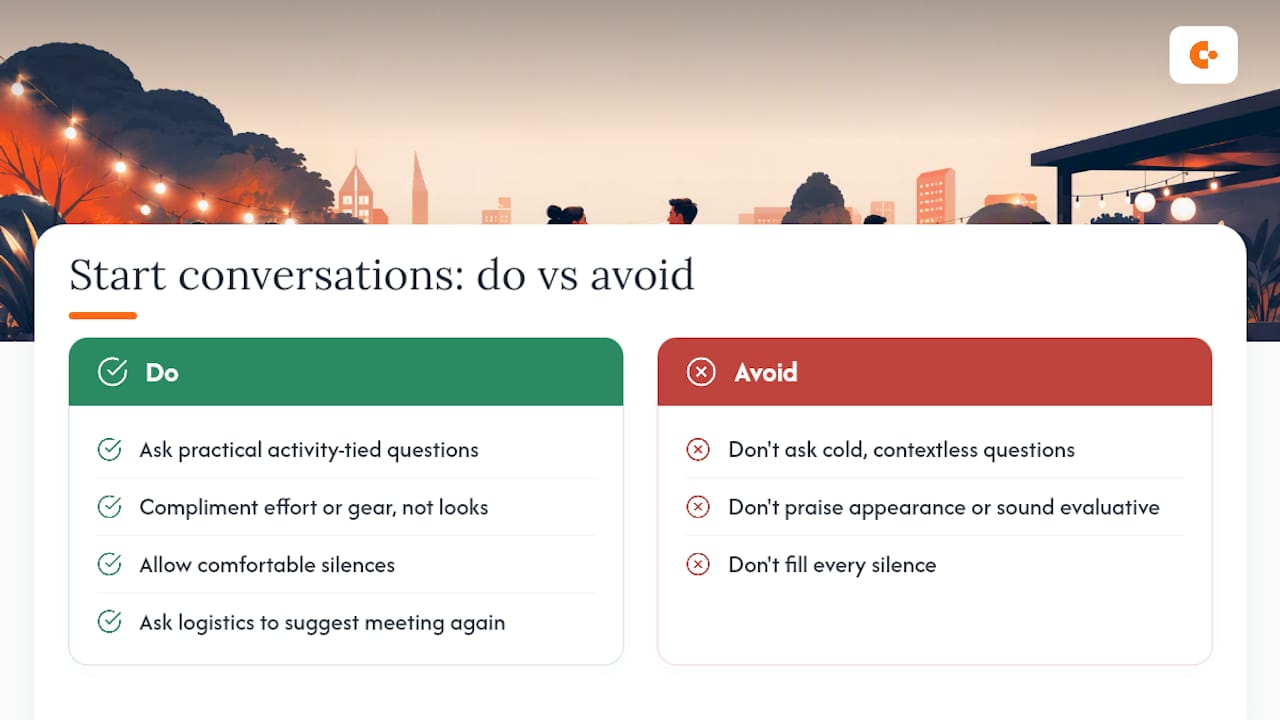
Talking to a stranger in person feels harder than texting one, mostly because there's no pause button. The fix isn't a clever opening line. It's using the activity itself as the conversation.
Ask a practical question tied to what you're both doing: "How long have you been coming to this club?" "What got you into padel?" "Do you usually work from this café, or is this your first time?" These questions are easy to answer, don't require vulnerability, and naturally lead somewhere. Compare that to walking up cold and asking about someone's weekend, which puts all the conversational weight on both of you with zero shared context to lean on.
Compliments on effort or gear work better than compliments on appearance in these settings. "Nice form on that serve" lands as friendly and specific. Anything that sounds evaluative undercuts the entire point of an activity-first space, which is to be judged on participation, not presentation.
Silence is fine, too. Not every minute of a run or a co-working session needs to be filled with talk. Let some of the connection happen through the shared activity itself, then talk more during natural breaks like a water stop or a coffee refill. People read forced constant chatter as more awkward than a comfortable pause.
If a conversation stalls, ask about logistics for next time. "Are you usually here on Thursdays?" does double duty: it's a normal question and it opens the door to seeing them again without any pressure attached.
Spotting the Right Person in a Group Setting
In a group of ten or fifteen people, you don't need everyone to like you. You need to spot the two or three people whose pace, energy, or intent actually matches yours, and that's a different skill than working a room.
Watch behavior before you approach anyone. Someone who arrives early, asks the organizer questions, or helps set up gear is signaling they take the activity seriously, which matters if you're looking for a consistent partner rather than a one-time hangout. Someone who's chatting easily with multiple people might be more open to a casual social connection than a focused training partner.
Match your approach to what you're actually looking for. If you want a running partner at your pace, watch the group during the activity itself, not just before it starts. Who's breathing at roughly the same rate as you at the halfway point? That's a far better compatibility signal than who seemed friendliest during introductions.
Approach during a natural break, not mid-activity. After a set in padel, during a coffee refill at a co-working meetup, at the halfway water stop on a run. Say something specific: "Want to grab the next set together?" or "Are you usually at this table on Mondays?" That's a concrete, low-stakes ask, easy to say yes to and easy to decline without awkwardness.

Group settings also let you test compatibility over multiple short interactions instead of one long one. That's an advantage over one-on-one meetups: you get to observe someone's actual behavior, not just their conversation, before deciding whether to seek them out again.
Getting Past the Hesitation to Show Up Alone
The gap between wanting a workout partner and actually walking into a run club by yourself is almost entirely psychological, and it's bigger than most people admit. Here's what actually narrows it.
Lower the stakes on purpose. You're not committing to a friendship or a relationship. You're showing up once to see if a Tuesday night run club is tolerable. Treat the first visit as pure information gathering, not a test you can fail.
Arrive with a task. Having a specific, small goal (find the person leading the group, ask one question about pace, stay for at least twenty minutes) gives your brain something concrete to focus on instead of spiraling into "what if this is awkward."
Remember that everyone else showed up for the same reason you did: they wanted this activity and, probably, some company while doing it. A group built around a shared hobby is self-selected for people open to meeting others, which is precisely why it feels less loaded than approaching a stranger cold in a bar or on the street.
If in-person still feels like too big a jump on day one, start with an app that lets you confirm a meetup with one specific person before you're standing in a room full of strangers. Knowing exactly who you're meeting and why removes most of the uncertainty that makes hesitation spike in the first place.
Why Activity-First Connection Feels More Honest
Swipe culture asks you to sell yourself in six photos and a bio before anyone knows a single true thing about how you actually behave. Activity-first meetups flip that order. You show up, you do the thing, and whatever chemistry exists gets revealed through behavior rather than performance. That's a more reliable signal, and it's also just less exhausting.
What gets underestimated is how much the format does the work that charisma is supposed to do in a dating-app bio. A shared run, a shared court, a shared co-working table removes the burden of being interesting on command. Tools built around real-time, activity-based matching, including Conppi's approach of filtering by activity and time window rather than curated profiles, are built on that same insight: compatibility shows up faster in what people do together than in what they say about themselves.
None of this replaces judgment. You still have to show up, still have to be someone worth spending a Tuesday evening with. But the pressure moves from presentation to participation, and for most people, that's a much easier place to be genuinely likable.
— Ilya
Try Conppi for Activity-First Matching, No Swiping Required
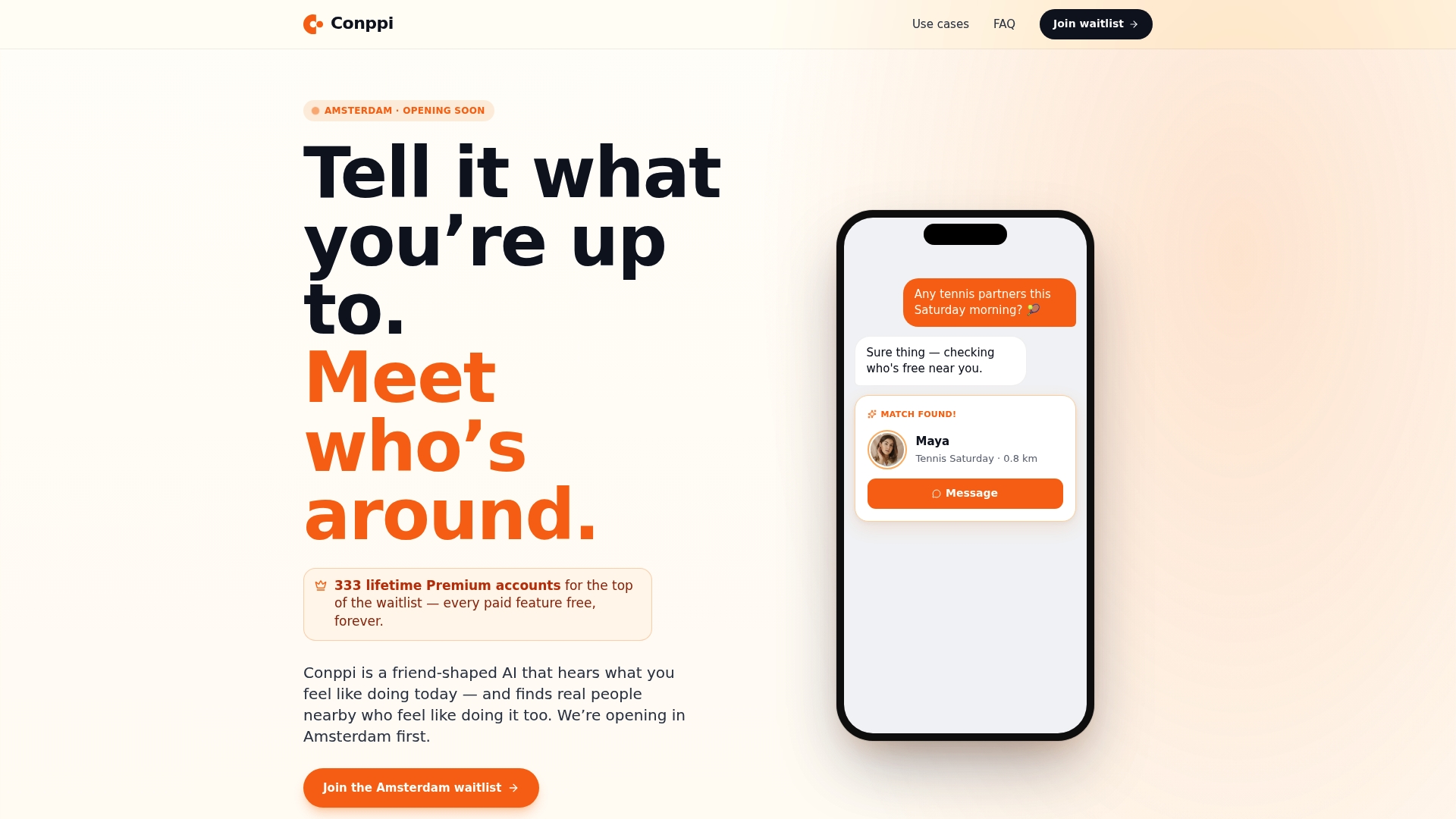
There are apps that offer an alternative to the profile-and-swipe grind: apps that match you with nearby people in real time based on what you actually want to do, not how you photograph. Instead of scrolling a feed of curated bios, you set an activity and a time window and get connected with someone free right now.
A few specifics worth knowing:
- Real-time matching connects you with people available for the same activity at the same time, no waiting on a like to be returned.
- Activity-specific filters cover sports like tennis, padel, running, cycling, and swimming, plus co-working and coffee meetups.
- Privacy by approximate distance means the app tells you someone is nearby without ever exposing your exact location.
It fits people looking for a sports partner, a co-working companion, a coffee meetup, or even someone to show them around when they're traveling and want to meet locals. If a run club feels like too big a first step, check out the activity partner app and set up your first meetup on your own terms.
Sources
- Forbes — dating app fatigue (2024)
- BBC — Dating apps could be in trouble
- Affinity Atlas — The Hobby App Takeover
- US Magazine — Hobby-based dating explained (2026)
FAQ
What Does It Mean to Meet People Without Swiping?
It means connecting with nearby people through shared activities like sports, coffee, or co-working rather than judging profile photos on a dating app. Apps like Conppi match by activity and real-time availability instead of a like-based swipe mechanic.
Are Hobby-Based Meetups Actually Replacing Dating Apps?
Reporting shows a real shift toward run clubs, book clubs, and other hobby spaces as places people meet, driven partly by widespread burnout on swipe apps among Gen Z users. These spaces work because they create repeated, low-pressure contact instead of a one-time judged interaction.
How Much Does Conppi Cost to Use?
Conppi's activity partner app does not list a public price; current details are available directly on the app's page. It's positioned around real-time, activity-based matching without profiles or swiping.
Is It Safe to Meet a Stranger From an Activity App?
It's reasonably safe if you follow basic precautions: meet in public the first time, tell someone your plans, and only share approximate location rather than a precise address. Apps that default to approximate-distance privacy, rather than exact GPS pins, add a meaningful layer of protection.
What's the Fastest Way to Find a Recurring Sports Partner?
Post a specific listing with your activity, skill level, and a real time window, then follow up within 48 hours of a good first session to lock in a repeat date. Consistency, not charisma, is what turns a single meetup into an ongoing sports partnership.