

Yes, remote work is linked to more loneliness and measurable mental-distress risk, particularly for people who live alone and work off-site three or more days a week. The fastest fix isn't a mindset shift. It's scheduling actual human contact this week, whether that's a co-working block, a coffee meetup, or one activity through an app like Conppi.
TL;DR:
- Working remotely three or more days a week increases loneliness and mental distress, especially for those living alone, by about five hours of lost casual contact weekly.
- Incidental office interactions are crucial for social connection but disappear in remote work, and increased screen time further narrows support networks to fewer high-stakes relationships.
- The highest risk groups include people living alone, early-career workers, recent city transplants, and those with preexisting mental health conditions, requiring prioritized strategies.
- Structured experiments such as scheduling co-working sessions and in-person activities can significantly reduce loneliness within three weeks.
- Small organizational changes like coordinating hybrid days and creating informal rituals are low-cost but highly effective in fostering connection at work.
Table of Contents
- What high-quality studies say about remote work and isolation
- Why working remotely quietly produces loneliness
- Which remote workers face the highest risk
- How to reduce remote work loneliness starting this week
- What managers and teams can do to cut employee loneliness
- Turning app matches into real meetups without the awkwardness
- Recognizing when loneliness needs professional support
- What I've learned about designing for connection
- Try Conppi to turn intent into an actual meetup
- Sources
What high-quality studies say about remote work and isolation
The strongest evidence on remote work loneliness comes from a 2026 study in Science that tracked how people in remote-capable jobs actually spend their time. Workers in these roles spent about one additional hour alone per workday compared with people whose jobs require in-person attendance. That's not a subtle shift. Stack it across a workweek and you've lost five hours of casual human contact you might not even notice going.
The effect concentrates hardest among people who live alone. Mental-distress scores (measured with the K-6 psychological distress scale) rose by about 0.1 standard deviations for people in remotable jobs. That sounds small until you remember it's a population-level average, meaning millions of workers shifted measurably toward more distress, not just a handful of outliers.
A separate PubMed-indexed study adds a critical detail: frequency matters more than remote status itself. Working from home one to two days a week showed no significant association with loneliness compared to never working remotely. But three or more remote days a week was linked to meaningfully higher odds of loneliness. That threshold is the single most practical data point in the entire body of research, because it tells you exactly where the risk curve bends.
Broader population data backs this up. A CIDRAP summary of pandemic-era research estimates remote work explains roughly one-third of the increase in population-level mental distress recorded between earlier years and the postpandemic period. And a comprehensive review in PMC analyzing 65 articles found that losing informal workplace contact correlates with emotional strain, elevated burnout risk, and lower organizational performance.
Here's how the evidence stacks up:
- One extra hour alone per workday for remote-capable workers, Science, 2026
- 83% relative increase in zero-contact days for people living alone in remote-capable jobs
- 3+ remote days/week is the threshold linked to higher loneliness odds; 1–2 days shows no significant link, per the PubMed study
- ~33% of the rise in mental distress tied to remote work's expansion, per CIDRAP
None of this means remote work is inherently bad for you. It means the dose matters, and most people are dosing wrong without realizing it.
Why working remotely quietly produces loneliness
Loneliness at home rarely arrives as one dramatic event. It builds from small, repeated losses that don't register individually.
The biggest one is the disappearance of incidental interaction. In an office, you get hallway small talk, a colleague dropping by your desk, someone grabbing you for a two-minute question that turns into ten minutes of actual conversation. None of that is scheduled. None of it shows up on a calendar. Remote work strips it out entirely, replacing it with meetings that have agendas and Slack messages that have purposes. You lose the unstructured social texture that made an office day feel human.
There's also a behavioral trap that makes things worse: instead of using the time saved from commuting to socialize more, research and expert commentary point to the opposite pattern. People tend to funnel that reclaimed time back into work, chores, or screens, not friendships. The boundary between "on the clock" and "off the clock" blurs, and paradoxically, workers end up with less after-work social activity than when they had a commute forcing a hard stop to the day.
Asynchronous communication compounds the distance. Text-based collaboration tools are efficient, but they flatten tone, delay feedback, and remove the micro-signals (a laugh, a raised eyebrow, a shared coffee run) that build real rapport over time. And because remote workers often rely on one or two close relationships for most of their social contact, their support network becomes a single point of failure. Lose touch with one close friend or partner, and there's no diverse web of looser office ties to catch you.
- Incidental interactions vanish (no hallway chats, no desk drop-ins)
- After-work socializing declines instead of increasing, despite more free time
- Asynchronous tools remove tone and nonverbal cues that build closeness
- Social networks narrow to fewer, higher-stakes relationships
Pro Tip: Pick one small, repeatable experiment rather than overhauling your whole schedule. Block two 90-minute co-working sessions this week with someone else, even a stranger matched through an app, and treat the session as non-negotiable calendar time, the same way you'd protect a client call.
Which remote workers face the highest risk
Not every remote worker experiences loneliness the same way. Risk clusters around a few identifiable factors, and knowing where you land helps you decide how urgently to act.
People living alone carry the highest measurable risk. The Science study found this group's jump in zero-human-contact days dwarfed that of people sharing a household. If you live solo and work fully remote, your baseline exposure to isolation is structurally higher than a colleague who comes home to a partner, roommates, or kids.
Schedule frequency matters just as much as living situation. Anyone working remotely three or more days a week sits above the threshold linked to higher loneliness odds, while occasional remote days (one to two per week) carry no measurable added risk. Early-career workers and people who recently moved to a new city face compounding pressure, since they haven't yet built the informal office relationships or local social networks that buffer isolation for longer-tenured employees.
A few groups should treat this as a priority, not a someday project:
- People living alone, especially those working 3+ remote days weekly
- Early-career workers who never built in-office mentorship or peer ties
- Recent transplants to a new city with a thin local network
- Anyone with a preexisting anxiety or depression diagnosis, since isolation tends to intensify those conditions faster
If two or more of these apply to you, the strategies below aren't optional extras. They're maintenance.
How to reduce remote work loneliness starting this week
Fixing isolation in remote work responds best to structured experiments, not vague resolutions to "socialize more." Here's a sequence that moves from immediate to sustained.
-
Book one co-working session this week. Find someone (a friend, a coworker, or a match through an app) and commit to a fixed 90 to 120 minute block, working side by side in person or on a video call. This is "body doubling," and it works because having another person present, even silently working on their own tasks, reduces both loneliness and procrastination at the same time.
-
Plan one in-person social activity, not a call. A phone catch-up is better than nothing, but it doesn't replicate shared physical presence. Coffee, a walk, a pickup sports game. Pick something with a natural time cap so it doesn't feel like an open-ended commitment.
-
Join a local interest group tied to something you'd do anyway. A running club, a language exchange, a board game night. The activity gives you a built-in reason to show up repeatedly, which matters more than any single great conversation.
-
If you have hybrid flexibility, commit to fixed office days rather than optional ones. Coordinating with teammates so the same people show up on the same days recreates the informal contact remote schedules erode. Random hybrid attendance defeats the purpose.
-
Set a measurable weekly social target. Something as simple as "three real conversations of 15+ minutes" turns a fuzzy goal into something you can actually track and adjust.
-
Convert online matches into short, structured offline plans. If you meet someone through a co-working or activity app, send a direct, specific message: "Want to grab coffee Tuesday at 10am at [café]? Happy to keep it to 30 minutes." Specificity and a built-in exit point make people far more likely to say yes and actually show up. Meet in public places for a first session, and keep initial meetups short (30 to 90 minutes) until you've built some rapport.
-
Run a 3-week experiment with real numbers attached. Pick one lever (say, two co-working sessions per week) and track two things: number of real in-person interactions and your subjective loneliness rating on a 1 to 10 scale, checked weekly. Three weeks is long enough to see a pattern without demanding a permanent lifestyle overhaul up front.
Pro Tip: Track your loneliness rating on the same day each week, same time, same method (a note on your phone works fine). The point isn't precision. It's catching the trend before it becomes the norm.
If you want a lower-friction way to find co-working partners for step one, platforms built for finding co-working companions nearby remove the awkward "does anyone want to hang out" text and replace it with a direct, activity-first request.
What managers and teams can do to cut employee loneliness
Individual effort only goes so far when the underlying schedule and culture work against you. Organizations that take loneliness seriously design connection into the workday rather than hoping it happens organically, a principle backed by the PMC review's recommendation that intentional social structure outperforms occasional big events.
A few moves cost almost nothing and produce outsized returns:
- Coordinate hybrid days so the same team members overlap in person, instead of letting attendance be random
- Run short, informal small-group rituals, like a 15-minute optional coffee chat with no agenda
- Pair new hires with a peer buddy for their first 60 to 90 days, not just a manager check-in
- Randomize weekly coffee pairings across departments so people build ties outside their immediate team
- Try walking meetings for one-on-ones that don't need a screen
- Add occasional "show-and-tell" sessions where people share something outside work, a hobby, a trip, a project
Small physical tokens can reinforce identity too. Thoughtful, useful swag that people actually keep and use gives distributed teams a shared marker of belonging, something a one-off virtual happy hour rarely achieves.
Turning app matches into real meetups without the awkwardness
Generic social apps tend to stall at the messaging stage because there's no built-in reason to actually meet. Activity-first matching solves that by giving both people a shared task from the start: play tennis, share a coffee, work side by side for two hours. The activity itself removes the pressure to "make conversation" out of nothing, which is why activity-based meetups convert to repeat contact far more reliably than open-ended chat.
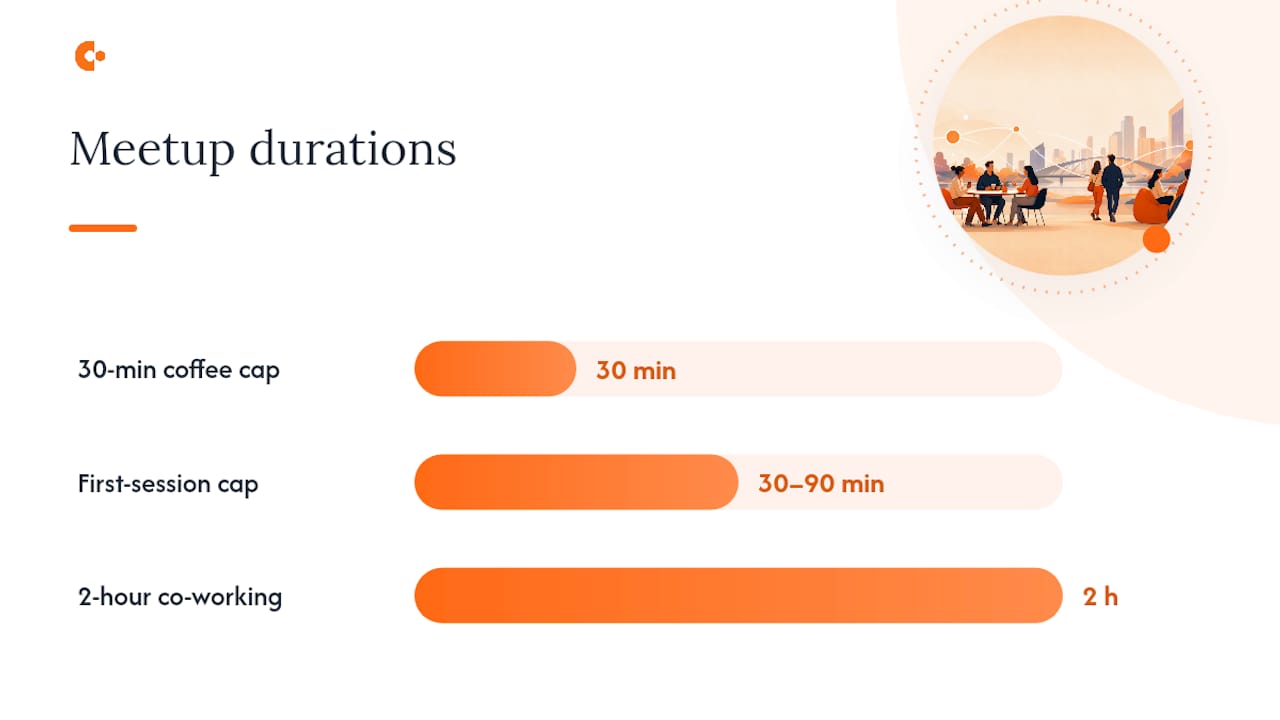
A safe first meetup follows a simple pattern: filter by time and skill level so expectations match, meet in a public place, and cap the first session at 30 to 90 minutes. Short, structured, and low-stakes beats open-ended every time.
Conppi applies this directly. It connects nearby people in real time for co-working, sports (tennis, padel, running, cycling, swimming, and gym sessions), coffee meetups, language exchange, and meeting locals while traveling, using filters for time and skill level instead of profiles or swiping. It also only shares approximate distance, not exact location, which keeps a first meetup low-pressure on the privacy front.
| Quick action | Why it works |
|---|---|
| Post a 2-hour co-working session | Creates body-doubling structure with zero small talk required |
| Filter by skill level for a sports match | Removes mismatch anxiety before you even meet |
| Set a 30-minute coffee meetup cap | Low commitment increases the odds someone says yes |
| Use approximate-distance privacy | Keeps first contact safe without exposing your exact location |
Recognizing when loneliness needs professional support
Most remote work loneliness responds well to the behavioral fixes above. But some signs mean it's moved past a scheduling problem into something that needs professional attention.
Watch for functional decline (skipping meals, neglecting hygiene, missing deadlines you'd normally hit easily), persistent anxiety or depressed mood that doesn't lift after a few weeks of trying to reconnect, and any thoughts of self-harm or suicide, which require immediate action, not a wait-and-see approach.
- Withdrawing from activities you used to enjoy, even virtual ones
- Sleep or appetite changes lasting more than two weeks
- Persistent hopelessness or a sense that nothing will improve
- Any thoughts of self-harm or suicide
If you notice these, talk to someone you trust today, check whether your employer offers an Employee Assistance Program, and contact a local mental-health provider. Availability and specific crisis resources vary by country and region, so confirm what's accessible where you live rather than assuming a service applies universally.
What I've learned about designing for connection
Most advice on remote work loneliness treats it as a willpower problem: just message more people, just try harder to network. That framing misses what the research actually shows. Isolation in remote work isn't a motivation gap. It's a structural gap, a design flaw in how the workday is built, and design flaws get fixed with design changes, not pep talks.
The pattern I keep noticing is that people don't fail to want connection. They fail to make it specific enough to act on. "I should socialize more" never survives a Tuesday afternoon. "I'm co-working with someone at 2pm for 90 minutes" usually does, because it's a scheduled commitment with a start and end time, not an intention floating in the background of your week.
Try one experiment from this article, just one, and actually track whether your subjective loneliness rating changes after three weeks. That's the whole ask.
— Ilya
Try Conppi to turn intent into an actual meetup
Reading about the fix and doing the fix are two different things, and the gap between them is usually just friction: who do I ask, where do we meet, what if it's weird. Conppi removes that friction by matching you with people nearby who want the same activity right now, whether that's two hours of focused co-working, a coffee break, or a tennis match, using filters for time and skill level instead of profiles to swipe through.
Start small. Post a 2-hour co-working session for this week, or a 30-minute coffee meetup if you'd rather ease in. Both give you a fixed, low-pressure structure and someone else showing up because they want the same thing you do. If co-working is your priority, Conppi's co-working matching is built specifically for finding a nearby work partner without the back-and-forth scheduling grind.
Sources
The research behind this article comes from a small set of high-authority sources worth reading directly if you want the full methodology behind the numbers cited above.
- Home alone: Remote work, isolation, and mental health (Science, 2026)
- Remote work frequency and loneliness (PubMed indexed study, 2026)
- Loneliness and isolation in the era of telework: a comprehensive review (PMC review)