
Start with one tiny, scheduled social step tied to an activity you already enjoy, not a forced conversation. Pick something structured, like a co-working session or a walk with one other person, and give yourself a 15 minute limit. Pair this with cognitive behavioral therapy or a support group when you can, since both are backed by clinical research. A tool like an activity partner app can help you find that first low-pressure activity partner nearby.
TL;DR:
- Starting with a brief, structured activity like a co-working session or walk helps reduce social anxiety triggers without feeling overwhelming.
- Using scripts for openers and planning exit strategies before attending social settings improves confidence and prevents overstaying.
- Joining activity-based groups such as hobby classes, sports, or volunteering offers predictable formats that lower the pressure of unstructured small talk.
- Online platforms with clear activity filters and short, public meetups provide safe environments to practice social interactions before in-person encounters.
- Building a graded-exposure hierarchy, repeating low-anxiety situations, and pairing them with CBT accelerates progress in overcoming social avoidance.
Table of Contents
- Quick, Practical Steps to Try This Week
- Where to Meet People: Structured, Lower-Pressure Settings
- Online and App-Based Options (How to Use Them Safely)
- A Practical Graded-Exposure Plan You Can Follow
- Support and Professional Help: What Works and When to Seek It
- How Conppi Fits Into Meeting People With Social Anxiety
- Author Perspective: Progress Isn't Linear, and That's Fine
- Try Conppi for Your Next Low-Pressure Meetup
- Sources
- FAQ
Quick, Practical Steps to Try This Week
You don't need a personality overhaul to meet people with social anxiety. You need a task small enough that your brain doesn't sound the alarm before you've even left the house. Clinical guidance from Mayo Clinic points to the same thing: pick a modest, realistic goal and practice it before you try anything bigger, since preparing for social situations with small steps works better than white-knuckling your way through a big event.
Here's a sequence that works for most people, regardless of what specifically triggers their anxiety:
- Set a measurable goal, not a vague one. "Say hi to one person and stay 15 minutes" is a finish line. "Be more social" is not.
- Use two or three scripted openers. Try "Mind if I join?", "How long have you been coming to this?", or "I'm new here, what's the setup?" Scripts remove the improv pressure.
- Prepare a follow-up line in advance. A simple "That's cool, what got you into it?" keeps the exchange moving without demanding cleverness.
- Plan your exit before you arrive. Decide you're leaving after 15 minutes or after one conversation, whichever comes first, and honor that plan even if it feels easy to stay longer.
- Do something calming right after. A short walk, music, or five minutes of quiet before you're back around people helps your nervous system reset.
- Write one sentence about what happened. Note who you talked to and one detail, so you have a natural reason to say hello again later.
That last step matters more than people expect. HelpGuide's research on practical exercises for social anxiety points to repeated, low-stakes practice as the mechanism that actually rewires the fear response, and a quick note turns a one-off interaction into the start of a pattern.
Pro Tip: Keep your notes in one place, even if it's just your phone's notes app. After a month, rereading them shows you proof that you've been building a social routine, which is the exact evidence your anxious brain resists believing.
Where to Meet People: Structured, Lower-Pressure Settings
The setting matters as much as the script. Rooms built around a shared task give you something to talk about that isn't yourself, and that single shift removes most of the burden social anxiety puts on small talk. Research on overcoming social anxiety through shared activities backs this up directly: joining a group organized around a specific activity gives you a built-in social script and lowers the pressure to perform.
Good options tend to share three traits: a defined activity, a predictable format, and low stakes if you skip a week.
- Hobby classes and sports teams (pottery, climbing gyms, rec league sports) give you a task to focus on so silence doesn't feel awkward.
- Book clubs and hobby meetups work well because the discussion has a topic besides you.
- Volunteering gives you a purpose bigger than the social discomfort, and most volunteer coordinators expect newcomers to be quiet at first.
- Workplace and neighborhood contacts are often underused. A coworker you already nod to in the hallway is a much smaller leap than a stranger.
When you're choosing among these, weigh three things against your specific triggers: group size, frequency, and activity type. If crowds spike your anxiety, a two-person co-working session beats a 20-person mixer every time. If unstructured chatting is your trigger, pick something with a clear task, like a running group where conversation is optional during the run itself. If you're worried about awkward silences, choose recurring, weekly formats over one-off events. Familiarity does a lot of the anxiety-reduction work for you, since the fifth time you show up feels nothing like the first.
Online and App-Based Options (How to Use Them Safely)
Digital spaces are a legitimate rehearsal room, not just a shortcut, and the distinction between introverts and extroverts matters less here than most guides suggest. Anyone can benefit from lower-stakes practice before an in-person meetup.
Three categories cover most of what's useful:
- Forums and asynchronous communities let you practice expressing yourself with time to think, no live pressure, and no facial expressions to read in real time.
- Activity-partner apps work best when they offer clear filters (skill level, activity type, time window) and small-group or one-on-one formats rather than open crowds. Look for options built around specific activities, like a sports partner search or a quiet co-working meetup, since a defined task lowers conversational demand from the first minute.
- Safety rules for the first meet matter regardless of platform: choose a public place, cap the meeting at 30 to 45 minutes, and tell a friend where you'll be.
Moving from chat to in-person goes smoother if you keep the first meeting anchored to the same activity you discussed online. If you matched over tennis, meet to play tennis. The shared task carries the conversation so you don't need to.
A Practical Graded-Exposure Plan You Can Follow
Graded exposure is the clinical backbone behind almost every social anxiety recovery. The idea is simple: build a list of feared situations ranked from least to most intense, then work through them in order, repeating any step that still spikes your anxiety before moving on. Clinical modules on breaking the avoidance cycle describe this hierarchy approach as one of the most reliable ways to reduce social avoidance over time.
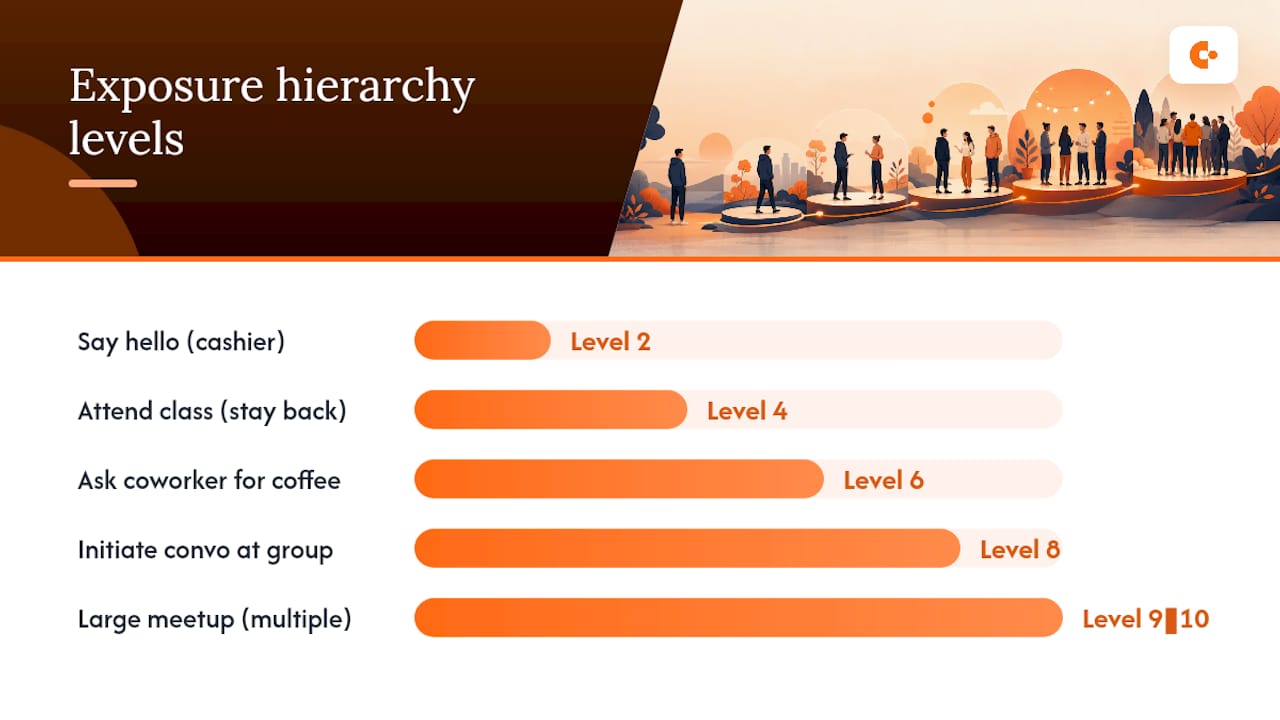
Build your own hierarchy on a 0 to 10 scale, anchored to concrete, personal examples:
- Level 2: Say hello to a cashier or barista.
- Level 4: Attend a class or meetup and stay quietly on the sidelines.
- Level 6: Ask a neighbor or coworker to grab coffee.
- Level 8: Initiate a conversation with someone new at a group activity.
- Level 9 or 10: Attend a larger meetup, like a 10-person social event, and speak to more than one stranger.
Spread this across four to six weeks, tackling one or two rungs per week depending on how anxious each step leaves you. Rate your anxiety before, during, and after each attempt on that same 0 to 10 scale. If a step still scores above a 6 after two tries, stay there and repeat it rather than pushing forward. Progress that skips steps tends to backfire.
CBT pairs naturally with this structure. Reframing a thought like "they're judging me" into "I don't actually know what they're thinking" reduces the emotional charge before you walk into a room, and behavioral experiments (testing whether your feared outcome actually happens) give you evidence your anxious brain will believe more than reassurance ever could.
Pro Tip: Before a scheduled step, try naming the feeling out loud ("I'm anxious right now") and take three slow breaths. Labeling the emotion and grounding your breathing shifts your physical arousal just enough to make the next 15 minutes manageable.
Support and Professional Help: What Works and When to Seek It
Cognitive behavioral therapy is the primary, most studied treatment for social anxiety disorder, and it works whether you access it one-on-one or through group therapy, where you practice social skills with other people who understand exactly what you're feeling. The NHS recommends CBT, guided self-help, and support groups as first-line options, with medication available when symptoms are severe enough to warrant it.
Support groups add something therapy alone can't: peer feedback from people who've tested the same feared scenarios and survived them. That corrective experience chips away at the distorted belief that everyone is watching and judging you.
- CBT and group therapy remain the strongest evidence-backed starting points.
- Support groups (in person or through services like Meddle's anxiety support programs) offer low-cost practice and honest feedback.
- Medication is worth discussing with a doctor if anxiety is severe, persistent, or paired with depression, but it's a conversation for a GP, not a self-diagnosis.
- Seek help urgently if anxiety leads to isolation lasting weeks, panic that doesn't ease, or thoughts of self-harm.
Before an appointment, write down your top three symptoms, how long they've lasted, and what situations you avoid because of them. Ask directly whether CBT, psychotherapy, or a combination fits your case. A clear list turns a nerve-wracking appointment into a straightforward conversation.
How Conppi Fits Into Meeting People With Social Anxiety
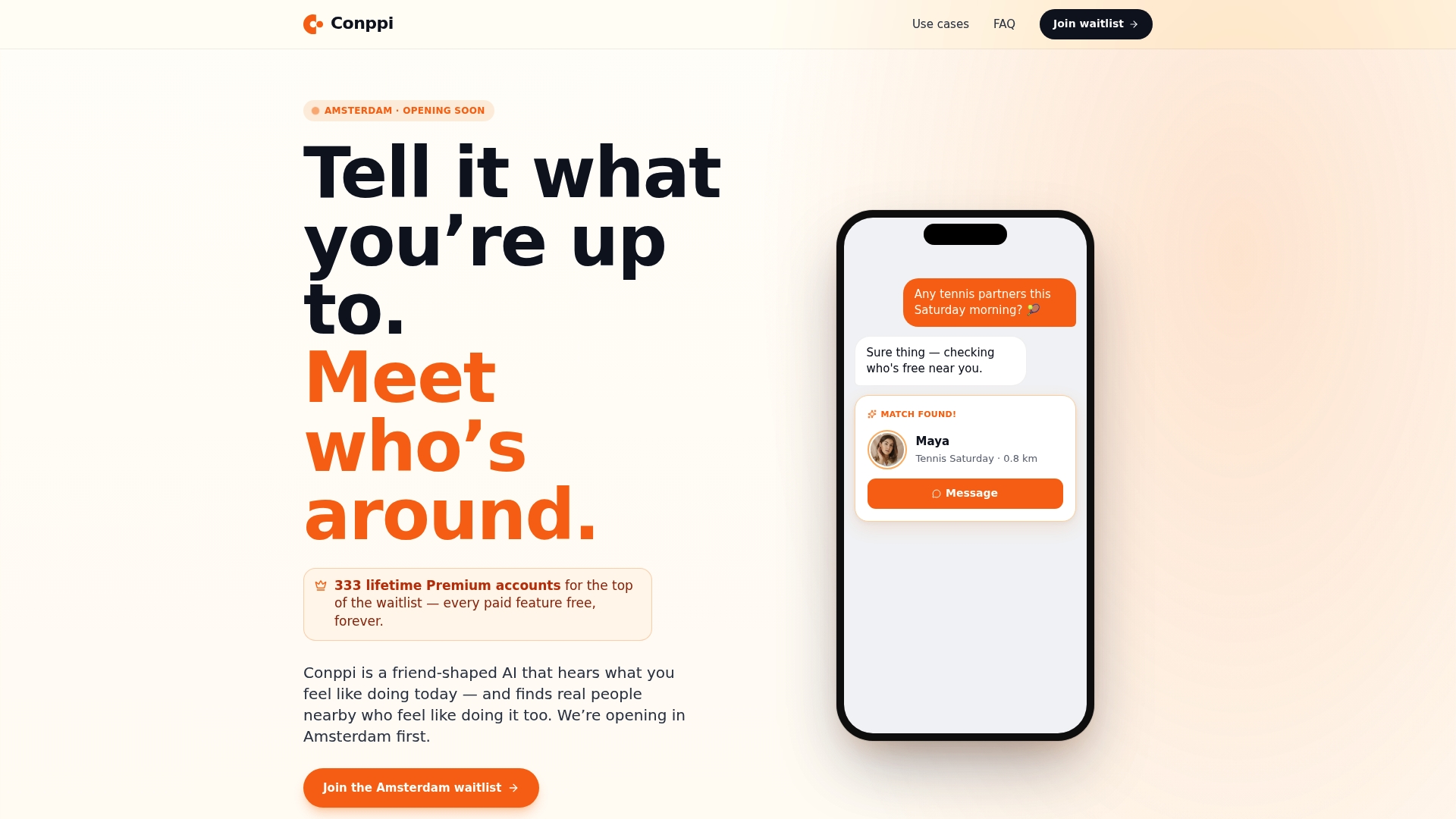
Some apps match you with someone nearby for a specific activity, such as tennis, co-working, or a coffee meetup, without profiles to curate or swiping to perform. That structure removes two of the biggest social anxiety triggers: ambiguous intent and open-ended small talk. You know exactly what you're doing and roughly how long it lasts before you agree to meet.
Activity filters on some partner apps let you match by skill level and time window, helping you avoid situations bigger than you're ready for. Short, defined formats, like a single co-working session or a one-off coffee meetup, work well as graded-exposure steps because they have a built-in end point. Some apps share only approximate distance, which helps keep first interactions lower stakes than exchanging exact addresses.
Author Perspective: Progress Isn't Linear, and That's Fine
Some weeks you'll cancel plans last minute. That's not failure, it's data about where your hierarchy needs an easier rung. What actually moves the needle is showing up small and often, not showing up big and once. Pair whatever tools you use, apps, groups, or a single scripted opener, with therapy if you can access it. One tiny step today, even just saying hello to a cashier, counts more than the perfect plan you never start.
— Ilya
Try Conppi for Your Next Low-Pressure Meetup
An app that gives you a defined activity and a time limit instead of an open-ended social obligation fits well as a graded-exposure step. Getting started takes three moves: pick an activity you already enjoy, set filters such as skill level or time window, and confirm a short, public first meetup.
Before you go, run through a quick safety checklist: choose a public location, cap the meeting at 30 to 45 minutes, and tell someone where you'll be. If sports feel more approachable than conversation, start with a tennis partner or a padel partner match, where the activity carries the interaction for you. If you'd rather ease in with something quieter, a co-working session is a natural first rung. Download Conppi and set your first activity for this week, not someday.
Sources
- Social Anxiety Disorder: What You Need to Know - National Institute of Mental Health (NIMH)
- Social anxiety (social phobia) - NHS
- The avoidance cycle and exposure strategies - BCM Luna Learning (caregiver module)
This article is general information, not a substitute for advice from a qualified doctor. Consult a qualified healthcare professional about your own circumstances before acting on anything here.
FAQ
How do I meet people if I have social anxiety?
Start with a small, activity-based step, like a short co-working session or a hobby class, and use a scripted opener so you're not improvising a conversation from scratch. Combine that practice with CBT or a support group for the strongest results.
How do people with social anxiety act?
They often avoid eye contact, over-rehearse or overthink what to say, and leave social situations early even when nothing went wrong. This avoidance reinforces the anxiety, which is why graded exposure to feared situations is used clinically to break that cycle.
Why do I get anxious when I meet people?
Social anxiety triggers a fear of judgment or rejection, and the body responds with a real physical stress reaction, faster heartbeat, tight chest, racing thoughts, even when there's no actual threat. Cognitive behavioral therapy targets the thought patterns behind that fear directly.
What jobs should I avoid if I have social anxiety?
There's no universal list, since the right fit depends on which specific situations trigger you most, whether that's public speaking, constant cold-calling, or open floor plans with no quiet space. A therapist can help you map your specific triggers against a role's actual daily demands rather than assuming based on job titles alone.