

Weekday social activities are low-commitment, early-evening gatherings built around a shared interest rather than a night out, and they almost always wrap up by 9 or 10 p.m. so nobody wrecks their next workday. The fastest way to get one on your calendar this week is to check local event listings for anything tagged "after-work" or "weeknight," or open a nearby matching app to find someone doing the same activity tonight.
TL;DR:
- Most weekday social activities end before 9 or 10 p.m., making them suitable for early evenings without risking next-day fatigue.
- Activities like craft nights, volunteer work, and co-working sessions tend to finish earlier and foster more genuine conversations than alcohol-centered events.
- Use event filters for early evening times, small group sizes, and tags like "weeknight" to find suitable gatherings, or try real-time matching apps for immediate nearby options.
- When choosing activities, consider natural finish times, travel distance, activity intensity, and group size to maximize the chances of meaningful connections.
- Meeting in public, arriving early, and following up within 48 hours are key steps to turning casual encounters into potential friendships.
Table of Contents
- Practical Weekday Activities That Fit an After-Work Schedule
- Where to Find and Join Weekday Events
- How to Pick Your First Weekday Activity
- Show Up Well and Actually Make a Connection
- Staying Sensible About Health Guidelines
- Virtual and Hybrid Options for Slower Weeks
- Why I Think Weeknights Beat Weekends for Making Friends
- Find Your Next Weekday Activity Partner Tonight
- Sources
Practical Weekday Activities That Fit an After-Work Schedule
You don't need a free Saturday to build a social life. Amsterdam and most Dutch cities run a steady rotation of weeknight options that ask for two hours, tops, and give you something to talk about besides the weather.
Here's a shortlist worth trying, roughly in order of how little energy they demand:
- Co-working evening — 6:30 to 8:30 p.m., bring a laptop and one task you can finish in that window; ideal after a long day when you still want company without conversation pressure.
- Craft night — 7 to 9 p.m., bring nothing but curiosity; working with your hands removes the burden of constant small talk.
- Volunteer project — often 6 to 8 p.m., check what the organizer needs; shared purpose tends to produce faster, realer connections than standing around with a drink.
- Board game night — 7 to 9:30 p.m., no experience needed; the game gives you built-in structure.
- Book club — 7 to 8:30 p.m., read the chapter, not the whole book, and show up anyway.
- Beginner sports drills (padel, running, cycling) — 6 to 7:30 p.m., bring gear appropriate to the sport and a willingness to be mediocre at first.
- Language exchange — 7 to 9 p.m., bring a notebook; these run in cafes across Amsterdam nearly every night of the week.
- Small dinner or supper club — 7 to 9:30 p.m., bring an appetite and, sometimes, a dish to share.
- Themed workshop (cooking, pottery, drawing) — 6:30 to 8:30 p.m., materials usually included in the fee.
Craft nights, volunteer shifts, and co-working sessions consistently end earlier and produce better conversation than anything centered on alcohol, since the activity itself carries the social weight instead of you.
Where to Find and Join Weekday Events
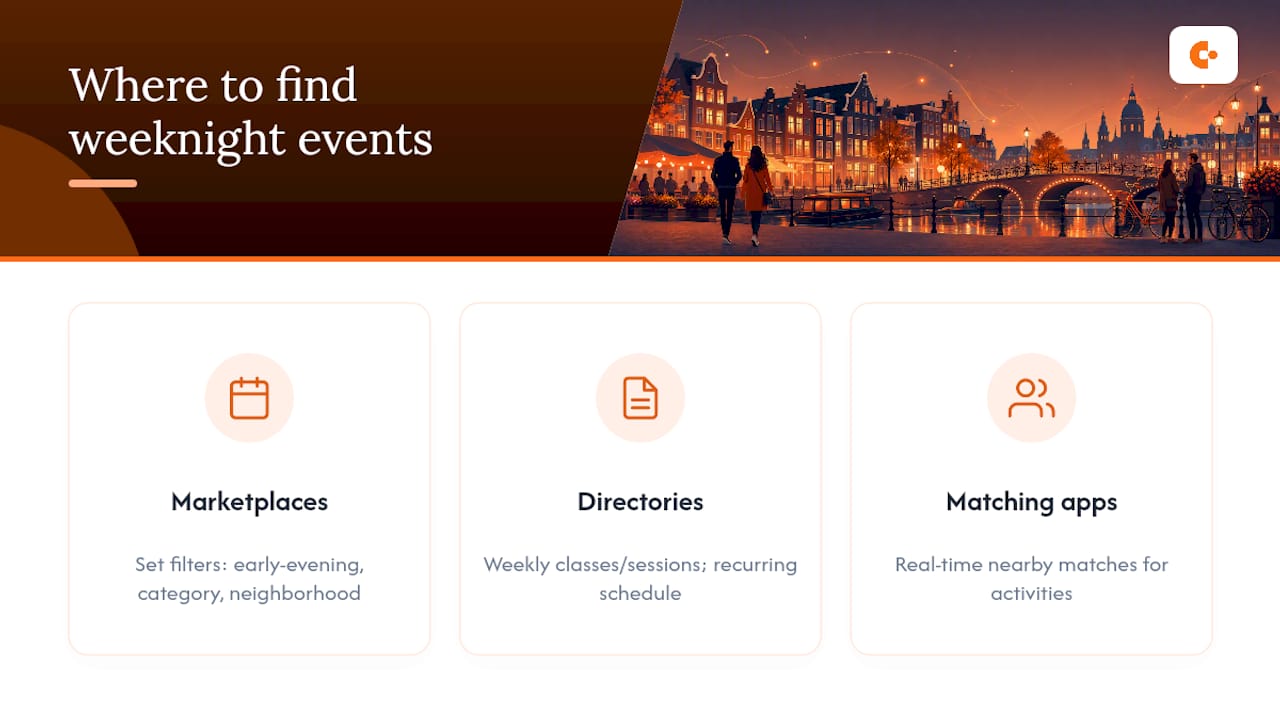
Three sources cover almost everything: event marketplaces, community directories, and matching apps built specifically for finding people, not just listings.
On general event platforms, filter by time of day (early evening), category (fitness, arts, social), and neighborhood. Search phrases like "after work Amsterdam Tuesday" or "weeknight meetup near me" surface far more relevant results than a generic search for "things to do." Tulsa's School Night Social Club is a good model for what a well-run weeknight event looks like: events wrap by 9 p.m. and lean on low-pressure formats like crafts and volunteer work rather than nightlife. Community calendars, meanwhile, often run the same class or session every week, which is why platforms like AYS Online Community's weekly schedule can turn a one-off visit into a standing weekly habit.
When you're scanning listings, look for three signals: an end time before 9 or 10 p.m., a small stated group size, and tags like "weeknight" or "after-work." Early-evening professional mixers such as Seaport's After 5 Social show the typical pattern: a 6 to 8 p.m. window with a modest fee or membership inclusion.
Conppi takes a different approach entirely: instead of browsing event listings, it matches you in real time with people nearby who want the same activity, whether that's a co-working partner, a coffee meetup, or a sports drill.
Pro Tip: Set your filters for "this evening" and a short distance radius first. A great event 45 minutes away rarely survives a Tuesday.
How to Pick Your First Weekday Activity
Overthinking kills more weeknight plans than actual scheduling conflicts. Run through this checklist before you commit to anything:
- Check your finish time. If the event ends after 9:30 p.m. on a work night, skip it unless it's genuinely worth the recovery day.
- Factor in commute. An activity 10 minutes from your office beats one that's "only" 25 minutes but requires two transit connections.
- Match energy level to format. Drained? Pick co-working or a craft night. Wired and restless? Pick a run club or a padel drop-in.
- Confirm the cost. Most weekday social activities are free or cost a modest fee, sometimes rolled into a membership.
- Look at group size. Smaller groups (6 to 12 people) tend to produce actual conversations; large mixers favor extroverts.
- Ask if it repeats. A one-off event is fine, but a weekly session builds familiarity faster than any single great night out.
A realistic Tuesday: leave work at 6, arrive at a co-working session by 6:30, work alongside new people until 8, grab a quick coffee after, and you're home by 8:45. That's a full social evening without touching your weekend at all.
Show Up Well and Actually Make a Connection
Getting to the event is half the work. What happens in the two hours after that determines whether you build a friendship or just tick a box.
Before you go: RSVP so the host has a real headcount, skim any notes they've posted, and arrive 10 to 15 minutes after the official start time. That short delay skips the awkward first-arrivals silence and drops you into conversation that's already warming up.
Once you're there, use the activity itself as your opening line. "How long have you been coming to this?" works better than any rehearsed icebreaker. Gravitate toward smaller clusters of two or three people rather than the loudest group in the room, and be selective about swapping contact information. Not everyone needs your number after one board game.
Afterward, message one person within 48 hours with something low-pressure: coffee, or just "same time next week?" Momentum fades fast otherwise.
- Meet in public venues, especially for a first one-on-one.
- Tell a friend where you're going and roughly when you'll be done.
- Use in-app messaging to sort out logistics before handing over your personal number.
Pro Tip: The follow-up message matters more than anything you said at the event. A quick "good meeting you, want to grab coffee sometime?" turns a stranger into a standing plan.
Staying Sensible About Health Guidelines
Weeknight social events in the Netherlands now operate mostly under standard event etiquette rather than any formal pandemic restrictions, but a few habits are still worth keeping. Smaller, activity-based formats like co-working sessions, craft nights, and outdoor sports drills naturally involve less prolonged close contact than a packed bar mixer, which is part of why organizers favor them.
If you're feeling unwell, the simplest courtesy is the same one that predates any health crisis: stay home and message the host instead of pushing through. Most weekday groups, especially recurring ones, will have you back the following week without any issue.
Outdoor and semi-outdoor formats, running clubs, cycling groups, padel drop-ins, remain a solid fallback if you'd rather keep gatherings ventilated. And if you're easing back into in-person socializing after a stretch of working from home, a hybrid option (see below) lets you test the waters before committing to a full evening out.

Organizers of recurring weeknight programming, the kind you'll find on community calendars, tend to build in flexibility for exactly this reason: predictable formats make it easy to skip a week without losing your spot in the rotation.
Virtual and Hybrid Options for Slower Weeks
Not every Tuesday allows for a real commute across town, and that's fine. Virtual co-working sessions, where you hop on a video call and simply work alongside others in silence, replicate a surprising amount of the accountability and light camaraderie of in-person sessions. Online language exchanges and virtual book club discussions work the same way.
Hybrid formats split the difference: some workshops and networking events now offer a video link for people who want to listen in before deciding whether to show up physically the following week. If you're new to a city or just easing back into a social routine, starting virtual and graduating to in-person within a month or two is a reasonable, low-pressure ramp.
Why I Think Weeknights Beat Weekends for Making Friends
Weekend plans get overloaded fast, errands, family, recovery from the week, and social intentions quietly lose to logistics. Weeknights carry lower stakes: nobody expects a three-hour commitment, so you show up, do the thing, and leave. That structure is exactly why formats built around a shared task, co-working, a craft, a volunteer shift, tend to outperform open-ended socializing when it comes to actually building a friendship. The activity does the work; you just have to be in the room.
If you're only going to make one move this week, make it small: open Conppi, search for a co-working session or a craft night near you, and go.
— Ilya
Find Your Next Weekday Activity Partner Tonight
Conppi skips the browsing entirely. Instead of scrolling through event listings hoping something starts near you before 7 p.m., you open the app and get matched in real time with someone nearby who wants the same thing you do, whether that's a co-working partner, a padel opponent, or someone to grab coffee with after work.
Here's the flow in practice: you set your activity and rough timeframe, the app surfaces nearby people looking to do the same thing right now, and you message before ever sharing personal contact details. Three steps, no swiping, no profile-building marathon.
- Search: pick an activity, sports, co-working, coffee, and set a distance radius.
- Match: see who's nearby and available this evening.
- Message, then meet: chat inside the app first, then agree on a public spot.
If you're in Amsterdam and want to start with something specific, the Amsterdam page is a good starting point, or head straight to the networking app if professional connections are the goal. Keep the first meeting public, and let the app's approximate-distance sharing handle privacy until you're ready to share more.