
The strongest options for young professionals networking in Amsterdam are Amsterdam Founders Club, Founders Carbon Network, Young Underground Professionals, and ASA Young Professionals. Some are members-only, others run open sessions you can walk into. The fastest way in is to find one listed open event or request a guest pass rather than paying for a full membership upfront. Expect event formats ranging from workshops to festivals, and membership costs that vary widely by group.
TL;DR:
- Joining open events or requesting guest passes often provides faster entry than committing to paid memberships upfront for most networks.
- Structured formats like workshops, pressure cooker sessions, and build weekends tend to facilitate better connections than informal mixers.
- Attending during peak seasons in September and spring increases chances of engaging with more active and well-organized communities.
- Repeated participation, committee involvement, and contributing to member channels offer more career benefits than sporadic attendance at one-off events.
- Using apps like Conppi can help maintain connections post-event by arranging informal meetups like coffee or sports activities, supplementing formal networking.
Table of Contents
- Active Amsterdam Communities Worth Your Time
- Choosing Where to Start and How to Get In
- Event Formats and When to Show Up
- Turning a Conversation Into a Career Connection
- Membership Culture Versus One-Off Events
- Who Drives These Networks Forward
- Who Actually Shows Up to These Events
- Amsterdam Networking Etiquette to Keep in Mind
- What the Data Actually Suggests About Networking Here
- Keep the Momentum Going After the Event
- Sources
- FAQ
Active Amsterdam Communities Worth Your Time
Amsterdam's young professional scene is not one club; it is a handful of overlapping networks, each with its own entry point and crowd. Picking the right one first saves months of attending the wrong drinks.
Amsterdam Founders Club runs founders-only events focused on scaling businesses, with programming aimed specifically at entrepreneurs running six and seven figure companies. It is not built for early-career professionals or first-time founders looking for general networking. If you already run a business past its first stage and want peers dealing with the same growth problems, this is a tighter fit than a general meetup. Access tends to run through invitation or paid events rather than open registration, so check the site directly for current entry requirements.
Founders Carbon Network is an Amsterdam-based founder network built around sustainability and climate-focused collaboration. Events lean curated rather than open-door, which suits founders and operators working specifically in climate, energy, or sustainability ventures who want conversations with people solving similar problems rather than a broad professional mixer.
Young Underground Professionals focuses on youth-oriented community activities with a more open-friendly structure than the founder-focused clubs above. It fits professionals earlier in their careers who want low-pressure social entry points before committing to a paid membership elsewhere.
ASA Young Professionals, delivered through AmCham's Young Professionals program, organizes cross-company networking and skills-based events for employees of AmCham member companies. This is one of the more accessible routes if your employer already holds a membership, since it can unlock discounted or free access to workshops and social events built around professional skills rather than pure socializing.
A few practical notes on getting in the door:
-
Amsterdam Founders Club and Founders Carbon Network skew toward curated or paid access, so expect an application step or invitation before you attend.
-
Young Underground Professionals tends to welcome newcomers to open sessions without a formal vetting process.
-
ASA Young Professionals runs through AmCham, so registration and event listings live on the AmCham site under the Young Professionals program.
-
Check each organization's own event page directly rather than relying on secondhand listings, since schedules shift seasonally.
Choosing Where to Start and How to Get In
The right community depends less on prestige and more on fit: your industry, the event formats you actually enjoy, what you can afford, and whether your employer already has a foot in the door.
Run through this before committing to anything:
- Match industry to network. Founders belong at Amsterdam Founders Club or Founders Carbon Network, corporate employees fit better at ASA Young Professionals, and anyone still exploring should start with the more open Young Underground Professionals.
- Check the event format first. A single mixer tells you little; a workshop or structured session shows you how the group actually operates.
- Look for a free or low-cost entry point. Many groups list an open event or a guest pass option before asking for a paid membership.
- Ask about employer partnerships. If your company holds an AmCham membership, you may already have access to ASA Young Professionals events at no extra cost.
- Consider committee involvement once you're in. Volunteering for a committee at a group like ORAM's Young Professionals tends to speed up access to private member channels where opportunities circulate faster than at public events.
Watch for red flags before you pay anything: a heavy sales pitch before you have attended a single event, no visible member communication channel such as a WhatsApp group, or registration details that are vague about who actually shows up. Ask organizers directly how many people typically attend, whether there is an ongoing member channel, and what happens after the event, since a group with no follow-up structure rarely turns into real career value.
Pro Tip: Email the organizer before an event and ask one specific question about the agenda. It signals genuine interest and often gets you a faster response on guest access.
Event Formats and When to Show Up
Not all networking events are built the same, and the format tells you more about the outcome than the guest list does. A congrestival blends a conference with festival energy, useful for meeting a wide range of people in a low-stakes setting. A link and learn session, like the one INREV runs for young professionals, pairs a workshop with a built-in networking lunch so conversation happens naturally around a shared activity. A pressure cooker session, a format used at the ORAM Next Gen Festival, forces small groups to solve a problem together in a short window, which tends to produce sharper connections than a passive panel talk. A build weekend, such as the one Young Creators runs in Amsterdam, pairs hands-on skill building with team formation over a full weekend.
Timing matters as much as format. Amsterdam's networking calendar tends to peak around September kick-offs, when groups restart their programming after summer, and again in spring as event volume picks up.
To spot a high-intent event in a listing:
- Look for a stated capacity limit rather than open-ended attendance.
- Check whether there is an application or selection step, which usually signals a more engaged crowd.
- Favor structured sessions over free-form mixers when your goal is a specific career outcome.
Turning a Conversation Into a Career Connection
Attending an event gets you in the room. What happens in the first five minutes and the days after decides whether it turns into anything.
- Bring one specific thing to talk about. A single project, question, or challenge works better than a vague pitch about what you do.
- Open with value, not a request. Lead with what you bring to the table professionally, then follow with what you are currently working on or looking for.
- Follow up within 48 hours. A short LinkedIn message referencing your actual conversation works better than a generic connection request.
- Offer something before asking for something. A relevant article, an introduction to someone in your network, or a quick coffee invite keeps the exchange balanced. For more on structuring these follow-ups, career transition networking guidance covers the sequencing in more detail.
- Use member channels to contribute, not broadcast. If a group has a WhatsApp or private channel, share something useful before you ask for anything, since groups notice who only shows up to pitch.
Pro Tip: Save your specific talking point as a one-line note before the event. Under pressure, people default to small talk, and a prepared line keeps the conversation moving toward something useful.
Membership Culture Versus One-Off Events
Amsterdam's networking scene rewards people who show up more than once. A single event rarely changes anything on its own, but consistent presence in a group, whether through committee work or repeat attendance, tends to open doors that a one-time guest pass never will. Groups with active member channels, like the WhatsApp hubs that accompany many Amsterdam networks, function as ongoing hubs where opportunities surface between formal events rather than during them. Combining a formal community membership with a more spontaneous, app-driven way to meet people for coffee or a co-working session tends to fill the gaps that scheduled events leave open, since not every useful connection happens at a planned mixer.
Who Drives These Networks Forward
Amsterdam's young professional networks are largely run by volunteer committees and organizational staff rather than solo influencers. At ORAM's Young Professionals, programming and event planning run through member committees who organize masterclasses, company visits, and festival programming throughout the year. AmCham's Young Professionals arm operates through the broader AmCham organization, coordinating with member companies to schedule workshops and social events. Groups like Amsterdam Founders Club and Founders Carbon Network tend to be shaped by their founders or core organizing teams, who set the tone for who gets invited and what kind of programming runs. Rather than a handful of visible personalities, the scene runs on rotating committee members and organizational staff who cycle through roles each season, which means the fastest way to build a recognizable presence is to join a committee rather than wait to be noticed at events.
Who Actually Shows Up to These Events
The young professionals filling Amsterdam's networking rooms skew toward a mix of finance, consulting, tech, and sustainability backgrounds, reflecting the city's concentration of multinational offices and a growing climate and impact sector. ORAM's Young Professionals network draws a cross-sector crowd by design, pulling in people from different industries rather than a single vertical. AmCham's Young Professionals programming leans corporate, since it runs through member companies with a strong presence of international business and finance employees. Founder-focused groups like Amsterdam Founders Club and Founders Carbon Network attract a narrower slice: people already running businesses, particularly in climate and sustainability for the latter. Younger professionals still building their first few years of experience tend to gravitate toward more open, lower-commitment groups before moving into founder or corporate-specific networks as their careers progress.

Amsterdam Networking Etiquette to Keep in Mind
Dutch professional culture runs direct, and that shapes how networking works here. Skip the long preamble and get to your point quickly, since a rambling introduction can read as unclear rather than polite. Flat hierarchy is another norm worth knowing: a junior employee at an AmCham event is expected to speak up and ask questions just as freely as a senior one, and titles carry less weight in conversation than they might elsewhere. Punctuality matters more than in many other cities, so arrive on time rather than fashionably late. Follow-up etiquette also leans practical: a short, specific message referencing the actual conversation lands better than a generic thank-you. Group channels like WhatsApp hubs work on a similar principle, contribute something useful before asking for a favor, since groups notice who only shows up to take.
What the Data Actually Suggests About Networking Here
Most advice about networking treats every event as equally valuable, and that is where it falls apart. The evidence points somewhere more specific: structured formats like pressure cooker sessions and link and learn workshops consistently produce better conversations than open bar mixers, because they force interaction instead of hoping for it. The overrated move is chasing every open event on the calendar. The better one is picking two or three groups that match your actual industry and showing up repeatedly, since committee involvement and member channels do more for career outcomes than a stack of one-time guest passes ever will. Timing also matters more than most people assume. Attending during the September and spring peaks means catching groups at their most active, not their quietest stretch. If there is one thing worth prioritizing first, it is choosing fit over volume, since one well-matched community beats five loosely attended ones.
— Ilya
Keep the Momentum Going After the Event
A good networking event ends with a handshake and a half-formed plan to grab coffee sometime. An app exists for that gap between the event and the actual follow-through. It can match you in real time with people nearby who want the same kind of meetup, such as a coffee catch-up, a co-working session, or a quick game of padel, without the back-and-forth of scheduling or the awkwardness of a cold LinkedIn message.
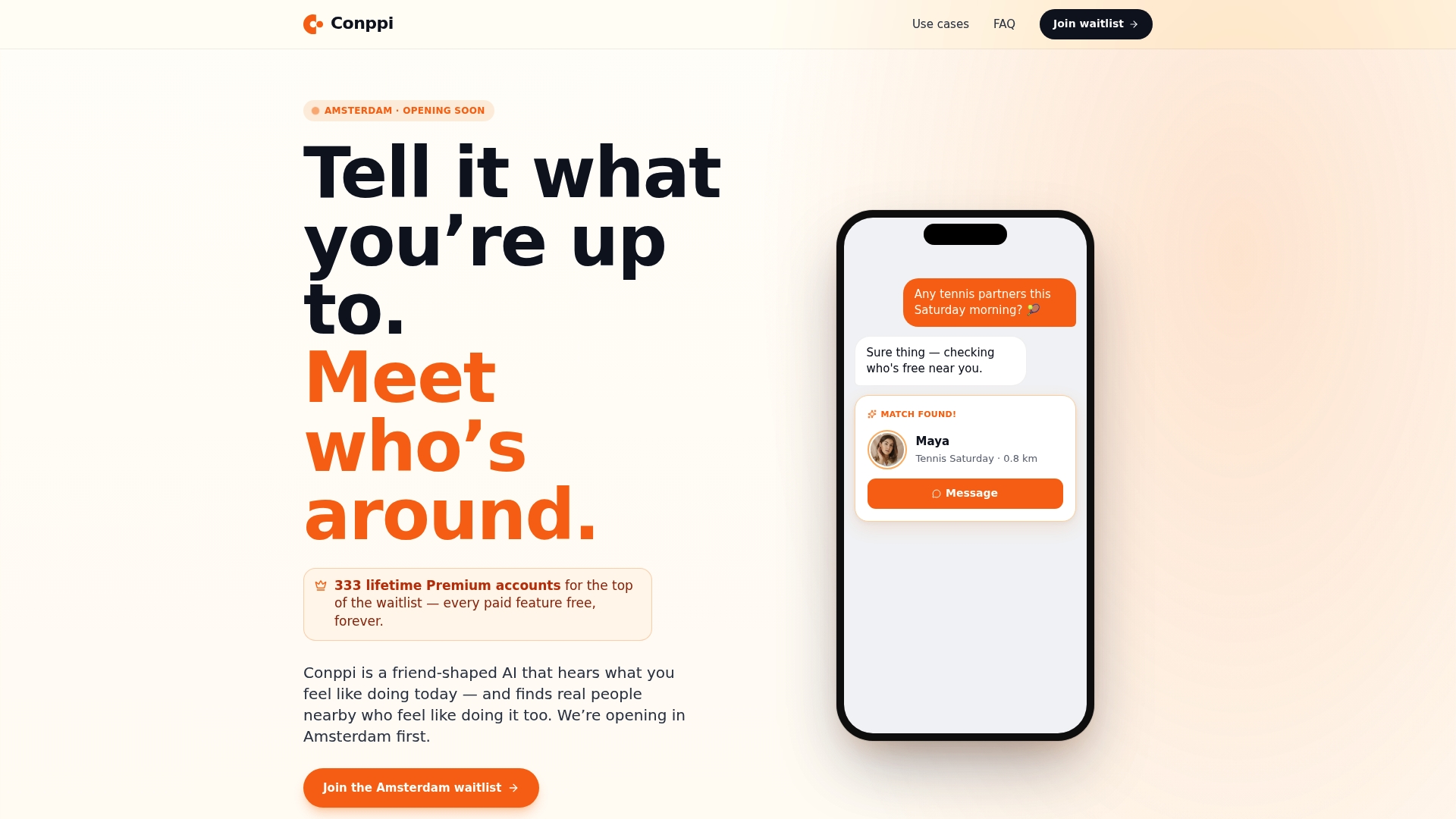
After a workshop or festival, Conppi gives you a few practical ways to keep the connection warm:
- Turn a follow-up coffee into a same-day meetup instead of a calendar back-and-forth.
- Find a co-working partner nearby when you want company without the formality of another event.
- Line up a sports session, tennis, padel, or a run, with someone from the same professional circle.
If you want a simpler way to turn one good conversation into an ongoing connection, try the Conppi activity partner app and see who's nearby.
Sources
FAQ
Is Amsterdam Founders Club open to non-founders?
No, Amsterdam Founders Club runs founders-only events aimed at entrepreneurs scaling six and seven figure businesses. Professionals who are not currently running a company will find a better fit with a more open network like Young Underground Professionals or ASA Young Professionals.
How do I get into ASA Young Professionals events?
Access typically runs through AmCham's Young Professionals program, which organizes events for employees of AmCham member companies. Check whether your employer already holds a membership, since that can grant free or discounted access to workshops and social events.
What is a pressure cooker session at a networking event?
It is a structured, small-group format used at events like the ORAM Next Gen Festival, where participants work through a problem together in a short, focused window. The format tends to produce sharper, more useful conversations than a passive panel or open bar mixer.
When is the best time to start attending networking events in Amsterdam?
Most groups restart or ramp up programming around September, with a second wave of activity in spring. Planning your first few events around those windows means catching communities at their most active rather than their quietest stretch.
Can an app like Conppi replace formal networking communities?
Not entirely, since formal communities offer structured programming, committees, and member channels that an app does not replicate. Conppi works better as a complement, helping you turn a single event connection into a follow-up coffee, co-working session, or activity meetup without extra scheduling friction.