
The fastest way to build a network in Amsterdam is to stop treating it as one task. Professional contacts, friends and neighbors come from different places, and each needs repeat contact more than a big night out. Mix one recurring group, one activity you do weekly and one app or community that gets you out of the house on short notice. This guide shows how, and what to do if the city still feels lonely after a few months.
TL;DR
- Go to the same two or three things repeatedly. A friendship usually forms on the third meeting, not the first mixer.
- Split your goals: professional networking (industry meetups, business clubs), friendships (sports, hobbies, language exchange) and local roots (neighborhood venues).
- Staying in touch with locals online can help you take part in Dutch life, while mostly messaging people back home can leave you lonelier.
- If loneliness lingers, Dutch municipalities have formal support under the Wmo, and your GP is a valid first call.
- Apps like Conppi fill the gaps between scheduled events by matching you with someone nearby for an activity today.
Table of Contents
- Why networking in Amsterdam works differently
- Decide what kind of network you need
- The kinds of expat events and groups you will find
- How to find the right group for your interest
- Turning events into friendships
- A simple four-week plan
- When it feels lonely
- Our perspective
- Filling the gaps between events with Conppi
- FAQ
- Sources
Why networking in Amsterdam works differently
Amsterdam is easy to arrive in and surprisingly hard to settle into. English works almost everywhere, so you can live here for months without needing Dutch. That is convenient, but it also means nothing forces you into contact with neighbors, colleagues outside your team or other newcomers.
A second reality: many people you meet are temporary, and many locals have full social calendars planned weeks ahead. That makes the first six months a bit of a market for people who are open to new friends. Newcomers, long-term internationals and Dutch people who like international company are all looking. You find them where they gather regularly, not at one-off events with 300 strangers.
So the useful question is not "which expat event is the best?" but "which three places can I show up at every week or two for a couple of months?"
Decide what kind of network you need
People search "expat networking" and mean at least three different things. Pick the one that matters most right now.
| Goal | Where it happens | Rhythm that works |
|---|---|---|
| Career contacts | Industry meetups, professional clubs, coworking days | Monthly events, plus a coffee follow-up within a week |
| Friends | Sports, hobbies, language exchange, walking groups | Weekly, same people, same time |
| Local roots | Community centers, neighborhood activities, volunteering | Weekly or fortnightly, close to home |
Most people over-invest in the first row and neglect the other two. Career contacts help you find a job or clients. They rarely help when you want someone to grab a drink with on a Wednesday.
If networking is the priority, we cover the professional side separately in our guide to networking in Amsterdam by field, and the budget version in free networking for young professionals.
The kinds of expat events and groups you will find
You will not run out of options. The task is choosing formats that suit you. These are the main types.
Social mixers and drinks
Monthly drinks nights in bars are the classic entry point, and they are what newcomers on forums usually ask about first. They are good for meeting a lot of people quickly and for hearing practical tips: which landlord to avoid, which dentist takes new patients. They are weaker for deep friendships, because conversations are short and the crowd rotates. Treat them as a way to find two or three people you want to see again, and suggest a specific follow-up before you leave.
Nationality and language communities
There are clubs for specific groups: women's clubs, business clubs tied to a home country, French-speaking communities, parent groups. A directory of expat groups and clubs shows how broad these are, from social networks for Francophones to professional clubs built around Dutch-American business relations. Home-country groups are comforting in the first weeks. Just keep a balance, because a network made only of your own nationality makes it harder to integrate later.
Activity groups
This is where friendships tend to form. Running crews, padel and tennis partners, skating nights, book clubs, life drawing, netball, board games. Shared activity gives you something to talk about and a reason to come back. If you like walking, our guide to walking groups in Amsterdam is a gentle starting point.

Coworking and remote worker meetups
If you work from home, your network may shrink to your laptop. Day passes, library workspaces and coworking socials fix that cheaply. We list venues and how to meet people in them in meeting remote workers in Amsterdam and digital nomad meetups.
Neighborhood activities
The least glamorous option is often the most durable. Buurtteam Amsterdam lists activities at community centers, schools, churches or mosques, including coffee drop-ins, shared meals, language lessons, arts and exercise. These are open to anyone in the area, not only long-term residents. You meet neighbors, which is how you stop feeling like a visitor in your own street.
How to find the right group for your interest
A practical search order that avoids scrolling forever:
- Start with the activity, not the label. Search the sport or hobby plus "Amsterdam" and "English". Plenty of Dutch clubs welcome internationals, and many run beginner sessions.
- Check the rhythm. A group that meets weekly beats a glamorous one that meets quarterly.
- Look at the last few events. If the same names show up and people actually chat afterwards, it is alive.
- Ask in your own building and workplace. Colleagues, landlords and neighbors know small groups that never advertise.
- Try a one-off activity partner when you cannot find a group. Our piece on meeting people without social media covers options if you would rather not scroll through feeds.
For your first month, our guide to pairing one meetup with one app in week one gives a simple plan.
Turning events into friendships
Most people attend an event, meet someone pleasant and never see them again. The gap is follow-up. A few habits close it.
Suggest something small and specific. "We should hang out sometime" is a polite goodbye. "I'm running along the Amstel on Saturday at 10, want to join?" is an invitation.
Go back. Pick one recurring event and attend four times before judging it. By the third visit people recognize you, and that changes the whole atmosphere.
Use online contact with locals, not only with home. Research from Erasmus University Rotterdam found that online contact with host-country relations predicts host-country participation and can strengthen friendships with locals. The same study found that among short-term sojourners, contact with people back home through social networking sites was associated with alienation, loneliness and homesickness. You do not need to stop calling your family. But if your evenings are mostly spent in chats with people abroad, building a local group chat for your Saturday run is worth the effort.
Mix expats and Dutch people. Dutch social circles are often established, and invitations tend to come from shared activities rather than cold approaches. A club or class with both groups is the most natural way in.

Keep plans light. A coffee or a walk costs little and is easy to repeat. Dinner parties come later.
A simple four-week plan
- Week 1: Join one recurring group and attend one neighborhood activity near your home. Install an app that can match you for same-day plans.
- Week 2: Return to the same group. Suggest a coffee to one person. Do one activity with someone new.
- Week 3: Add a second interest, such as a sport or language exchange. Invite someone from week one to join.
- Week 4: Keep what works, drop what does not. Aim for two recurring commitments and one flexible option.
That is about three outings a week at most. It is not exhausting, and it is enough for a small circle to form by month three.
When it feels lonely
Loneliness among newcomers is common and not a personal failure. Moving removes your routines, your history with friends and the accidental contact of daily life. Research on sojourners in the Netherlands, cited above, links heavy reliance on contact with home to loneliness and homesickness, which is one reason a local routine matters.
The City of Amsterdam also treats this as a public matter. Its 2025-2030 social basis policy framework states that strong community connections and open conversations about mental health act as protective factors, and it prioritizes preventing isolation through neighborhood and workplace connection.
If you have tried groups and still feel isolated, or the feeling is affecting sleep, work or mood, talk to your GP (huisarts). You can also apply to your municipality for support under the Wmo. After assessing your needs, the municipality may offer standard or customized services, including companionship or facilities for social contact. Under the Wmo 2015, if someone cannot cope alone or participate fully in society and has no one in their network to help, the municipality must offer support. Eligibility depends on your situation, so ask the municipality directly. If you feel in crisis, call your GP or the out-of-hours GP service right away.
Our perspective
We built Conppi because the usual advice, "just go to events," ignores how people actually live. Most of us do not have a free Thursday evening for a mixer. We have a free hour on Sunday, an empty padel court booking, or a half-day when we would like to work next to someone.
From what we see, the real friction is not a lack of people in Amsterdam. It is the gap between wanting company now and knowing who to ask. Profiles, swiping and long chat threads add effort without adding connection. That is why we focus on activities: you say what you want to do, when, and at what level, and we show who nearby wants the same. Only approximate distance is shared, so you do not give away where you live.
We are opening in Amsterdam first because matching only works when there are enough people nearby. Our advice stays the same whatever tool you use: pick recurring things, show up, and suggest the next meeting before you part.
— Ilya
Filling the gaps between events with Conppi
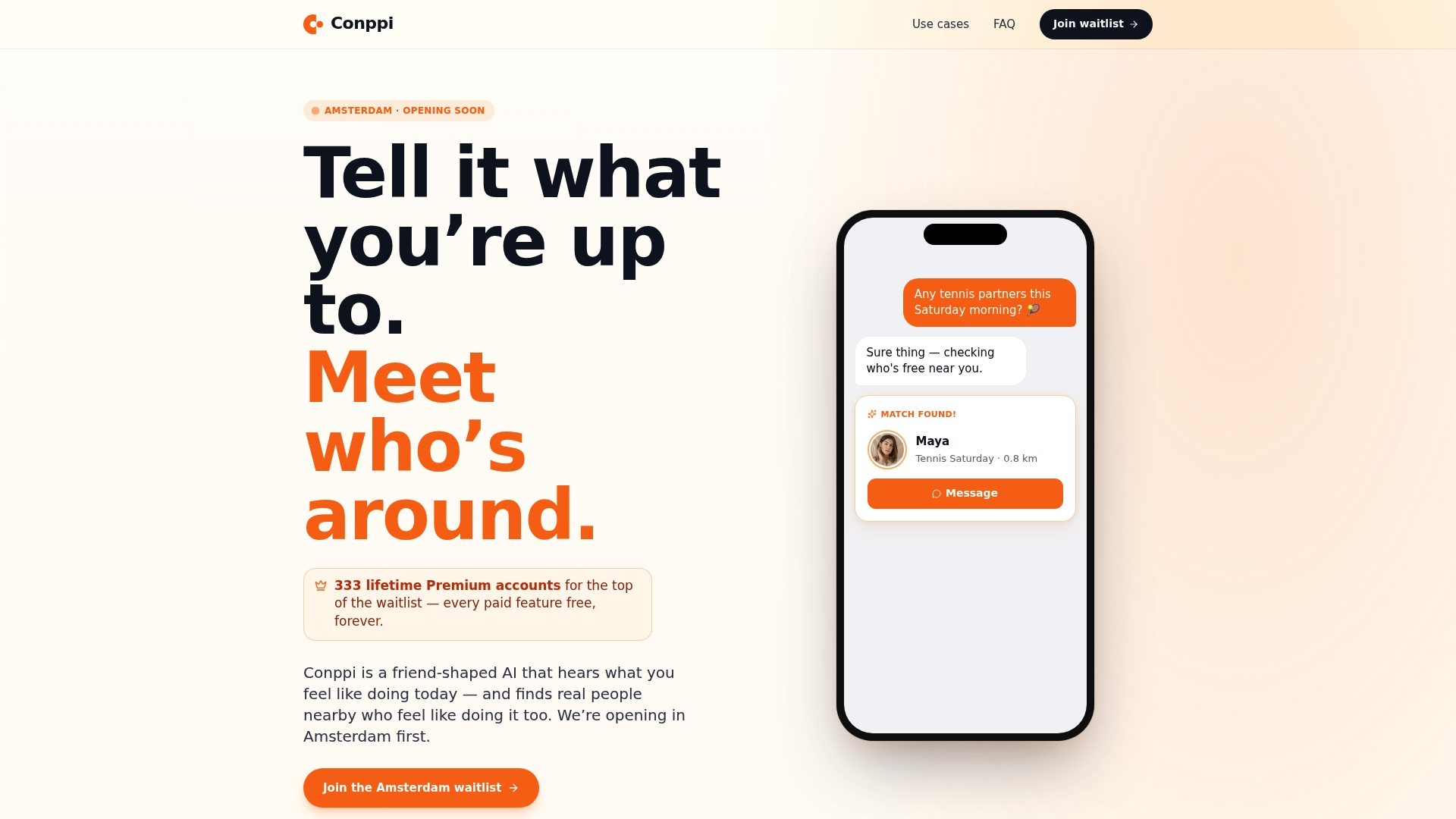
Scheduled events are good for structure, but they leave empty days. Conppi is an app for iOS and Android that matches you with people nearby for sports, coffee, coworking, language exchange or exploring the city, one-on-one or in a group, without profiles or swiping. See how it works on our activity partner app page, or read our guide to making friends in Amsterdam. The app is currently free to use.
Visiting rather than moving? Our page on meeting locals in Amsterdam while traveling covers that case, and our weekend meetups guide helps when you want plans within hours.
FAQ
Where do expats usually meet people in Amsterdam?
Most meet people through a mix of recurring social events, sports and hobby groups, workplaces and coworking spaces, and neighborhood activities. Monthly drinks nights are the most visible entry point, but friendships tend to form in groups that meet weekly. Try one of each type before deciding what suits you.
Are expat events in Amsterdam worth going to?
Yes, if you go in with a goal. They are useful for quick introductions and local tips, less so for deep friendships. Attend the same one a few times, talk to two or three people rather than everyone, and propose a specific follow-up.
How do I find a community if I do not know anyone?
Start with an interest and look for groups built around it, then add one neighborhood activity near your home. If your schedule is irregular, use an app that matches you for same-day activities. Within a few weeks you should recognize faces at two or three places.
Is loneliness normal for expats in the Netherlands?
It is common, especially in the first months, when routines and friendships are missing. Building local routines helps, and research suggests relying mainly on contact with home can add to homesickness. If it persists, speak to your GP or ask your municipality about Wmo support.
Do I need to speak Dutch to build a network in Amsterdam?
Not to get started, because many groups and events run in English. Learning some Dutch does open more local groups and neighbor relationships over time, so a language class is also a good place to meet people.
Sources
- Participate in Amsterdam | Activities in the area, Buurtteam Amsterdam
- Social network sites and acculturation of international sojourners, Erasmus University Rotterdam
- What assistance can I get at home from my municipality?, Government of the Netherlands
- Beleidskader sociale basis Amsterdam 2025-2030, City of Amsterdam
- Expat Groups and Clubs Directory, Expatica Netherlands