
Speed friending is speed dating with the romance taken out: you sit down with a stranger for a few minutes, talk, move on, and keep in touch with the people you clicked with. In Amsterdam, the format suits newcomers well, because everyone in the room is there to meet someone. The catch is that one evening gives you a handful of short chats, and friendships are built afterwards, by doing something together. That is why we think the best way to use speed friending is as a starting point, and to pair it with a way to find people nearby for a real activity this week. That is what Conppi is built for.
TL;DR
- Speed friending means short, rotating one-on-one conversations (usually a few minutes each) with a platonic goal, so there is no dating pressure.
- In Amsterdam, most listed rotation events are speed dating. Check that an evening is explicitly for friends before you book, and look at age bands, language and price.
- Realistic expectation: you are looking for one good friend or acquaintance, not 15 new ones.
- The friendship forms in the follow-up. Propose a concrete, low-key activity (a coffee, a padel game, a co-working morning) within a few days.
- Conppi is a free iOS and Android app that matches you with people nearby for activities, with no profiles and no swiping, so you can keep the momentum going.
Table of Contents
- What speed friending is, and how it differs from speed dating
- Why it makes sense in Amsterdam
- What an evening usually looks like
- How to find and choose an event in Amsterdam
- Making the evening work for you
- The follow-up is where friendship starts
- Other free ways to meet people around Amsterdam
- Who gets the most out of it
- Our perspective
- Keep the momentum with Conppi
- FAQ
- Sources
What speed friending is, and how it differs from speed dating
The mechanics are borrowed from speed dating. A host runs the clock, you talk to one person at a time, and a signal tells you to rotate. What changes is the purpose and the pressure. A Canadian organiser interviewed by CBC describes it as a low-stress alternative to speed dating, with themed tables and conversation starters, where the point is friend-making and anything more is a bonus rather than the goal.

The format also spares you the hardest part of meeting people, which is the opener. At one café event reported by NPR in March 2026, the host starts with a discussion question, each person answers for a minute, and then everyone switches tables. The rules are clear and the stakes are low, which is exactly what makes it easier than walking up to someone at a bar.
A few differences worth knowing:
| Speed dating | Speed friending | |
|---|---|---|
| Goal | Find a romantic match | Find friends or activity partners |
| Typical conversation | One-on-one, a few minutes | One-on-one or small themed tables, often with prompts |
| After the event | Mutual matches exchange contact details | You choose who to message, usually in person or via a group |
| Pressure | Higher: you are evaluating attraction | Lower: you are looking for shared interests |
For comparison, the Dutch rotation format is well established. One Amsterdam speed-dating organiser runs 15 to 20 one-on-one dates of four minutes each, with a bell for each rotation. Speed friending uses the same rhythm, with a friendlier brief.
Why it makes sense in Amsterdam
Amsterdam is a city of newcomers. Expats, students, remote workers and visitors arrive without a social circle, and the usual routes (work, school, sports clubs) take months to pay off. A format where everyone in the room is actively looking to meet someone removes the awkwardness of introducing yourself to strangers who might not want to be approached.
There is also a wider reason the idea is spreading. The NPR report places these events against what some researchers call a "friendship recession", and the café owner it quotes is realistic about the goal: one good friend or acquaintance, not a room full of new friends. Hold that expectation and an evening of short conversations becomes a success if it produces a single person you want to see again.
The founder of an early Halifax speed-friending night put it simply: it is quite hard to make new friends. A Dalhousie University researcher quoted in the same piece points out that friendships lack the cultural scripts that romantic relationships have, which is why reaching out can feel awkward. A structured evening gives you a script for the first meeting. You still need your own for the second.
What an evening usually looks like
Formats vary by organiser, but the pattern is consistent:
- Arrival and a name tag. You check in and are given a table or a number.
- Short rounds. Expect conversations of roughly four to ten minutes. The Halifax event gave 12 participants five minutes with everyone else over three hours, while the Washington café format uses one-minute answers at themed tables.
- A prompt for each round. A question on the card or from the host means nobody has to invent a topic.
- Rotation. A bell or the host signals the move.
- Mingling at the end. Many events finish with a free period so you can return to the people you clicked with.
Group sizes differ widely. Dating-style evenings in Amsterdam often gather 15 to 20 people, while larger singles nights list up to 70 attendees. For friend-making, a smaller room is easier: you will actually speak to everyone and remember names.
How to find and choose an event in Amsterdam
Search results for this topic in Amsterdam are dominated by speed dating: singles nights, themed dating evenings, age-banded sessions. Friend-focused evenings exist but are less frequent and tend to be run by community groups and language-exchange hosts. Before you register, check these things:
- Is it explicitly platonic? If the listing talks about singles, matches or "dates", it is a dating event. A friends event will say so.
- Age range. Many Amsterdam sessions are banded, for example 25 to 45 or 33 to 48. Make sure you fall inside the band, or choose an event with no limit.
- Language. Some evenings welcome both expats and Dutch people and run in English. Confirm the language of the evening in the listing.
- Price and what it includes. Dating-style evenings in the city are commonly priced in the range of €15 to €25 per person, and friend-focused evenings tend to be in the same region. Look at whether a drink is included.
- Group size and structure. Fewer than about 20 people with prompts per round is the sweet spot for shy first-timers.
- Venue and timing. A central café at a weekend afternoon or an early weeknight evening is easier to commit to than a late-night venue.
- Recurrence. A series is better than a one-off, because you can meet the same people again.
Schedules change constantly, so rely on the organiser's own listing for current dates rather than a blog post. If you are unsure whether a given evening suits you, message the host and ask who usually comes.
Making the evening work for you
A few habits make a big difference to what you take home.
Go in with a small goal. Aim to leave with two or three people you would genuinely like to see again. That is a very achievable target, and it fits the NPR café owner's "one good friend" mindset.
Use the prompt, then add one thing about your week. Prompts get you started. What makes you memorable is a specific detail: you are training for a half marathon, you just moved from Lisbon, you are looking for a padel partner on Thursdays.
Ask what they do on a normal weekend. It tells you quickly whether you would enjoy doing something together, and it hands you the idea for the follow-up.
Take notes. Right after each round, jot down a name and one detail on your phone. After ten conversations the names blur.
Do not rate people in the room. Unlike speed dating, nobody needs a verdict at the end of a round. Friendships often start with someone you did not think of as your type at first.
The follow-up is where friendship starts
The trouble with an evening of short conversations is the day after. You liked three people, you have their first names and a vague memory of what they said. A friendship needs a second meeting, and the second meeting needs a reason.
The simplest reason is an activity. Something with a fixed start and end is far easier to propose than "we should hang out":
- a Saturday morning coffee walk
- a one-hour tennis or padel rally
- a run along the Amstel
- a co-working morning in a café
- a language exchange over a drink
The shorter and more specific, the easier it is to say yes. This is also how you test whether you get along, without the weight of a whole evening.
If you did not get contact details from anyone, or you want to meet more people between events, this is where an activity app helps. Our guide to getting matched within hours for weekend meetups in Amsterdam shows how a same-weekend plan works, and the templates for same-day activity partners give you the messages to send so the first contact does not feel awkward.
Other free ways to meet people around Amsterdam
Speed friending is one route among several. Amsterdam's own neighbourhood teams list local activities for people who want company, including neighbourhood restaurants, coffee walk-ins, painting clubs, choirs, walking groups, yoga, mahjong and language or computer lessons. These are good for building a regular routine in your own district.
What they have in common is that you commit to a fixed time and place. If your week is irregular, because you work remotely, travel, or work shifts, you often need something more flexible: a partner who is free when you are. That is the gap real-time matching fills. If you prefer to avoid social feeds altogether, our piece on meeting people without social media in Amsterdam covers the options.

Who gets the most out of it
Expats and new arrivals. Pair one structured event with one app in your first week, as we lay out in pairing one meetup with one app in week one. For wider professional contacts, see where to start with expat networking.
Remote workers. Isolation sneaks up on people who work from a laptop. You can meet remote workers in Amsterdam tonight, or find people who want to co-work with you.
Sports partners. A short chat is enough to know whether someone plays at your level, but you still need to book a court. Skill-level filters help here.
Visitors. If you are in town for a few days, a scheduled evening may not fit your trip. You can meet locals in Amsterdam while visiting at short notice instead.
Our perspective
We built Conppi around a simple observation: the hardest part of making a friend is not the first conversation, it is the second one. Speed friending solves the first. It puts you in a room where everybody wants to talk, gives you a prompt, and removes the fear of rejection.
But an evening on the calendar only helps if your schedule matches the organiser's. Most people we want to reach are expats, remote workers and travellers whose weeks change constantly. They need something that works when they are free: a tennis partner tonight, a coffee on Sunday, someone to work alongside on a Wednesday morning.
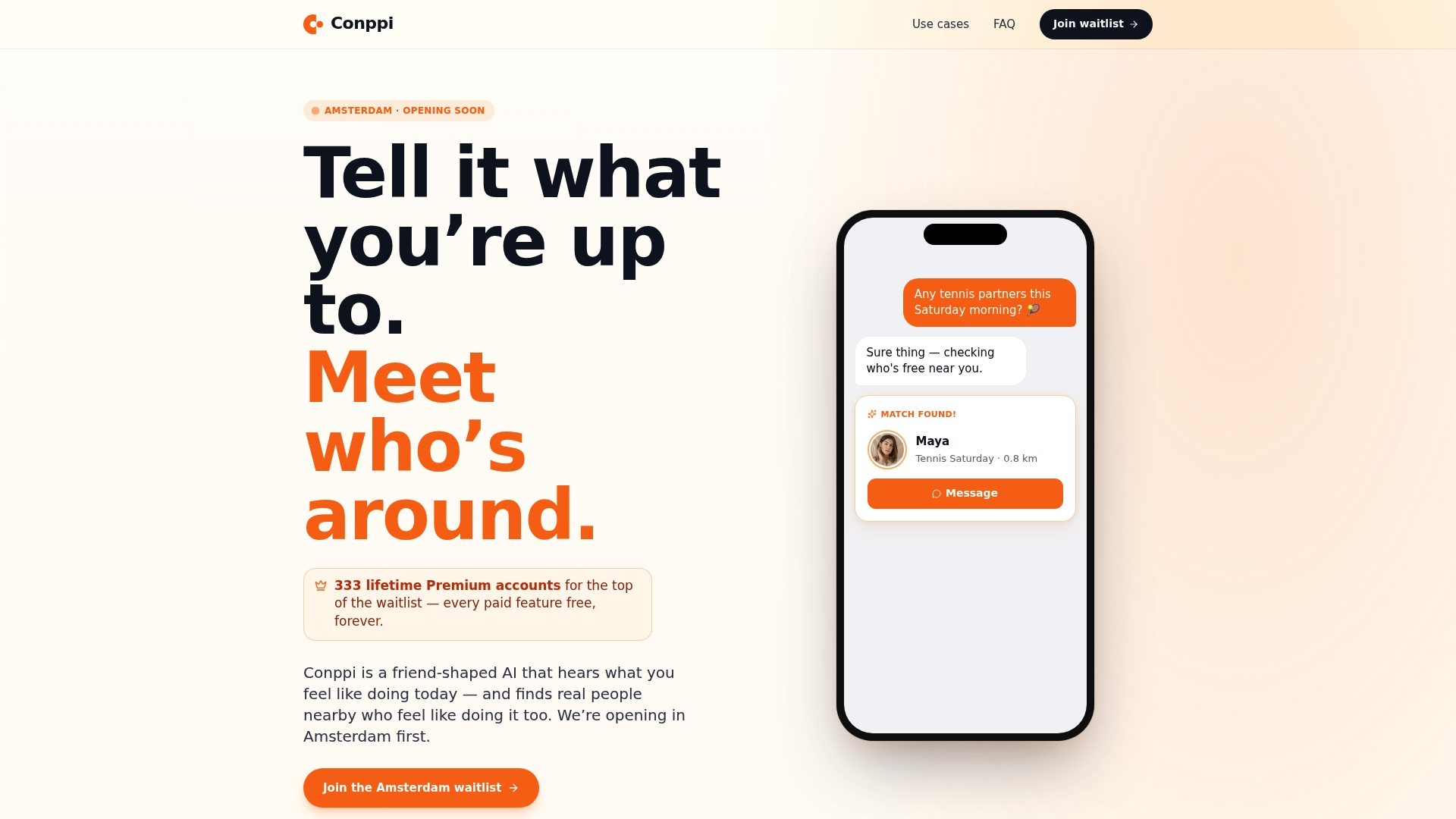
That is why Conppi matches people by activity and by who is nearby right now, without profiles or swiping. You choose what you want to do and when, and the app connects you with someone who wants the same. It shows only approximate distance, so you decide how much you share. We are opening in Amsterdam first because matching works best where there are many people nearby.
Our advice: go to a speed-friending evening if one appeals to you, collect a couple of names, and then turn them into a plan within three days. If you want more options between events, we made Conppi for exactly that.
Ilya
Keep the momentum with Conppi
Conppi is a free mobile app for iOS and Android that connects you with people nearby for sports (tennis, padel, gym, running, cycling, swimming), co-working, coffee meet-ups and language exchange. There are no profiles to build and no swiping: you pick an activity, set details such as time and skill level, and get matched with someone who wants the same. Only approximate distance is shared between users. You can read more about how we handle this in our note on approximate location privacy.
If you want a first coffee or workout lined up for this week, see the Conppi activity partner app, or start with our page on how to make friends in Amsterdam.
FAQ
Is speed friending only for people who are shy?
No. It suits anyone who wants to meet several people quickly, from newcomers to long-time residents widening their circle. Shy people often like it most, because the structure and the prompts mean you never have to approach a stranger.
How long is each conversation?
Usually between about four and ten minutes, though some formats use much shorter prompt rounds at themed tables. The Dutch speed-dating rotation, for comparison, uses four-minute rounds. Check the event listing for the exact format.
Can I go alone?
Yes, and that is the norm. Everyone arrives wanting to meet new people, so there is no need for a plus-one. Arriving alone also makes you more likely to talk to many people.
What should I do after the event?
Message the people you liked within a few days and suggest one specific, short activity, such as a coffee or a run. A concrete plan beats "we should meet up". If you want to line up more partners for the week, you can use Conppi to match with people nearby.
Sources
- CBC News: Move over, speed dating: speed friending (2025)
- NPR: Speed 'friending' events help platonic pals meet (2026)
- CBC News: Why more people in their 20s and 30s are choosing speed friending (2019)
- Speeddaten Amsterdam format
- Buurtteam Amsterdam: Participate in Amsterdam, activities in the area