
The fastest way to find a tennis doubles partner is to ask at your club, join open pickup sessions, and post a clear request in an activity app or local group. What keeps a partnership alive is a similar level, a shared schedule, and honest communication. Post one short request today, with your level and preferred times, or try a real-time matching app.
TL;DR:
- Before committing, check that you can rally together, agree on weekly availability and playing goals, and try one casual set to assess communication.
- Choose the serving order and middle coverage before play; the doubles court is 36 feet wide, compared with 27 feet for singles.
- Many Dutch national events replace a full third set with a match tiebreak to 10 points; check the event rules, especially for club play.
- Plan one weekly session each for patterns, serve and return placement, and match play; repeated short sessions help partners revisit practiced routines.
- When using a matching app, choose one that shows approximate distance rather than your exact location, and meet first at a public court.
Table of Contents
- Where can you meet a doubles partner this week?
- How do you choose a compatible doubles partner?
- Which doubles rules change how you pick roles?
- What should you agree on before and during a match?
- Which drills build doubles chemistry fastest?
- How do you handle mismatched skill levels?
- What are the best doubles strategies and positions?
- How do you keep a partnership healthy off the court?
- How can an activity app help you find a doubles partner?
- What are the usual challenges in doubles partnerships, and how do you fix them?
- Why doubles teaches patience
- Find your next doubles partner with Conppi
- FAQ
- Sources
Where can you meet a doubles partner this week?
Most partnerships start in ordinary places. Reporting on how doubles teams form points to friendships, club networks, and chance meetings on court as common starting points. So start where players already gather, and work down this list.
- Your club or team: Ask the captain or the coach directly, and post a short message on the noticeboard or team chat. Send it early in the week, well before fixtures, when people are still planning.
- Pickup sessions and open courts: Introduce yourself, say your level in one sentence, and ask whether a fourth is needed. Players who hit with you once and enjoyed it will often invite you back.
- Online groups and forums: Write a specific ad: your level, the days you can play, and whether you want social hits or league matches. Vague posts like "looking for a partner" get ignored.
- Activity apps: Matching apps filter by activity, skill, and time, which saves you from long message chains. We cover this in detail further down.
- Events and social mixers: A round-robin or club social turns a one-off hit into a familiar face. Seeing someone repeatedly can do more than meeting lots of people once.
If you want to know how many tries it usually takes, our guide on meeting people through sports walks through realistic expectations. Pick a couple of channels from this list and commit to them consistently.
How do you choose a compatible doubles partner?
Compatibility beats raw talent. Look at four things before you commit to regular play: level, role, schedule, and goals.
On level, you do not need identical games. Baseline compatibility means you can rally with each other without one person doing all the work. Complementary skills are a bonus: a steady returner pairs well with someone who likes finishing at the net.
Commitment matters just as much. Two strong players who cannot train together lose to a pair who practice weekly. Expert players often stress that consistent teamwork and joint practice decide doubles results more than two isolated strong individuals.
Use this short vetting script before scheduling anything regular:
- What level would you say you play at, and what are you working on?
- Which days and times can you commit to each week?
- Do you want social play, league matches, or tournaments?
- How do you like to handle mistakes during a match?
Pro Tip: Play one casual set together before you agree to anything. The way someone reacts to a lost point tells you more than any answer in a chat.
Scheduling is the quiet killer of partnerships. If your calendars clash constantly, these tips for coordinating busy schedules apply just as well to finding a weekly practice slot.
Which doubles rules change how you pick roles?
Rules shape tactics, so learn the few that matter. Under the ITF Rules of Tennis, the doubles team decides which partner serves first in a set, and the serving and receiving order then rotates through the set. Because the order is fixed once chosen, it is worth discussing deliberately.
- Who serves first: Let your stronger server open, unless your partner holds serve better under pressure early in a match.
- Court width: The same rules record a doubles court as 36 feet (10.97 m) wide, against 27 feet for singles. That extra width is why partners must cover lanes together instead of chasing everything alone.
- Receiving sides: Put the player with the more reliable return on the side where the big points usually land, and keep that choice consistent through the set.
- Third set: Many Dutch national events use a match tiebreak to 10 points in place of a full third set, per the KNLTB ranking tournament regulations. Club competitions are organized under the KNLTB competition regulations, so check which one your event follows.
A doubles court is 36 feet (10.97 m) wide, per the ITF Rules of Tennis. Agree on who covers the middle before the first serve.
A short tiebreak rewards partners who have already agreed on a plan, so settle roles before you walk on court.
What should you agree on before and during a match?
Good communication is mostly small and boring. Agree on a handful of things before the warmup ends, and then keep the talk during points to a minimum.
- Before the match: Settle who covers the middle, whether poaching is welcome, and the serving order.
- Signals: A closed or open fist behind the back is the classic way for the net player to tell the server about a poach. Pick one signal and stick with it.
- Between points: A short word like "switch," "mine," or "yours" beats a sentence. Keep your tone calm.
- Etiquette: Arrive on time, respect your partner's warmup, and give plenty of notice if you must cancel.
For feedback, use a quick debrief after each match. Our debrief guide suggests that each partner name something that worked and something to try next time, with no blame attached.
Pro Tip: Say what you want, not what went wrong. "Let's try me taking more lobs" lands much better than "you missed that lob."
Which drills build doubles chemistry fastest?
Chemistry comes from repeating the same patterns together until they feel automatic. Keep sessions short and focused.
- Serve plus volley: One partner serves while the other practices the first volley at the net, then swap roles.
- Return plus crosscourt: Return crosscourt on every point so your net partner knows where the ball is going.
- Poach and cover: In a small group, practice the net player crossing and the baseline player shifting to cover the vacated side.
- Tiebreak pressure: Play first to 10 points with a forfeit for the loser, so you rehearse staying calm.
A simple weekly plan: one session for patterns, one for serve and return placement, and one for match play. Several short sessions can be more useful than one long one because partners can revisit what they practiced recently.
How do you handle mismatched skill levels?
Uneven levels are normal, and they can work if both players treat the gap as a shared project. The stronger player's job is not to hit everything. It is to make the partner's job easier.
Start by giving the weaker player a clear, repeatable role. That might be returning crosscourt, holding the net on one side, or serving to a specific zone. Fewer decisions mean fewer errors and more confidence.
Next, protect the stronger player from frustration. Agree in advance that the aim of the session is a pattern, not the scoreboard. If you are the stronger player, resist coaching mid-point. Save observations for the debrief, and frame them as ideas to try together.
If you are the weaker player, ask for one specific thing, such as "tell me where you want my return." A direct request shows you are working with your partner, not apologizing for your level.
Finally, choose the format. A relaxed social set, a mixed-level round-robin, or a practice-focused hit all suit uneven pairs better than a competitive league match on day one. Move to more competitive play once your patterns hold under pressure. A gap in level shrinks quickly when two players commit to the same drills each week, and it matters far less than a gap in attitude.
What are the best doubles strategies and positions?
Good doubles is about moving as a unit. Think of the two of you as a single wall that slides across the court with each shot, keeping the middle closed and the lanes covered.
Start with the basic formation: one player at the net, one at the baseline, shifting to two up when you win the point's initiative. Getting both players forward puts pressure on the opponents, because they have less room to pass and must hit lower, riskier shots.
The middle is the most important area. A ball down the center can be taken by either player, which causes hesitation and errors. Agree on a simple rule: the player with the forehand takes the middle, or the net player takes everything they can reach. Whichever you choose, say it out loud before the match.

When you serve, aim at your opponent's weaker return and follow with a clear plan. A deep serve to the middle limits the angles available to the returner and lets your net partner anticipate. Your partner should know where the serve is going before you toss.
When you return, a crosscourt return to the server's feet keeps the ball low and gives your partner a predictable target. A lob over the net player is a useful change of pace, but use it sparingly so it stays a surprise.
Finally, move with the ball. If your partner is pulled wide, shift toward the center to cover the gap they left. That habit alone prevents many easy points from going to the opposition.
How do you keep a partnership healthy off the court?
A good partnership survives a bad Saturday because the two of you like each other. The off-court habits are what make losing bearable.
Be reliable first. Reply to messages quickly, confirm times, and give early notice if plans change. Reliability tells your partner you take the pairing seriously, and that builds trust faster than any shot.
Keep praise specific. "Your second serve has been great lately" lands better than a general "nice game." When something goes wrong, talk about the pattern, not the person, and do it away from the court once tempers have settled.
Share the logistics. Take turns booking courts, bringing balls, and choosing the post-match coffee spot. Small shared chores make the partnership feel like a team instead of a favor.
Do things that are not tennis. A coffee after practice or a walk before a tournament gives you a reason to know each other beyond the scoreboard. After an invitation to hit, a quick message the next day, like those covered in our guide to meeting people without swiping, keeps momentum going.
If your calendars fill up, use shared calendar invites for recurring sessions. Calendar integrations built for busy studios show how recurring bookings reduce missed sessions, and the same principle works for two players trying to protect a weekly slot.
Finally, agree on how to end things kindly. If the fit is not right, say so early and warmly. Most players would rather hear it early than stay in a pairing that quietly fades.
How can an activity app help you find a doubles partner?
An activity app solves the most common doubles problem: you know what you want, but you do not know who is free tonight. Instead of waiting for a lucky encounter at the club, you post what you need and see who nearby is looking for the same thing.
The useful part is the filtering. You set the activity, your level, and your time window, so everyone who responds already matches your basics. That cuts the back-and-forth that kills most partner searches before a ball is hit.
Here is a quick routine that works in any activity app:
- Write a one-line request with your level, the days you can play, and whether you want a casual hit or regular doubles.
- Check responses for a similar level and a schedule overlap.
- Use the vetting questions from earlier before agreeing to a regular slot.
- Meet in a public place such as a club court, and confirm the time the day before.
Privacy matters when you meet strangers. Look for apps that show only an approximate distance instead of your exact location, and that let you decide how much to share before you meet.
We built Conppi around this idea: spontaneous, interest-based matching for sports like tennis, padel, and running, without profiles to polish or swiping to endure. If you are in Amsterdam, our find a tennis partner page shows how that works for tennis specifically. Start small, with one hit, and let the partnership grow from there.
What are the usual challenges in doubles partnerships, and how do you fix them?
Most doubles problems fall into a few familiar categories, and each has a simple fix.
Schedule drift. Two people start with good intentions, then life gets busy. The fix is a recurring slot, even a short one. A fixed hour each week survives better than "let's play sometime."
Blame after errors. A missed volley turns into a sour mood. Agree before the match that comments about mistakes wait until the debrief. During points, use only encouraging or neutral words.
Unclear roles. If both players go for the same ball, or both leave it, you lose the point and the confidence. Settle who covers the middle and who takes lobs before the first game.
Mismatched goals. One player wants to win the league and the other wants a relaxed hit. Talk about this early, using the goals question from the vetting script, and be honest if the answers do not fit.
Pressure moments. Tiebreaks expose gaps in communication. Practice them in training, as described in the drills section, so the real thing feels familiar.
Losing streaks. Streaks happen. Review one thing to change, not five, and play a relaxed set afterward to remember why you enjoy it.
When a pairing stops working, treat it as information, not failure. Players change levels, move, and shift goals. A kind, direct conversation protects the friendship even when the partnership ends, and it leaves you free to find a better fit for both of you.

Why doubles teaches patience
Every lasting partnership I have seen grew from small, repeated actions: a message sent, a pickup session attended, a short drill booked for next week. Nobody finds a perfect partner in one afternoon. What builds a team is showing up again and saying clearly what you need and what you appreciate.
So pick one next step. Post your request once, join a pickup session, or book a short drill with someone you met. Then keep communicating, because honest, steady talk is the highest-return habit in doubles.
— Ilya
Find your next doubles partner with Conppi
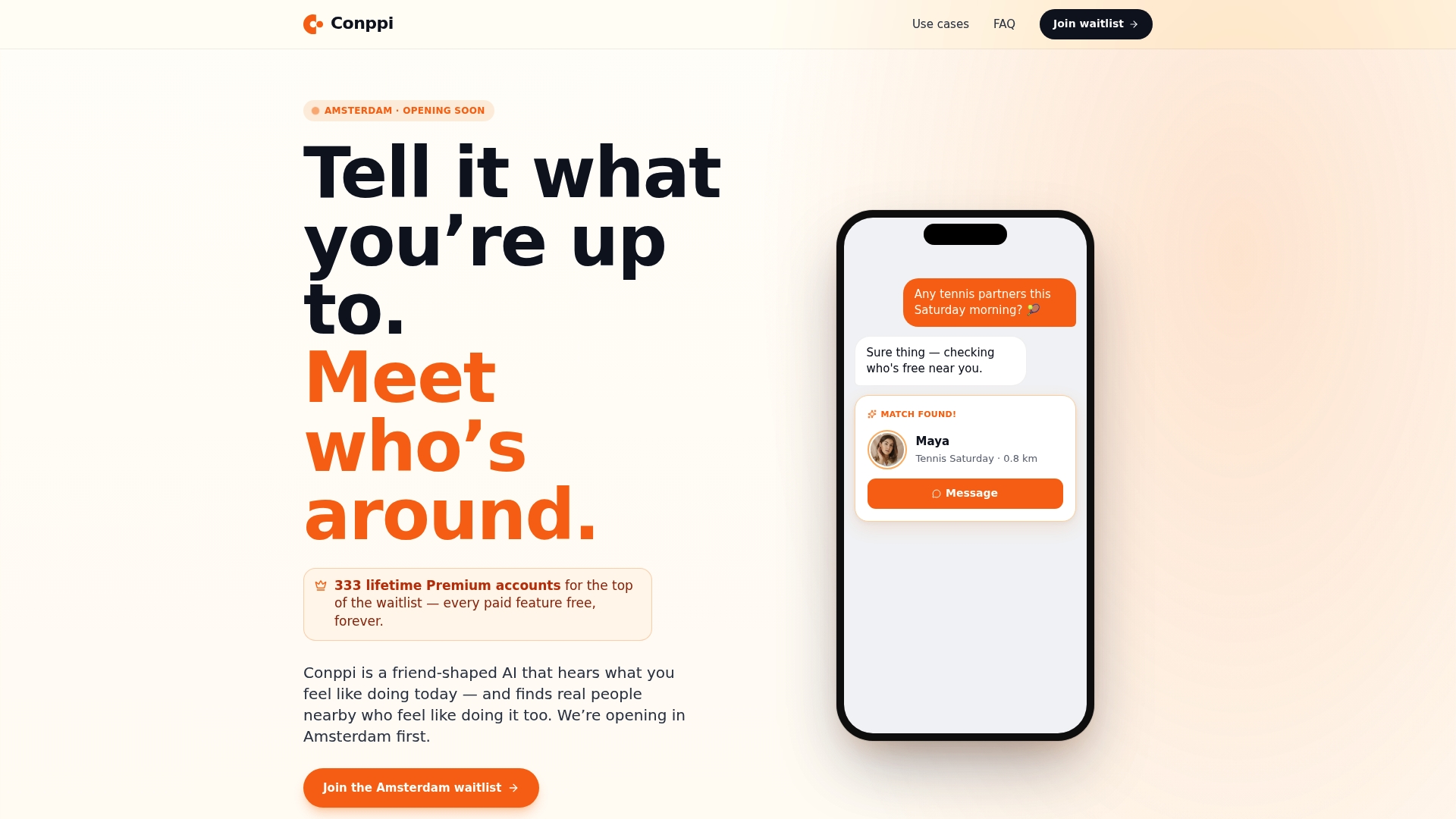
If you want a faster route than waiting for the right person at the club, our activity partner app is built for exactly that. We help you find people nearby who want the same activity, at a similar time and level.
- Activity-focused matching, not dating, for finding people interested in tennis.
- Filters for skill and time help you look for people who fit.
- Only approximate distance is shown, which keeps your privacy intact.
- Real-time meetups, so you can go from request to arranging a first hit.
Open the app and post a short request with your level and preferred times.
FAQ
Can you play doubles in tennis with any partner?
Yes, players can form a doubles team. The ITF Rules of Tennis let the team choose who serves first in a set, so partners can set their own roles. Events and leagues may add their own entry rules.
Are doubles harder than singles?
They are different, not simply harder. Doubles asks for less running but more coordination, communication, and net play. Many players find the teamwork aspect harder to master than the fitness side.
What is the best net position in tennis doubles?
The net player usually stands close to the net and a little toward the center, ready to cover the middle and poach when the chance appears. Agree with your partner who handles middle balls so neither of you hesitates. Adjust your spot based on where your server is aiming.
How do you ask someone to be your doubles partner?
Keep it short and low pressure: say your level, your available times, and offer a single casual set first. A one-set trial lets both of you check fit before committing. Follow up the next day to keep momentum.