
The quickest way to find a lunch buddy is to stop looking for "a friend" and look for one lunch: someone nearby, free at the same hour, happy to sit down for 45 minutes. In the Netherlands that usually means one of four routes: a recurring lunch group, a coworking space or workplace circle, a hobby club that eats together afterward, or a real-time activity app that matches you with someone close by today. This guide covers each route, what to say when you set up a first lunch, and how to keep it safe and low-pressure.
TL;DR
- Decide what you want first: a one-off lunch today, a weekly regular, or a group. The right route differs for each.
- Recurring groups and hobby clubs build lasting lunch habits. Real-time matching is faster when you want lunch this week, not next month.
- Agree on place, time, length and language in the first message, and say upfront that it is a one-hour lunch. That removes most awkwardness.
- Meet in a public place first, tell someone where you are, and keep a polite exit ready.
- If it is not a fit, cancel or reschedule early and kindly. A short, clear message beats silence.
Table of Contents
- Why lunch is the easiest first meeting
- Four ways to find a lunch buddy in the Netherlands
- Which route fits you
- What a good first lunch looks like
- Our perspective
- Using Conppi to set up a lunch
- Staying safe when you meet someone new
- When the plan changes or the match is not right
- Making it a habit
- Common worries, answered honestly
- FAQ
- Sources
Why lunch is the easiest first meeting
Lunch is the lowest-stakes social format there is. It has a natural end time, because everyone has an afternoon. It happens in daylight, in a public place, and it needs no big plan. Nobody has to commit to an evening or a weekend.
That suits the people who most often search for this: remote workers whose only conversation is with a laptop, expats a few weeks into a new city, students and freelancers between meetings, and anyone who moved for work and has colleagues but not yet friends. In the Netherlands there is an extra reason. Dutch lunch culture at work is often short and practical, so a deliberate, relaxed lunch with someone new has to be arranged rather than stumbled into.
The good news: a lunch buddy does not need to become a best friend. Many useful lunch buddies are people you see every second Thursday, and that is enough to make a week feel less solitary.
Four ways to find a lunch buddy in the Netherlands
1. Recurring lunch groups and social clubs
Meetup-style groups exist in every larger Dutch city for lunch, dining out and general socializing. Some are age-based, such as groups for people over 50 that meet for lunches around the city. Others are interest- or nationality-based. In Amsterdam, for example, the Amsterdam Expat Meetup Group is listed on the city's official portal as a social club that hosts regular dinners, drinks and karaoke nights, and it welcomes native Dutch people as well as expats.
What works: a fixed rhythm, a host who greets newcomers, and a group big enough that one missed week does not matter.
What to watch: many groups are evening-focused. If you want a weekday lunch, look at the event list before you join. Also expect to attend two or three times before faces become familiar. Most people who give up on groups do so after a single visit.
2. Coworking spaces and workplace circles
If you work remotely or freelance, the most natural lunch buddy is already in the building or in the next one. Coworking spaces in Amsterdam, Utrecht, Rotterdam and The Hague often run community lunches or have a shared kitchen where "do you want to grab a sandwich?" is a normal sentence. Day passes let you try a space without committing.
If you are specifically looking for English-speaking coworkers, our guide on finding English coworkers in Amsterdam shows how to do it within an hour. And if you want to see where remote workers gather after hours, there is a companion piece on meeting remote workers in Amsterdam.
3. Hobby clubs that end at a table
The reliable pattern in the Netherlands is that friendships form around a shared activity, and the activity usually ends at a café. A commentary on building a community as an expat in the Netherlands points to book clubs, cooking classes, photography groups and cycling groups as ways to meet people, and also to language classes and online communities tailored to your city, language or interests.
For lunch, the best candidates are daytime activities: a Saturday morning run or ride, a padel or tennis session, a swim, a weekday gym slot, a language exchange. The lunch is simply the second half of the activity. You already have something to talk about, and nobody has to carry the conversation.
4. Real-time matching with an activity app
Groups run on a schedule. Sometimes you want lunch today. That is where a real-time app helps: you say what you want to do and when, and you see people nearby who want the same thing right now.
The things to look for in an app like this are specific. Does it connect people for activities rather than for dating? Does it work without building a long profile or swiping through photos? Does it protect your location? Those three questions filter out most of the noise. Our article on skipping dating apps to find friends in weekly activities explains why the activity-first approach tends to feel less loaded.
Which route fits you
| Your situation | Best first move | Why |
|---|---|---|
| New to Amsterdam, want a regular crowd | Recurring social group or expat club | Familiar faces build over weeks |
| Work from home, want a midweek lunch | Coworking day pass or real-time app | Daytime availability matters most |
| Play a sport, want company afterward | Sport partner match, then lunch | The activity breaks the ice |
| Want to practice Dutch or English | Language exchange over lunch | Built-in topic, clear purpose |
| Travelling, want a local to eat with | Real-time app | No time to wait for a group event |
| Anxious about meeting strangers | Small group first, then one-on-one | Less pressure, easy exit |
What a good first lunch looks like
Most lunch meetups that go badly fail on logistics, not chemistry. Agree on these five things before you meet, ideally in writing.
Place and time
Pick somewhere public, central and easy for both of you, with a plan B if it is full. Name a start time and an end time: "12:30, I have to be back at my desk by 13:30." An end time makes it easier to say yes, and it makes it easier to leave.
Language
In the Netherlands, many people speak excellent English, but state it anyway. If you are hoping to practice Dutch, say so: "Can we speak half English, half Dutch?" is a friendly opener and a built-in topic.
Budget and who pays
Dutch norms lean towards everyone paying their own bill, and splitting is easy at most places. Say "separate bills is fine" and the question never comes up. It also makes clear this is not a date.
Dietary needs and venue
Mention vegetarian, halal, allergies or a preference for somewhere quiet. It takes ten seconds in a message and saves a cramped walk to a second venue.
Intent
Say what this is. "I'm new in town and looking for a regular weekday lunch" tells the other person whether you are a match. If you are looking for friendship only, say that as well. Clear intent is the main difference between a pleasant lunch and an uncomfortable one.
A message that covers everything might read: "Hi! I work near Amsterdam Centraal and I'm looking for a lunch buddy this week. Free Wednesday or Thursday at 12:30 for about an hour? Happy to meet at a café on the Spuistraat side and split the bill. I'm easy on cuisine."
Planning the logistics
If you and your lunch buddy both have messy schedules, the back-and-forth is where lunches die. A shared calendar habit helps. A piece on coordinating schedules ahead of time shows the same principle for shared households: lay out everyone's free windows first, then pick the overlap, rather than proposing times one at a time.
Our perspective
We built Conppi around a simple observation: people rarely lack the wish to meet someone, they lack a low-effort way to do it at the moment they are free. Lunch, coffee, a run, a padel court are all small things. Yet the usual tools make them heavy. Profiles to fill in, photos to judge, messages that go nowhere, or event calendars that fill up weeks ahead.

So we are building for spontaneous, interest-based matching. You choose the activity, the time and what you want, and you meet someone nearby who wants the same. We deliberately avoid dating mechanics, because the point is companionship, not chemistry. We also share only an approximate distance between people, never an exact location, because a stranger should not know where you are before you have decided to meet them.
We are opening in Amsterdam first for a practical reason: matching only works with density. A lunch buddy app with three people in your neighborhood is a disappointment. A city of expats, remote workers and students who are all looking for the same small thing is where it works. If you have ever eaten a sandwich alone at your desk and wished someone would ask you out for lunch, this is for you.
— Ilya
Using Conppi to set up a lunch
Conppi is a free iOS and Android app that matches you with people nearby for activities in real time, including coffee meet-ups, co-working, sport, language exchange and meeting locals while traveling. There is no swiping and no long profile. You set the activity and the time, use filters such as time and skill level, and arrange one-on-one or group plans.
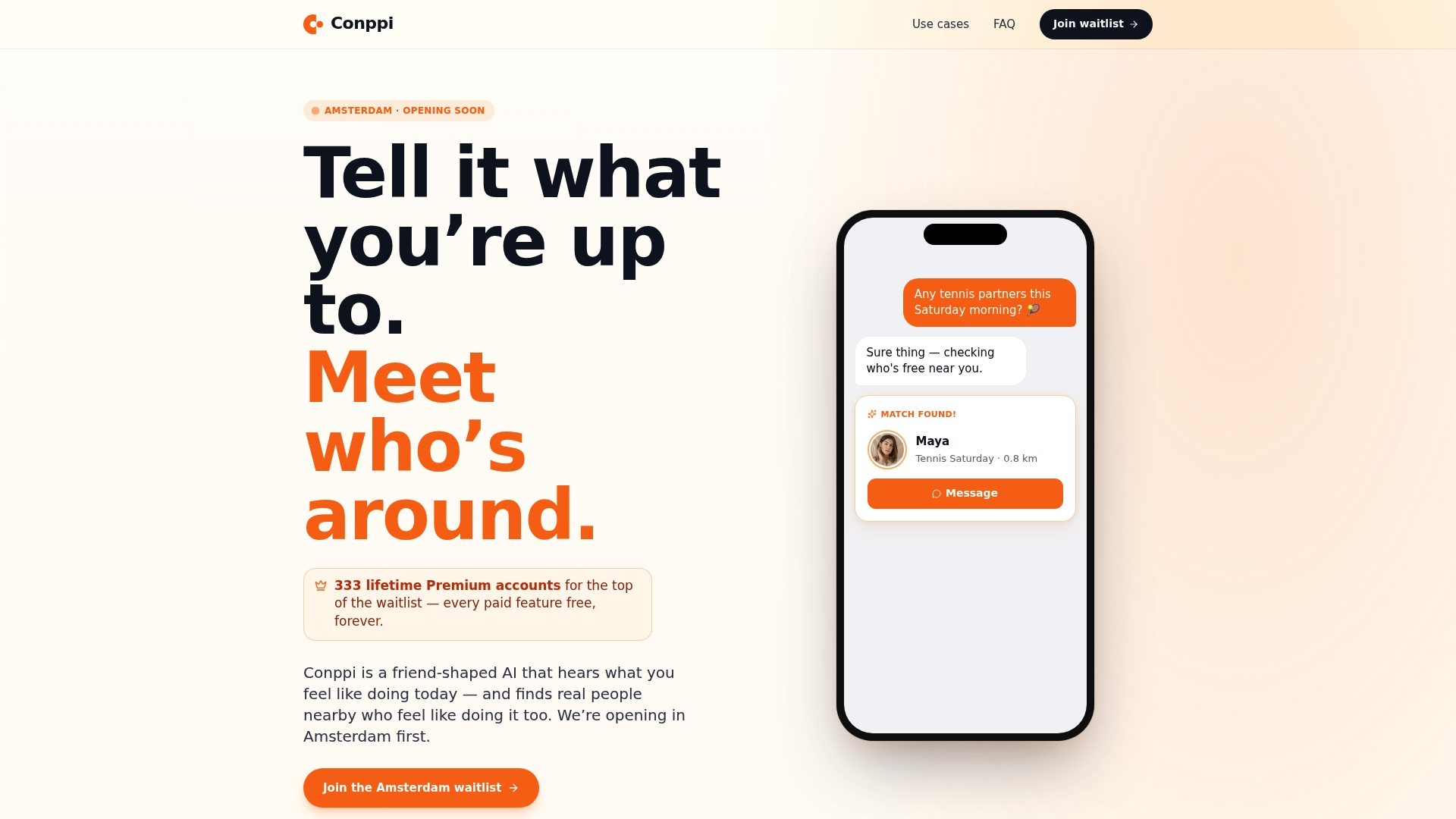
For a lunch buddy, the practical way to use it is to set up a midday plan, keep it short and public, and confirm the place with your match. You can see the activity partner app for how matching works and download it from there.
Staying safe when you meet someone new
A lunch is a good safety format, but a few habits apply every time. Ireland's police service, An Garda Síochána, advises that before meeting someone you have only talked to online you should ask for a face photo or a video call, tell a trusted friend, share your live location and meet in a public place first. The advice comes from Ireland, but it is general common sense that applies equally in an Amsterdam café.
In practice:
- Do a short video call or at least an exchange of voice messages before you meet. It confirms the person is who they say they are.
- Choose the venue yourself or agree on it together. Choose somewhere busy with staff present.
- Tell a friend the name of the place, the time and who you are meeting. Share your live location from your phone for the length of the lunch.
- Travel on your own to and from the lunch, rather than accepting a ride.
- Keep personal details light until you know the person: no home address, no workplace details beyond what is needed.
- Leave if it feels wrong. You do not owe anyone an explanation beyond "I have to go."
If anything seriously worrying happens, contact the Dutch police. In an emergency, call 112.
When the plan changes or the match is not right
Plans change. The kind thing is to say so early. In Dutch there are two verbs worth knowing: verzetten means to reschedule something that will still happen, afzeggen means to cancel it. Using the right one in a message makes your intention clear: "Kunnen we de lunch verzetten naar donderdag?" is a friendly reschedule, "Ik moet helaas afzeggen" is a clean cancellation.
To suggest a meeting in Dutch, the same guide recommends "Zullen we afspreken?" and asking whether a time suits with "Past het?". Even if your lunch buddy speaks English, a little Dutch usually lands well.
If the lunch went fine but you did not click, you do not have to continue. A short message works: "It was nice meeting you, I don't think we're the best lunch match, but I wish you a great week." Honesty with a friendly tone beats ghosting. If the match was a group and the group was not for you, leave quietly and try another. Groups differ widely in tone, and the first one you try is not the only one.

Making it a habit
One lunch is an event. Three is the start of a habit. A few ways to move from one to the other:
- Propose the next one before you leave. "Same time next week?" is easy to answer while you are still smiling.
- Fix a rhythm. Every second Wednesday at 12:30 is easier to keep than "let's do this again sometime."
- Rotate the venue. Let each person pick, so you discover new places in the city together.
- Widen the circle. After two or three lunches, invite another person. Our guide to group activities in the Netherlands has ideas for turning a pair into a small group.
- Combine with another meetup. The guide on pairing one meetup with one app in your first week works well for expats arriving in Amsterdam.
If you prefer to stay spontaneous, a one-line invitation is often enough. Our ideas for spontaneous meetups in the Netherlands show what such short invites look like, and instant meetups near you covers how to meet people the same day. If you would rather not rely on social media for any of this, read about meeting people without social media in Amsterdam.
Common worries, answered honestly
"It feels awkward to ask a stranger to lunch."
It is, a little, for about thirty seconds. After that it is just lunch. Using a platform where everyone has signed up to meet someone removes the hardest part: you already know the other person wants to meet.
"I don't speak Dutch."
In Amsterdam and the other big cities, English works almost everywhere in daily life. Learning a few phrases is a courtesy and a conversation starter, not a requirement.
"What if we run out of things to say?"
Pick a lunch with a built-in topic: a sport you both play, a neighborhood you both just moved to, a language you are both practicing. A one-hour limit means a quiet patch is never long.
"What if it turns out to be something romantic?"
Say what you are looking for in the first message. Keeping it to friendship, activities and companionship is the whole point of an activity-based approach, and an honest sentence at the start keeps it clear.
FAQ
How do I find a lunch buddy near me in Amsterdam?
Start with a recurring group or coworking space for a steady crowd, or use a real-time activity app when you want lunch this week. Whichever route you choose, name the day, a one-hour window and a public place in your first message. Expect to try two or three times before it clicks.
Is it safe to meet a stranger for lunch?
It can be, if you take sensible steps. Do a short video call first, meet in a busy public place, tell a friend where you are and share your live location. Leave if you feel uncomfortable. Lunch in daylight is among the safest formats for a first meeting.
Should I split the bill with a lunch buddy?
In the Netherlands, paying your own share is the common default, and most cafés handle separate bills easily. Suggest it when you arrange the lunch. It keeps things simple and makes clear that the lunch is a friendly meetup.
What do I do if my lunch buddy cancels?
Write back without fuss and offer a new slot if you want to keep going. If the other person has been unreliable twice, you can let it go and look for someone else. Reschedule once, then move on.
Can I find a lunch buddy if I do not speak Dutch?
Yes. Many groups in Dutch cities run in English, and expat clubs, coworking communities and language exchanges are built for international people. Say your language preference upfront so the match is right from the first lunch.
Sources
- Amsterdam Expat Meetup Group, I amsterdam
- Building new connections as an expat in the Netherlands, Dispatches Europe
- Safety advice for meeting people online, An Garda Síochána
- Appointments and scheduling, Dutch grammar, Elon.io