
A lunch break meetup is a short, daytime plan to eat, talk or move with someone nearby, and the best ones are built around a hard time limit. In Amsterdam that means picking a person and a place within a few minutes of where you already are, agreeing an end time, and doing one simple thing together. We built Conppi for exactly this: you say what you want to do and when, and it finds people close by who want the same, with no profiles to browse and no swiping.
This guide covers what a lunch break meetup is, how to make it fit a real midday window, which activities suit friends, sports partners and coworking company, and what to sort out before you meet a stranger.
TL;DR
- A lunch break meetup is a one-hour-ish daytime plan, usually between 12:00 and 14:00, built around food, a walk, a game or a workout.
- Time is the constraint: a Dutch study found people had about 30 minutes in total for lunch, so stay within roughly a five-minute trip.
- Pick one activity, one place and one end time before you meet. Dutch culture rewards punctuality and a clear plan.
- Meet in public, tell someone where you are going and use your own transport.
- Conppi matches you with people nearby for real-time activities such as coffee, co-working, running or padel, and only shows approximate distance.
Table of Contents
- What a lunch break meetup actually is
- Why midday suits people who are new in the city
- Making it fit a real lunch break
- Lunch break activities that work, by what you want
- Talking across backgrounds and language levels
- Before you meet: timing, cost and safety
- A simple routine for your first lunch meetup
- Our perspective
- Find your lunch companion with Conppi
- FAQ
- Sources
What a lunch break meetup actually is
The format is older than any app. The Dutch networking organisation MYN describes a lunchnetwerk as a low-threshold gathering around lunchtime: roughly 12:00 to 14:00, one to one and a half hours, with a light meal, a seat next to members or other guests and often a short round of introductions. It is aimed at people who would rather not go out in the evening.
That description fits far more than professional networking. The same slot works for:
- a coffee and a sandwich with someone new
- a walk or a run along the canal
- a quick game of table tennis, tennis or padel
- a shared work session at a café followed by lunch
- a language exchange over soup
What these have in common is the shape: short, public, specific and easy to say yes to. The time limit is not a weakness. It lowers the stakes for both people, because nobody is committing an evening or a weekend to a stranger. If it goes well, you plan a second one.
Why midday suits people who are new in the city
If you are an expat, a remote worker or a traveler, evenings in Amsterdam are crowded with drinks and events, and they take energy. A lunch slot asks less. You are already awake, already nearby and already planning to eat.
It also fits the Dutch calendar. The Leiden International Centre explains that the Dutch are very time-conscious and punctual, even for casual appointments, and that even lunch with a Dutch friend may need planning days or weeks ahead. A clearly bounded one-hour plan is easier to fit into a full agenda than an open-ended invitation, which is why it often works better than "let's hang out sometime."
For people feeling lonely, the format has another advantage: it repeats. A Tuesday lunch walk with the same person or small group builds a habit faster than one big night out.
Making it fit a real lunch break
The biggest reason lunch plans fail is arithmetic. A peer-reviewed Dutch study, The 5-Minute Campus (Jansz, Mobach and van Dijk, 2023), found that participants had only about 30 minutes in total for lunch, including ordering, waiting and eating, and recommended keeping lunch facilities within roughly a five-minute trip.
Your break may be longer, but the lesson holds. Count everything before you suggest a plan:
- Travel there. Keep it to five to ten minutes on foot or by bike.
- Ordering and waiting. Choose a place with quick service, or one where you can order ahead.
- Eating and talking. Give this at least 30 minutes if you want a real conversation.
- Paying and the trip back. People forget these, and they are the reason meetings run late.
Use a real schedule
A useful template comes from Cycle-Up HUB's guide to organising a lunch lecture: arrive and eat at 12:00, welcome at 12:15, a talk of at most 30 minutes, questions at 12:50 and finish at 13:00. The guide stresses starting and ending on time because guests often have appointments at 13:00. You do not need a talk, but the rhythm works for two people too: ten minutes to settle, thirty to talk or play, ten to wrap up.

Agree the end time out loud
Amsterdam café-restaurant De Bazel makes the same point in a post about planning business lunches: service duration cannot be guaranteed, so say when you are arriving and agree a hard end time in advance. A meeting that ends when the food is done is very different from one where everyone must leave at 13:00. Saying "I have until 13:00" at the start is polite, not rude, and in the Netherlands it is expected.
Confirm the day before
Propose a time within the usual 12:00 to 14:00 window, offer an alternative, and send a short confirmation a day or two ahead. A one-line message with the place and the end time is enough.
Lunch break activities that work, by what you want
The right activity depends on who you hope to meet. Here is how we think about it.
If you want a friend
Pick something with a built-in topic so the conversation does not depend on small talk. Lunch.nl lists casual lunch-break activities such as a pub quiz, riddles, games that finish within half an hour, or ordering a shared lunch once a week. Translated to two or three strangers: bring a short game, share a plate or walk a fixed loop and talk about what each of you misses and likes about the city.
If you want a sports partner
A full match will not fit into a lunch break, but a rally, a short run or a swim will. Tennis, padel, gym sessions, running, cycling and swimming all work in 45 minutes if the court or route is close. State your skill level up front so nobody is bored or out of their depth.

If you work remotely
The lunch break is the natural hinge of a co-working day. Work side by side in the morning, eat together and split up, or meet for lunch and work afterwards. Our guides on coworking cafés in Amsterdam and silent coworking meetups show how the format runs, and finding people to co-work with in Amsterdam is the quickest way to get a companion for the same afternoon. Spaces for tech workers often run lunchtime games and community gatherings too, and the idea of community gatherings and networking built around shared interests is a good model for what you can organise yourself.
If you are traveling
A lunch with a local is the most compact way to see a city through someone else's eyes. Ask them where they eat on a normal workday, not where tourists go. It costs one hour and gives you better tips than a guidebook.
If you want to widen your professional circle
A lunch is gentler than an evening networking event. Our page on networking in Amsterdam explains how to meet people in your field, and the guide to finding a lunch buddy in Amsterdam and the Netherlands goes through the practical steps for a first meal together.
Talking across backgrounds and language levels
In Amsterdam, a lunch table often mixes Dutch speakers, long-term expats and people who arrived last week. A few habits make it easy:
- Start with the food or the place. It gives everyone something to comment on, whatever their English level.
- Keep sentences short and ask open questions. "What did you cook growing up?" beats "What do you do?"
- Use themed lunches. A lunch where everyone picks a dish from their home country turns into a conversation about culture, an approach commonly described for lunch groups that aim for inclusivity.
- Share a task. Walking, playing or working side by side lowers the pressure to talk constantly.
If you want to practice Dutch or English, say so when you propose the meetup. Most people are glad to help with a one-hour language exchange, especially when the plan is clear.
Before you meet: timing, cost and safety
Meeting someone new is easy to do well if you cover a few basics.
Choose the place carefully
IntiemComfort recommends a public place where conversation is possible, a specific café with a recognisable meeting point, a short plan such as coffee with about an hour available, and a check on prices beforehand without assuming who pays. For group lunches, pick somewhere with low noise and a low-cost menu, and check that it can take a table at the time you want.
Keep yourself safe
The Dutch site DatingAssistent lists safety rules for a first in-person meeting that apply just as well to a friendship or activity meetup:
- Tell a friend or family member the person's name, the venue's name and address, and when you expect to be back, then send a check-in message afterwards.
- Choose a busy public place such as a café, restaurant, park or market, never a private home.
- Travel there and back on your own.
- Share your live location with someone you trust.
- Do not give your home or work address before you have met.
These steps cost nothing and take two minutes. If anything feels wrong during the meeting, leave. A short lunch plan makes that easy because you already have a reason to go.
Settle money simply
Split the bill or pay for your own, and say so early. Choosing a place where separate checks are normal removes the awkwardness.
A simple routine for your first lunch meetup
- Choose the activity. Coffee and a sandwich, a short run, a rally on the court, a co-working hour.
- Choose the slot. Something between 12:00 and 14:00, with an end time you both state.
- Choose the place. Public, close to both of you, quick to order from. Walking time under ten minutes each.
- Confirm. A message a day before, and another when you are on your way.
- Finish on time. End warmly at the agreed time and, if it went well, suggest the same slot next week. That is how a first lunch becomes a regular one.
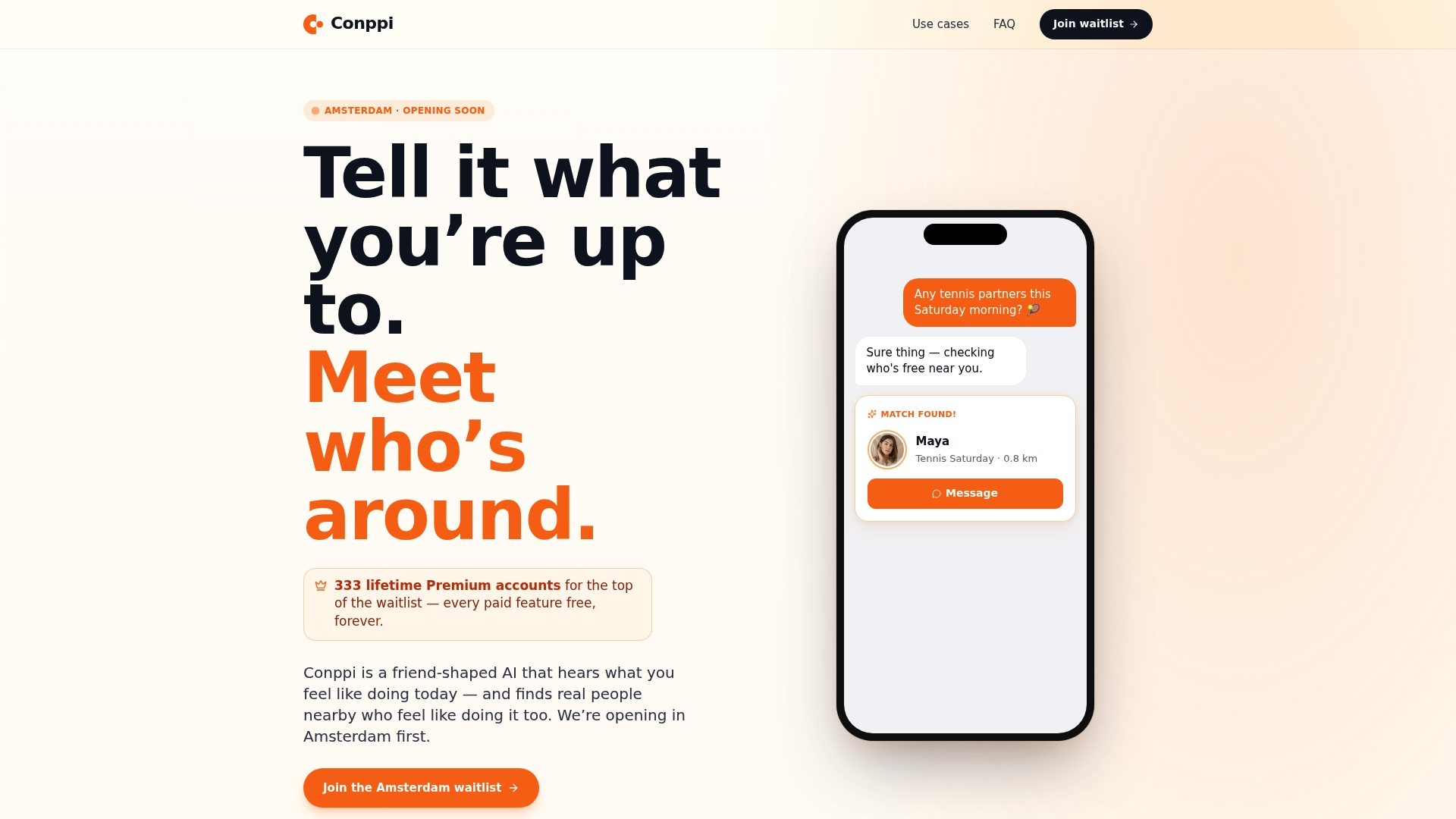
Step one to three is where most of the effort goes: finding someone who wants the same thing, at the same time, nearby. That is the part Conppi takes on. You pick the activity and the time, and the app shows people close to you who are looking for the same, so you are not messaging strangers in a group chat hoping someone replies.
Our perspective
Most people do not lack the wish to meet someone for lunch. They lack a person who is free at 12:30, within ten minutes, and happy with the same plan. Calendars and group chats are bad at that kind of spontaneity.
That is why we started Conppi in Amsterdam, where density makes real-time matching possible. You do not build a profile or swipe through faces. You say what you want to do, such as coffee, a padel rally, a co-working hour or a language exchange, and you see people nearby who want the same. The app only shows approximate distance, so your exact location stays yours.
We built it around activities, not dating, because a shared plan is the easiest way to start a real connection. A one-hour lunch with a clear end time is exactly that: small enough to say yes to, structured enough to feel safe, and repeatable until it becomes a habit.
Ilya
Find your lunch companion with Conppi
Conppi is a mobile app for iOS and Android that matches you with people nearby for activities in real time, from coffee and co-working to tennis, padel, running, cycling and swimming. You can use activity-specific filters such as time and skill level, and organise one-on-one or group plans. If a coffee-length lunch is what you want, start with meeting someone for coffee in Amsterdam, or see the full activity partner app.
If you would rather go in the evening, there is also a page for finding people to grab a drink or borrel with.
FAQ
How long should a lunch break meetup last?
Aim for 45 to 60 minutes door to door. Research from the Netherlands found people had about 30 minutes in total for lunch once ordering and waiting were counted, so a plan that fits that window will fit most schedules. Say your end time at the start.
Where is the best place to meet?
Choose a public, busy spot close to where both of you already are, with quick service and low noise. A café or a market stall near the office or your coworking space works well. Agree the exact spot in advance so you can find each other quickly.
Is it safe to meet someone new for lunch?
It can be, with sensible habits. Meet in a public place, tell a friend who you are meeting and where, use your own transport and share your live location with someone you trust. Do not give out your home or work address before you have met.
Can I do a lunch break meetup if I do not speak Dutch?
Yes. Amsterdam has a large international community, and many lunch plans happen in English. Pick an activity with something to look at or do, keep your sentences simple, and mention at the start if you want to practice a language.
What if I only want to do something active, not just eat?
A short run, a gym session, a swim or a quick rally fits into a lunch hour if the location is close. State your skill level when you propose it, and agree a finish time that leaves you a few minutes to shower and get back.
Sources
- Lunchnetwerk uitleg | MYN
- How to Meet Up and Socialize | Leiden International Centre
- The 5-Minute Campus
- Kennissessie of lunchlezing organiseren | Cycle-Up HUB
- Zakelijke lunch in Amsterdam: plannen rond je afspraak | De Bazel
- De leukste activiteiten voor in je pauze | Lunch.nl
- What Is A Lunch Bunch
- Your first meeting after an online connection | IntiemComfort
- Veilig daten: 10 regels voor je eerste ontmoeting | DatingAssistent
- The Lekker Network | Joburgstyle Online