
A silent coworking meetup is a small group session where everyone works on their own task in the same place, with talking kept to a short hello at the start and a short check-in at the end. You get the focus of a quiet room and the company of other people, without the small talk. In Amsterdam you can join one through a coworking space or a meetup group, or you can set one up in minutes with someone nearby through Conppi, which matches people who want to work alongside each other in real time.
TL;DR
- A silent coworking meetup is shared, quiet work time: a short intention at the start, a long silent stretch, a short check-in at the end.
- The rituals at the start and end are what make it feel different from sitting alone in a café, not the silence itself.
- Agree three things beforehand: where, how long, and what counts as an interruption. One message is enough.
- In Amsterdam, formats range from open coworking days to small pairs at a café table. Pairs or groups of three to five are the easiest way for newcomers to start.
- With Conppi you can find a nearby co-working partner without a profile or swiping, and without sharing more than your approximate distance.
Table of Contents
- What a silent coworking meetup actually is
- What usually happens in the room
- Formats you will find in Amsterdam
- How to agree on venue, length and quiet rules
- Etiquette that keeps the room quiet
- What to bring, and what to do before and after
- Why a silent meetup suits newcomers and introverts
- Using a partner to stay on task
- Find or start one with Conppi
- Our perspective
- FAQ
- Sources
What a silent coworking meetup actually is
The idea is simple. You bring your own laptop and your own task. Other people do the same. Nobody pitches, networks or chats through the work period. The group's presence does the job that a deadline or a manager normally would: it makes focus feel like the normal thing happening in the room.
It differs from a regular coworking day in one way. At a normal coworking space people share a desk area but do not share a start, an end or a goal. In a silent meetup the group begins together, works together and closes together. Remote work practitioner Tom McCallum describes the difference as coming from the bookends: a short welcome where each person sets an intention, a block of quiet work, and a short check-back. His format is about 5 minutes of welcome, 50 minutes of silence and 5 minutes of check-back. Even if nobody talks during the work, the shared start and finish create a feeling of collective focus.

This is also why it works for people who are not in an office every day. If you work from home several days a week, the missing ingredient is often not a desk but other people. Our piece on remote work loneliness covers that in more detail, and a silent session is one of the lowest-effort fixes: you do not have to be sociable, you only have to show up.
What usually happens in the room
Most sessions follow the same shape, whether they are held in a coworking lounge, a café or a borrowed meeting room. Exact formats differ from host to host, so treat this as the typical pattern rather than a rule.
- Arrival and settling in (a few minutes). You find a seat, open your laptop and put your phone away. Quiet greetings are fine.
- Intentions (2 to 5 minutes). Each person says in one sentence what they will finish. "Draft the first page of the report" is better than "work on the report". Saying it aloud, even to strangers, makes it harder to drift.
- Silent work (25 to 50 minutes). Headphones are normal. If a distraction pops into your head, write it down and return to the task. Questions wait until the end unless something is urgent.
- Check-out (3 to 5 minutes). Each person says what got done. This is where most of the social contact happens, and it is short on purpose.
- Optional coffee afterwards. Many groups stay for a drink. Nobody has to.
If you have never done this, start with a shorter block. Half an hour of real quiet is more useful than two hours of half-attention, and you can lengthen the block once the group is comfortable.
Formats you will find in Amsterdam
Amsterdam has a deep coworking culture, so silent work shows up in several forms.
Open coworking days and community events. Some coworking spaces host community days and networking events for the wider public. A coworking space may also organize its own coworking days. One Amsterdam office, for instance, lets a member propose a working day, has an admin confirm it, and then curates the guest list from RSVP requests. That pattern, someone proposes, a small group confirms, is the natural shape of a good silent session.
Meetup-style groups. Large event platforms list recurring coworking sessions in the city. They are good for regular slots, but groups can be big and the quiet rules are set by whoever hosts.
Borrels and after-work events. The Dutch borrel is an informal drinks gathering, usually 17:00 to 19:00, and sector borrels are often organized by professional associations or coworking spaces. A borrel is the social counterpart to a silent session. Many people do a quiet work block first and go to the drinks afterwards.
Café sessions with one or two others. The simplest format needs no venue booking at all. You meet at a laptop-friendly café and work for 45 minutes. Our guide to coworking cafés in Amsterdam lists where a laptop is welcome, and coworking versus a coffee shop helps you match the task to the place.
If you want to compare styles of coworking meetups and pick the one that suits how you work, see matching your work style with Amsterdam coworking meetups.

How to agree on venue, length and quiet rules
The awkward part of a silent session is not the silence. It is the five minutes before, when nobody has said what the rules are. A short working agreement solves it. Scrum.org's guidance on facilitation recommends an explicit agreement with the group covering timings, breaks, technology and engagement, and asking the group's permission before you lead. You do not need a formal document. You need three answers:
- Where. A café with power sockets and Wi-Fi, a coworking lounge, or someone's living room. Decide who brings what.
- How long. 30, 45 or 60 minutes of silent work, plus five minutes at each end.
- What counts as an interruption. Agree a short list: a fire alarm, a delivery for the host, a real emergency. Everything else waits.
To keep it low pressure, write the invitation as an offer rather than a commitment. Something like this works well: "I'm doing 45 minutes of quiet work at a café near Oosterpark this afternoon. Want to join? One goal each, no chatting until the end." It names a place, a length and the rule, and it is easy to say yes or no to.
For a first meeting with a stranger, keep the block short, choose a public place and tell someone where you are going. That is ordinary good sense for meeting anyone new.
Etiquette that keeps the room quiet
Amsterdam's coworking spaces publish their own house rules, and they agree on the basics. The Social Hub's Amsterdam CityHouse rules ask members to respect that some people need silence and privacy and to move long or noisy conversations to phone booths or booked meeting rooms. The Dutch coworking community Baseline asks members to keep volume low in open areas, use headphones for calls and media, take longer conversations elsewhere, and respect other people's work and confidentiality.
Translated into a silent meetup:
- Arrive on time. Walking in ten minutes late breaks the shared start that makes the format work.
- Silence your phone and your laptop notifications before the intentions round.
- Use headphones for anything with sound, and keep calls for later or for a booth.
- Do not look at other people's screens. Confidentiality is part of the deal.
- If you must speak, whisper once and keep it short. If it will take longer, leave the room.
- Keep the check-out short. Others may want to say their piece too.
- Ask before starting a long conversation afterwards. Not everyone has time.
Our longer list of coworking etiquette rules, with scripts for booking and guests gives you wording for the situations that feel awkward, such as asking a neighbor to lower their voice.
What to bring, and what to do before and after
Before. Choose one task that fits the length of the block. Close tabs and files you will not need. Charge your laptop, pack headphones, and bring water. Write your one-sentence goal on paper so you can say it without thinking.
During. Work on that single task. Keep a scrap of paper beside you for stray thoughts such as "reply to Anna" or "book the train", and return to the main task. Resist checking messages. If you finish early, take the next item on your list rather than starting a conversation.
After. Say what you finished. If the group clicked, suggest the next date there and then. A recurring slot, the same time each week, does more for your focus and your social life than any one-off event.
If you want a social layer without turning the session into networking, the Amsterdam coworking space A'DAM.works suggests that connections come naturally over coffee, in the lounge, or at shared tables, starting with a question about someone's project rather than "So, what do you do?". The same applies after a silent block: ask what they were working on.
Why a silent meetup suits newcomers and introverts
If you have just arrived in Amsterdam, a silent session is one of the easiest social situations to enter. There is a clear structure, a clear end and a built-in topic of conversation: the work you each just did. Expat NL Hub notes that the Dutch networking style is direct and purposeful, which suits people who prefer fewer but more substantive conversations to performative socializing, and it advises arriving early, when it is easiest to join in.
For travelers working remotely for a week or two, the format has another advantage: you can drop in, get real work done and meet locals without committing to anything. If English is your working language, finding English-speaking coworkers in Amsterdam shows how to do it within an hour.
Using a partner to stay on task
A pair is the smallest silent meetup, and it is the one people most often get wrong by waiting for a perfect group. Working next to one person who is also working is often called body doubling, and it is a simple way to start tasks you keep postponing. Our guide to body doubling for focus explains how to start in under a minute and how to find a partner.
Groups of four to six are also a good size once you want more variety. A small group is easy to coordinate, quiet enough to work in and large enough that one absence does not cancel the session. Our write-up on curated small group meetups explains why small groups build friendships more reliably than big events.
Find or start one with Conppi
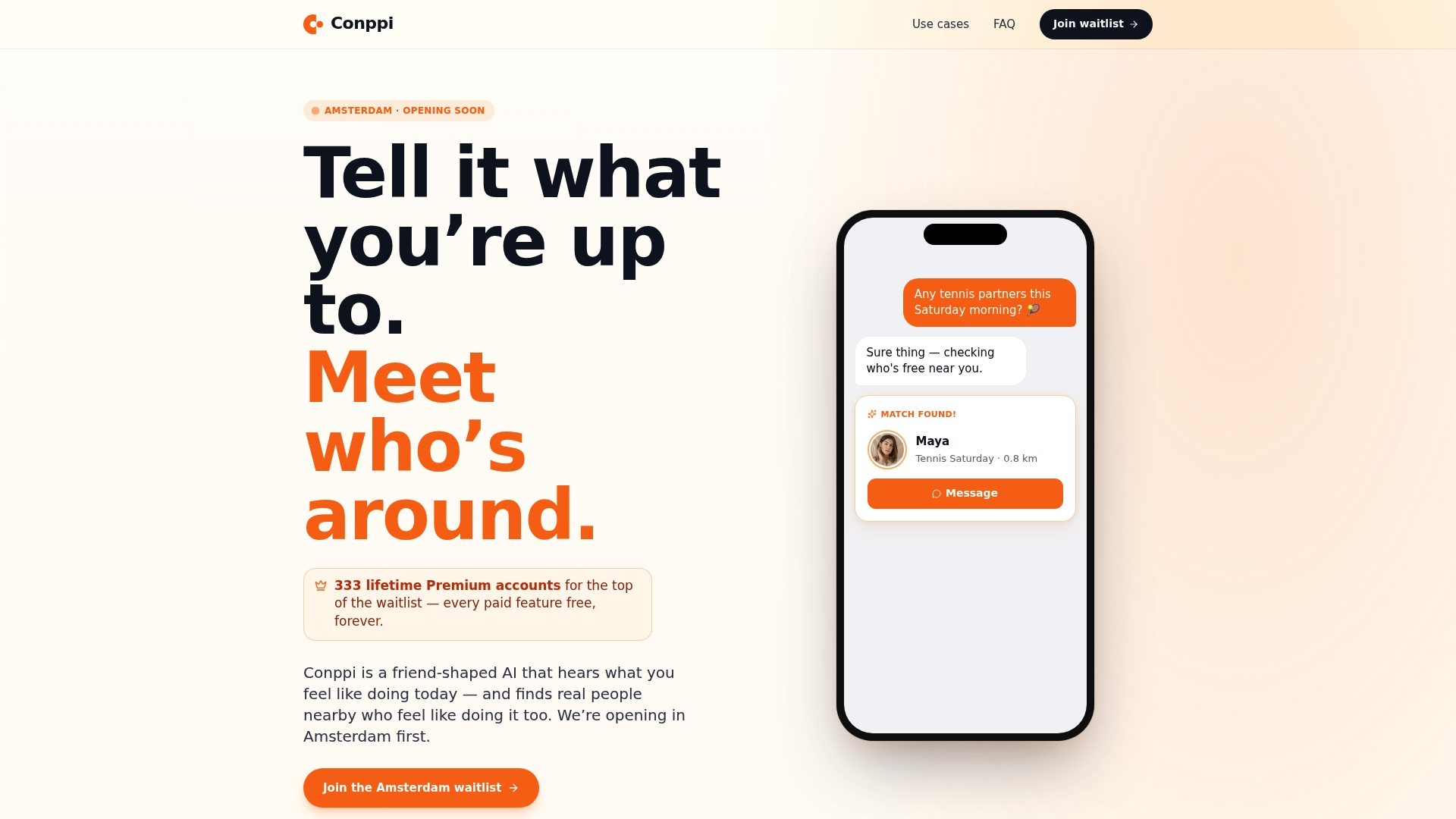
Conppi is a free iOS and Android app that connects you with people nearby who want to do something together right now. Co-working is one of the activities, alongside coffee, sports and language exchange. There are no profiles to build and no swiping: you say what you want to do, and the app matches you on interests and activity-specific filters such as time. It shows only your approximate distance to other people, not your exact location. We are opening in Amsterdam first, so there are more people nearby to match with.
To set up a quiet session, post a co-working activity at your preferred time, then agree the length and the quiet rule in your first message. Find people to co-work with in Amsterdam or read how the activity partner app works.
If you would rather host than join, hosting a meetup takes under ten minutes: post, match, meet. And if you are after remote workers specifically, the guide to meeting remote workers in Amsterdam tonight lists rooftops, day passes and apps.
Our perspective
Most people think the hard part of working alongside others is finding a room. In our experience of building Conppi, the hard part is the first message. "Do you want to cowork?" feels like asking a stranger for a favor. "45 minutes, one goal each, no talking until the end" feels like an easy yes.
That is why we built Conppi around activities rather than profiles. You do not need a polished bio to sit at a table and work. You need someone nearby, at a time that suits you, who wants the same thing. Matching on interests and timing, with only an approximate distance shown, keeps the pressure low and the privacy high.
We are starting in Amsterdam because the city has the density to make this work: remote workers, expats, travelers and locals, all within a short bike ride. A silent session is the gentlest way to meet any of them. You leave with work done and a person you could do it with again.
Ilya
FAQ
Do I have to talk at a silent coworking meetup?
Only briefly. Most sessions start with a one-sentence goal from each person and end with a short check-out about what got done. In between, nobody speaks unless it is urgent. If you want to chat, do it before or after.
How long should a first session be?
Aim for 30 to 45 minutes of silent work, plus a few minutes at each end. A short block is easy to commit to and easy to finish well. Once the group is comfortable, extend it to 60 or 90 minutes.
Is it free to join?
That depends on the host. Some coworking spaces charge guests for a day pass; The Social Hub's Amsterdam house rules, for example, mention a day pass at €20 plus VAT for guests in its flexible area. A session at a café costs the price of your coffee, and the Conppi app is free to use.
What if I do not know anyone in Amsterdam?
That is the common case, and the format is built for it. The structure gives you something to say, and the silence takes the pressure off. Start with one partner through the app, then widen to a small group once you know your rhythm.
What should I do if someone is too loud?
Ask quietly and kindly, once, ideally using the agreement you made at the start. If it continues, move to another seat or end the session politely. Our etiquette guide has short scripts for this.
Sources
- Why consciously silent co-working feels different, Tom McCallum
- Facilitation and Conflict: Ground Rules, Scrum.org
- Amsterdam CityHouse house rules, The Social Hub
- Community Guidelines, Baseline
- How to network in a coworking space, A'DAM.works
- Networking in Netherlands: Expat Guide 2026, Expat NL Hub
- EA Netherlands office app README