

Body doubling is working beside someone, in person or online, whose quiet presence helps you start a task and stay on it. Many people with ADHD and other attention-related challenges find it a low-cost way to get unstuck. Try short, timed blocks of shared presence, matched to the task: in person for physical jobs, virtual for screen work. Simple steps follow below.
TL;DR:
- Set a short, fixed block, name one task and its first action aloud, then work quietly; open ended sessions invite extra decisions.
- Choose in person company for physical tasks, live virtual sessions for screen work, and recorded work videos when live interaction feels draining.
- Community surveys report perceived help with starting, motivation, and completion, but controlled research remains limited; a Virginia Tech comparison included 40 participants.
- Choose a reliable partner who stays focused on their own task; meet new in person partners in public and agree on boundaries beforehand.
- Use body doubling alongside prescribed care, not instead of it, and add brief solo work if you become unable to focus without a partner.
Table of Contents
- What is body doubling, and what does a session look like?
- Why does body doubling work for focus?
- In-person, virtual, or recorded: which format fits your task?
- How do you run a body-doubling session, step by step?
- How do you find and choose a reliable body double?
- How do you make body doubling stick and fix common problems?
- What do the evidence and community research actually show?
- Why do we think you should try it?
- How can Conppi help you find an in-person body double?
- FAQ
- Sources
What is body doubling, and what does a session look like?
Body doubling, sometimes called parallel working, means doing a task while another person is present, physically or virtually, without that person necessarily helping with the task. Wikipedia's entry on body doubling describes it exactly that way. The idea grew out of community practice: people with ADHD and other neurodivergent people noticed that they got more done with someone else in the room and then shared the habit with each other long before researchers paid attention.
Picture a simple scene. You sit at a kitchen table with a friend. You each name a task, then work in near silence for a set period. Nobody coaches anybody. Nobody checks your work. The presence does the job.
Formats vary, and you can mix them:
- In person: a friend, partner, coworker, or someone at a coworking space working next to you.
- Live virtual: a video call or voice call with the camera on or off, where both of you work on your own things.
- Recorded videos: "study with me" or "work with me" videos that show someone working in real time while you work along.
- Mixed or extended reality: an emerging mode in which a virtual figure or avatar shares your space. It is still experimental, and you don't need it to benefit.
Everyday use cases are pleasantly unglamorous:
- Studying for a class or exam
- Clearing an email backlog
- Cleaning a kitchen or sorting laundry
- Paying bills and doing other admin
- Exercising, such as a walk or a gym session
- Starting a creative project you keep avoiding
Body doubling differs from collaboration because you aren't working on the same thing or splitting the labor. It also differs from coaching or therapy because the other person isn't there to instruct or evaluate you. A good body double can even be a stranger. The Cleveland Clinic notes that the most successful body doubles often focus on their own unrelated tasks, and that the technique works through modeled behavior and shared presence rather than direct interaction.
That makes it unusually easy to adopt. You don't need special equipment, a diagnosis, or a perfect partner. You need another person, a clear task, and a start time.
Why does body doubling work for focus?
Nobody has pinned down a single mechanism, but several plausible ones show up repeatedly in research and practitioner commentary, and each translates into a session rule you can use.
Social presence raises arousal. For many people with ADHD, a task that feels boring or vaguely threatening gives the brain too little to grab onto. Another person in the room adds just enough social stimulation to nudge alertness upward without demanding conversation. That is why a silent partner can feel strangely effective.
Time structure removes the open-ended fog. When you agree to meet at 2:00 and work until 2:45, the task gains edges. You no longer decide when to start, how long to continue, or when you're allowed to stop. Those micro-decisions are exactly where executive function tends to stall.
Light public commitment makes starting easier. Saying "I'm going to draft the first page" to another person turns a private intention into a small promise. You aren't being graded. You're simply less likely to wander off when someone saw you declare the task.
Fewer switching costs. If someone is quietly working a few feet away, grabbing your phone feels more noticeable, even if nobody says a word. The social context makes drifting into another tab slightly less automatic.
Modeled behavior. Watching someone else settle into focused work gives your own brain a template to copy. This is the mechanism the Cleveland Clinic summary leans on, and it explains why the double's own task matters more than their feedback.
A large community survey supports the claim that people already use the technique this way. In an ACM Transactions on Accessible Computing study of neurodivergent participants, respondents reported using body doubling to start tasks, stay motivated, and finish them, and described reduced overwhelm and added accountability as benefits.
Statistic callout: The ACM survey of neurodivergent participants found that many respondents use body doubling to start, stay motivated, and complete tasks, with companionship, accountability, and reduced overwhelm as the benefits they named most. It reflects what people say works for them, not a controlled trial of the method.
Community reports and clinical commentary line up reasonably well on mechanisms, even though large randomized trials of body doubling as a named intervention are still thin. We say that plainly because it shapes how you should treat the technique: as a cheap, low-risk experiment, not a guaranteed fix.
Here is how those mechanisms turn into rules you can apply today:
- Start small. Name a tiny, specific first action ("open the document and write one heading") so the arousal boost gets pointed at something concrete.
- Fix the block. Decide the length up front. A defined time window works better than "until I'm done."
- Say the task out loud. A one-sentence announcement does the work of public commitment.
- Keep chatter near zero. Conversation reintroduces switching costs. Save it for the end.
- Pick a partner who is busy too. Someone absorbed in their own work models focus without drawing yours.
None of this requires a clinical setting. You can run every rule at a kitchen table with a roommate.
In-person, virtual, or recorded: which format fits your task?
Format matters more than people expect, because the best partner in the wrong setting still fails. Match the format to the task and to your tolerance for being seen.
In person works best when the task is physical or tool-based. Folding laundry, decluttering a closet, assembling furniture, cooking a week of meals, or hitting the gym all benefit from a person who can actually share the room. A partner nearby also removes the screen from the equation, which helps if your screen is your biggest distraction.

Live virtual works best for screen work and odd hours. Writing, coding, email, spreadsheets, and studying fit a video or audio call well, and you can find a partner at 10 p.m. or across a time zone. In the comparative study of body doubling in extended reality, a Virginia Tech thesis, researchers compared no body double, in-person, video-call, and mixed-reality modes across 40 participants to see which modes people prefer and how helpful each is. The takeaway for everyday use is that different modes suit different people, so treat your first few sessions as a test.
Recorded or "study with me" videos work best when people feel like too much. If social anxiety, fatigue, or sensory overload makes a live partner draining, a video of someone working in real time gives you presence without any obligation. NPR's reporting on virtual study buddies documents how widely these videos and live focus sessions are used, and notes that experts find virtual buddies useful when in-person options are impractical.
Some rules of thumb for choosing:
- Physical or messy task: go in person.
- Writing or screen work, tight schedule: go live virtual.
- Low social energy: go recorded, or live with the camera off.
- Chronic procrastination on one dreaded task: try a pair session with a person you trust, because accountability is strongest one on one.
- Need a bit of company but don't want to be watched: a group room where everyone is muted and busy can feel lighter than a pair.
- Easily distracted by faces: audio only, or a camera angle that shows hands and desk but not expressions.
Camera on versus camera off is a personal call. Camera on delivers stronger presence and slightly more accountability, while camera off removes self-consciousness and eye strain. Neither is "correct." Start with the option that feels least effortful, since effort spent managing the setup is effort not spent on the task.
Pro Tip: Run the same task in two formats across two days and note which one got you started faster. Your own start time is better data than any general advice.
How do you run a body-doubling session, step by step?
Keep the first session boring and simple. The recipe below fits any format and any task.
- Pick one task and shrink it. Choose something concrete you can start in under a minute, such as "reply to the five oldest emails" or "put away everything on the kitchen counter."
- Agree on the time box. Settle the start time and the end time. A short session can help you get started. As you gain experience, choose a length that suits the task. Avoid open-ended sessions that blur into the rest of the day.
- Open with a brief check-in. Each of you says one sentence: "I'm drafting the intro to my report," "I'm sorting my paperwork." No long catch-up, no planning marathon.
- Start the timer together. A shared countdown, or both of you starting a phone timer, makes the beginning unmistakable.
- Work in silence or near-silence. Skip screen sharing. Don't check on each other's progress. There is no pressure to look productive, only to stay in the room.
- Park distractions on paper. When a random thought surfaces, jot it on a sticky note and return to the task rather than leaving to deal with it.
- Close with a quick recap. When the timer ends, each person says what got done in a sentence or two. Celebrate small wins, even "I opened the file and wrote a heading."
- Book the next slot before you leave. A recurring time removes the friction of re-arranging every week.
An opening script can be as simple as: "Task: schedule three appointments. Block: 30 minutes. Starting now." Closing: "Done: two booked, one left. Same time Thursday?"
Several variants help when the standard session feels like too much:
- Restful sessions: both of you do something low-key, like folding laundry, sketching, or reading, so the point is companionship rather than output.
- Camera-off or audio-only: you hear a keyboard or a rustle without being seen.
- Short sprints: 25 minutes on, five minutes off, repeated, for days when sustained focus is hard.
- Long blocks: 60 to 90 minutes with one stretch break in the middle, for deep work once the habit is established.
- Silent group room: several people working in a muted call, which spreads the social pressure thin.
Resist the urge to optimize. If the session happened and you touched the task, it counted. The first few runs are about proving to your brain that this works, not about squeezing out maximum output.
Pro Tip: Write the first physical action on a sticky note before the session starts ("open the tax folder"). When the timer begins, you follow the note instead of deciding what to do.
How do you find and choose a reliable body double?
Finding a partner is usually the real bottleneck, not the technique. The good news is that the pool is larger than most people assume.
Places to look:
- Friends and family: the easiest start, since trust is already there and scheduling is flexible.
- Coworkers or classmates: a standing "focus hour" in an office or study group needs almost no setup.
- Coworking spaces and libraries: you don't have to know anyone, and the room supplies the presence.
- Online focus communities: body-doubling rooms, ADHD forums, and scheduled live co-working sessions.
- Focus groups with a fixed schedule: recurring slots beat ad hoc arrangements for reliability.
- Activity-partner apps: these match you with nearby people who want company for coffee, co-working, sports, or other shared activities. We built our activity partner app for exactly this kind of real-time matching.
What makes someone a good body double? The ADDA article on the ADHD body double describes the benefits as improved focus and positive reinforcement, and offers guidance on looking for suitable partners. In practice, look for these qualities:
- Reliability: they show up on time and don't cancel at the last minute.
- Their own task: someone with something to do stays absorbed and models focus.
- Low check-in frequency: they won't interrupt you every ten minutes to ask how it's going.
- A calm manner: you shouldn't feel judged, rushed, or entertained.
Before the first session, agree on a few basics: start and end times, camera on or off, how much talking is fine, and what to do if one of you needs to leave. If you want ready-made wording for these conversations, our conversation boundaries scripts cover awkward moments, and the coworking etiquette rules are useful for in-person sessions.
Safety matters, especially with someone new:
- Meet in a public place for the first few sessions, such as a café or a coworking space.
- Share only the information you'd be comfortable sharing with any acquaintance.
- Tell a friend where you're going and when you expect to be done.
- Trust your discomfort. Ending a session early or not rebooking is always an acceptable choice.
- With online partners, keep personal details, addresses, and financial information out of the conversation.
If you want a regular in-person option, coworking meetups give you a recurring slot with a built-in crowd, which solves the reliability problem for many people.
How do you make body doubling stick and fix common problems?
Starting is easy. Keeping it going takes a few deliberate choices, and most failures trace back to the same handful of causes.
- Pick a regular slot. The same day and time each week turns the session into a routine you don't have to decide on. Reliability beats a perfectly designed plan.
- Keep the start goal tiny. "Open the laptop and write one sentence" is easier to commit to than "write the chapter."
- Keep logistics trivial. If setting up takes longer than five minutes, you'll skip sessions. Use the same link, the same café, the same table.
- Track a single metric. A checkmark on a calendar for each completed session is enough to see the habit forming.
- Switch formats when something grates. If your partner's presence distracts you, try camera off, audio only, or a recorded video before giving up on the whole approach.
- Switch partners when the fit is wrong. A partner who chats, cancels often, or hovers is not a failure of the method. Find another.
- Don't wait for motivation. The technique is meant to work before you feel ready, so show up anyway.
- Pair it with other supports. Body doubling works alongside, not instead of, treatment such as medication when a clinician has prescribed it, along with simple task lists or timers.
- Watch for over-reliance. If you can only work with someone present, mix in short solo sprints so the skill transfers.
Remote workers often find the loneliness side of this just as valuable as the focus side. Our piece on remote work loneliness explains why scheduled shared time helps, and the same logic applies to a weekly body-doubling slot.
Pro Tip: If a session goes badly, change one thing only (the partner, the format, or the time of day) before judging the method. Changing everything at once hides what actually helped.
What do the evidence and community research actually show?
The honest summary is that the research is promising, young, and mostly about people's experience rather than controlled outcomes.
Community-driven work has been the engine. A SIGACCESS paper proposing body doubling as a continuum worked with neurodivergent participants to describe the practice along dimensions of space, time, and mutuality, and drew out implications for future design. The larger ACM Transactions on Accessible Computing investigation surveyed neurodivergent participants and found many use the technique across a wide range of tasks. They do not prove that body doubling causes better outcomes.
Controlled comparisons exist but are small. The Virginia Tech work cited earlier compared modes with 40 participants, which gives useful signals about preferences without settling questions about long-term effectiveness. Large randomized controlled trials of body doubling as a named intervention are limited.
Clinical and charity outlets have added practitioner commentary. The Cleveland Clinic explains the shared-presence mechanism, and CHC Online's resource describes it as a useful strategy for people who struggle with focus, with practical session advice. These are expert voices and community anecdotes, not trial results, and we treat them that way.
At the technical edge, researchers are exploring virtual body swapping and embodiment technology as an extension of presence-based approaches. That work is experimental and unnecessary for ordinary body doubling.
| Source type | What it offers | Main limit |
|---|---|---|
| Community survey (ACM, neurodivergent participants) | Reported use and perceived benefit | Self-reported, no control group |
| Comparative user study (Virginia Tech thesis, 40 participants) | Mode preferences and perceived helpfulness | Small sample, short-term |
| Continuum research (ACM SIGACCESS) | A framework for describing the practice | Conceptual, not outcome data |
| Clinical outlets (Cleveland Clinic, CHC Online) | Expert explanation and practical advice | Commentary, not trials |
The practical takeaway is simple. Trying body doubling costs almost nothing and carries little risk, so the lack of large trials shouldn't stop you from experimenting. If attention difficulties are significantly affecting your work, school, or health, combine the technique with professional care rather than treating it as a replacement.
Why do we think you should try it?
Plenty of people stumble onto body doubling by accident. They find that the dishes get done when a roommate is cooking, or that a report finally moves when a friend is also on a laptop at the same café. The survey participants in the research above describe the same thing: they found it works for them and learned the name later.
That matters to me because it means the technique doesn't need to be sold. It needs to be tested, cheaply and without shame. My editorial view is that most productivity advice fails neurodivergent readers by demanding willpower first and support second. Body doubling reverses the order. It borrows structure and presence from another person so that your own willpower isn't the only fuel.
So start smaller than feels respectable. One 25-minute block, one tiny task, one partner who is also busy. If it flops, change one variable and try again. Along the way, in-person company is often the missing ingredient for people who work from home all week, and that's where we can help, which I'll explain next.
— Ilya
How can Conppi help you find an in-person body double?
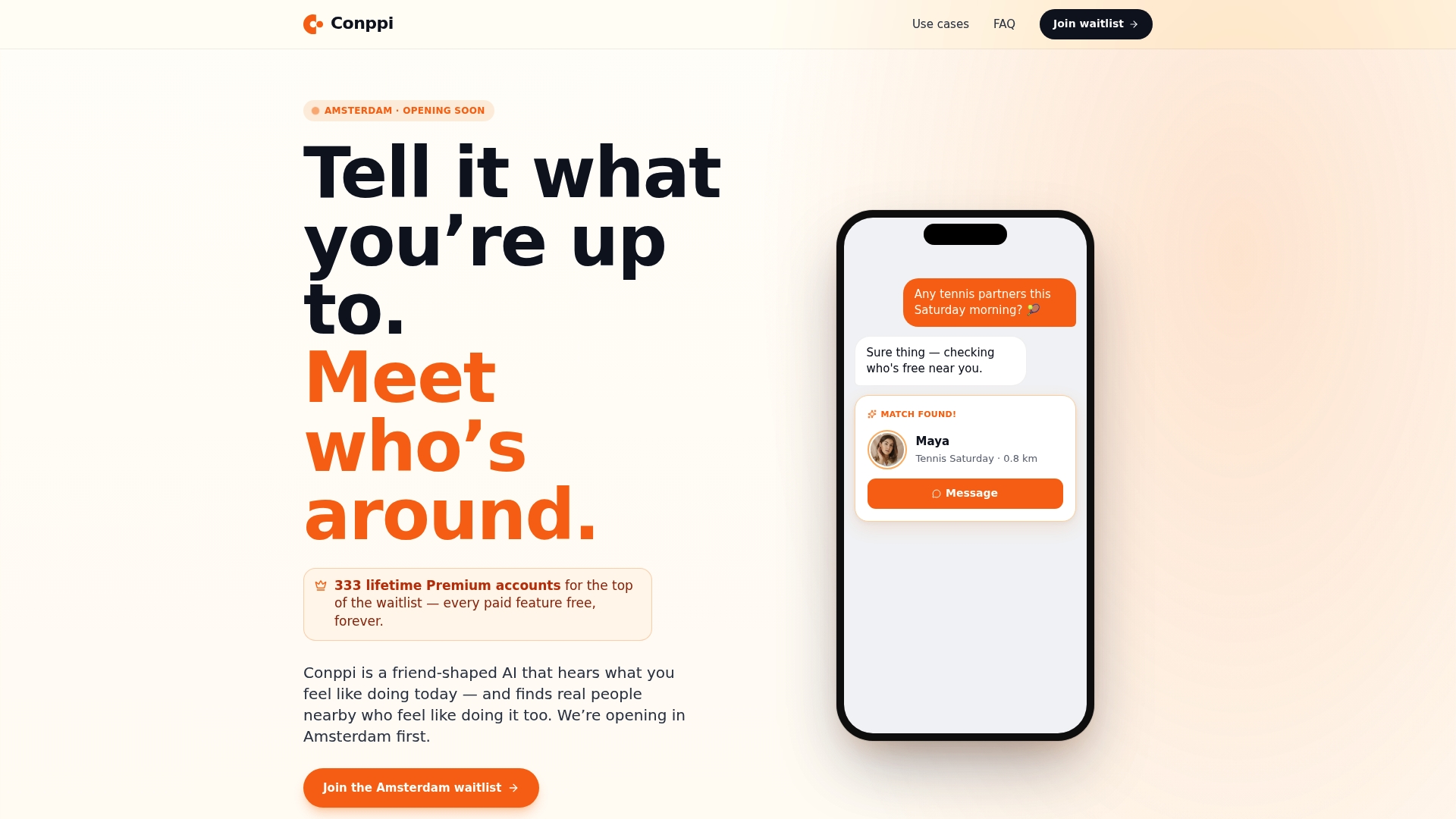
If the hardest part for you is finding someone to sit beside, we built Conppi for that. Our app matches you with people nearby who want company for an activity in real time, including co-working and coffee meetups, with activity-specific filters like time and skill level. There are no profiles to polish and no swiping, and we show only approximate distance, so your privacy stays intact.
That fits body doubling well: you ask for a co-working partner, set a time, and meet somewhere public. A first test could look like this:
- Open the app and choose a co-working or coffee activity for a time that suits you.
- Tell your match your task and agree on a time block before you meet.
- Work quietly, do a two-minute recap, and decide whether to meet again.
Start with our activity partner app and book one short session this week.
This article is general information, not a substitute for advice from a qualified doctor. Consult a qualified healthcare professional about your own circumstances before acting on anything here.
FAQ
Is body doubling good for ADHD?
Many people with ADHD report that it helps them start and finish tasks, and clinical commentary describes plausible mechanisms. It is not a replacement for treatment, so use it alongside professional care. The Cleveland Clinic overview explains the shared-presence idea in more detail.
What is the 10-3 rule for ADHD?
We could not find a source that defines a standard "10-3 rule" for ADHD, and definitions vary from one coach or community to another. Approaches can vary, so check the exact version before relying on it. For body doubling, a defined block and a clear start matter most.
What is the 20 minute rule for ADHD?
Definitions of a short-time commitment rule vary between sources, and none of ours defines it. Some approaches involve committing to a task for a brief, fixed period and then deciding whether to continue. Body-doubling sessions work similarly, with a short, agreed block that lowers the barrier to starting.
What is the ADHD buddy system?
It generally means pairing up with another person for mutual accountability, which overlaps with body doubling. A buddy might check in on goals, while a body double simply shares work time. The ADDA article describes how body doubles can help with focus and positive reinforcement.
Sources
- How Body Doubling Helps With ADHD
- “It Was Something I Naturally Found Worked and Heard About Later”: An Investigation of Body Doubling with Neurodivergent Participants | ACM Transactions on Accessible Computing
- Come study with me: How a virtual buddy might help you get things done : NPR
- Comparative Study of Body Doubling in Extended Reality