
Beginner means you are still learning the rules and basic movements. Intermediate means you can keep a game going with someone of similar standard. Advanced means you play with control, tactics and consistency under pressure. The catch is that no single official scale covers every sport, so the same word can mean different things in tennis, padel, basketball or skiing. This guide shows what each label means in practice, how Dutch clubs and federations put numbers on it, and how to describe your own level so you end up on court with the right people.
TL;DR
- Beginner, intermediate and advanced are relative labels. Each sport, and often each club, defines them differently.
- In Dutch tennis the KNLTB uses a 1 to 9 scale where 1 is the strongest and 9 the weakest, so a lower number means a better player.
- Padel levels are published on several different scales (Peakz Rating, Playtomic, KNLTB-style numbers), so always name the scale when you quote a level.
- Describe your level by what you can do (rally, serve, read the game), not by how long you have played.
- For casual play, a match in level is what keeps games fun, so be honest and slightly modest.
Table of Contents
- Why the same word means different things
- What beginner, intermediate and advanced mean in plain language
- How the levels look in different sports
- Tennis: the KNLTB playing strength scale
- Padel: one sport, several scales
- Team sports and the outdoors
- How to work out your own level
- Our perspective
- Describing your level to a new partner
- When levels do not line up
- Find someone at your level with Conppi
- FAQ
- Sources
Why the same word means different things
Skill labels exist to put people of similar ability on the same court. The KNLTB, the Dutch tennis federation, says that clearly defined playing levels help organize equal matches, which leads to more satisfaction and longer engagement in sport, as its 2025 tennis report explains.
There is no world standard behind that idea, though. The International Ice Hockey Federation treats levels as stages of development rather than fixed rules. In its framework, players at any level show a range of ability, and the labels are there to guide training, not to box people in. That is a useful way to read any label: it is a rough pointer, not a verdict.
There is also a scientific reason a label cannot simply travel from one sport to the next. A 2025 study in Scientific Reports explains that motor performance in one sport does not necessarily correlate with performance in another, because skills are shaped by the specific demands and training of each discipline. A strong cyclist is not automatically an intermediate squash player, and an advanced runner may be a beginner on a padel court.
What beginner, intermediate and advanced mean in plain language
Beginner
A beginner is new to the sport and still learning the rules, the basic strokes or movements, and how scoring works. Consistency is the main gap: a beginner tennis player may hit a good shot, then miss the next four. Learners at this stage tend to benefit from outside feedback, such as a coach or a partner pointing things out, while experienced performers rely more on their own feel for the movement, as the BBC Bitesize guide on feedback describes.
A useful test: if you spend most of a session thinking about where your feet and hands go, you are a beginner, and that is a perfectly good thing to be.
Intermediate
Intermediate is the widest and most confusing band. In general it means you have the basics and can sustain rallies or phases of play, so you can play real matches against people of a similar standard. What you are still missing is the finer stuff: tactics, spin, positioning, handling pressure.

Because the band is so wide, many clubs split it. One Dutch padel provider, for example, calls its lower middle tier "Intermediate Basis" and the next one simply "Intermediate". If you say "I'm intermediate" to a stranger, expect a follow-up question.
Advanced
Advanced means a more developed level where training and play are sport-specific and performance-focused. Even then, advanced is not elite. The IIHF puts advanced players in a development category below elite and professional level. An advanced recreational player is consistent, tactically aware and can execute a game plan, but is still not a professional.
How the levels look in different sports
The table below pulls together how Dutch clubs and federations describe the middle of the scale. Treat it as a map of how definitions vary, not as a conversion chart.
| Sport | How the scale is built | What "intermediate" tends to mean |
|---|---|---|
| Tennis (KNLTB) | Playing strength 1 to 9, where 1 is the highest and 9 a beginner | Roughly categories 6 and 7 are the club-level middle; most Dutch players sit in 7, 8 and 9 |
| Padel | Several scales: four-tier names, Peakz Rating, Playtomic, KNLTB-style numbers | Controlled basic strokes, real rallies, first tactics |
| Basketball (student club) | Named tiers such as "Mid" | Knows the basic rules, can dribble and finish an open layup |
| Surfing | Beginner, intermediate, advanced | Catches waves independently, stable pop-up, basic turns |
| Skiing | Colors from green to black | Controlled turns on varied slopes |
| Pickleball (USA) | Numeric 1.0 to 5.5+ | Defined by on-court capabilities and strategy |
Tennis: the KNLTB playing strength scale
If you play tennis in the Netherlands, the number you need to know is your speelsterkte. The KNLTB uses a scale of 1 to 9, where 1 is the highest level and 9 is a beginner. The scale groups players of equivalent level for fair competition, and the federation's data shows that most Dutch tennis players fall in categories 7, 8 and 9, the recreational to light-competitive range, according to its 2025 report.
Two practical consequences follow. First, the scale runs backwards from what most people expect, so a 6 beats a 7. Second, if you are a 7 or 8 you are in good company: that is where the bulk of players are, so finding a partner is easier than you might think. If you want the rules around doubles pairings and ratings, see our guide to finding a tennis doubles partner and the KNLTB rules.

Padel: one sport, several scales
Padel is where the vocabulary gets messy, because providers publish their own scales and each describes the middle a little differently.
- A Dutch padel chain groups players into four categories: Starter, Intermediate, Advanced and Challenger. Its intermediate range is Peakz Rating 5, 6 and 7, which it says is comparable to KNLTB level 6 or 7. It describes intermediate players as having solid court experience: they can place the serve, play a good forehand, backhand and volley, and keep a rally going.
- Another provider's classification puts "Intermediate Basis" at KNLTB 9 to 8 or Playtomic 1 to 2, and "Intermediate" at KNLTB 8 to 7 or Playtomic 2 to 3. At that level you play regularly, rallies are steadier, you are more confident with the glass and you start to use strategy and think about positioning and working with your partner.
- A third source defines intermediate as 2.5 to 3.5: you control basic strokes at normal speed, understand court positioning, play controlled balls and real rallies and start using tactical plans, though unforced errors under pressure are still common.
Notice what happens: the first source places intermediate near KNLTB 6 or 7, the second near KNLTB 7 or 8. Same word, neighboring numbers. When you tell a possible partner your level, give the scale and the number, for example "Playtomic 2.5", not just "intermediate". If you are looking for someone to play with in the city, our page on how to find a padel partner in Amsterdam is built around exactly that kind of matching.
Team sports and the outdoors
Basketball
Student club basketball in Utrecht shows how a Dutch club defines a middle tier. In the Utrecht student basketball association, the "Mid" level is meant for players with some experience: they know what a layup is, can usually score on an open basket, dribble adequately with the dominant hand, understand the basic rules and have some idea what to do in attack and defense. It is a refreshingly concrete definition, and you can reuse the method: list what you can reliably do. If you want drop-in games, see pickup basketball in Amsterdam and how to find pickup games near you.
Surfing
A surf school in Scheveningen describes an intermediate surfer as someone who catches waves independently, has stable balance, performs a fluent pop-up, trims along the wave, makes basic turns and duck-dives, and can handle varied conditions without constant guidance. The key phrase is "without constant guidance": in outdoor sports, level often means how much supervision you need.
Skiing
In skiing, levels are often color-coded. A Dutch ski school uses a system similar to Austria's, running from Green for no experience to Black for dynamic parallel turns and tricks. Colors make it easy to group a class, but they do not map directly onto the beginner to advanced words used in ball sports.
Pickleball
Pickleball is unusual because it has one official scale. USA Pickleball set up a nationwide skill level scale in 2005, from 1.0 to 5.5 and above, which groups players by on-court capabilities and strategic knowledge, not just by match results.
How to work out your own level
People tend to overrate themselves. Pickleball Canada notes that skill determination can be controversial because players frequently overrate their abilities, which is why it publishes an assessment guide to keep clubs consistent. That guide also shows a sensible structure: assess specific shots first, then check your performance by playing against people at the level you think you are.
You can copy that approach for any sport:
- List what you can do reliably. Not on your best day, but on an average one. Can you keep ten balls in play? Can you finish a 5 km run without stopping?
- List what still breaks down. Serves under pressure, left-hand dribbling, turning in choppy water.
- Use an official scale if one exists. The KNLTB rating for tennis, a club's published description for padel, or USA Pickleball's 12-question self-assessment for pickleball.
- Test it in a game. Play a session with someone at the level you think you are. If you win easily, move up. If you are chasing every point, move down.
- Round down in your description. A game where you are slightly the stronger player is usually more enjoyable than one where you are outclassed, and partners remember honesty.
For tennis specifically, scoring and match results already give you a number, but for most sports the self-description is all you have. Make it concrete.
Our perspective
We built Conppi around a simple observation: most people do not struggle to find a sport, they struggle to find the right person to play it with. The word "intermediate" is a big reason. Two people can both say it and turn up with completely different games.
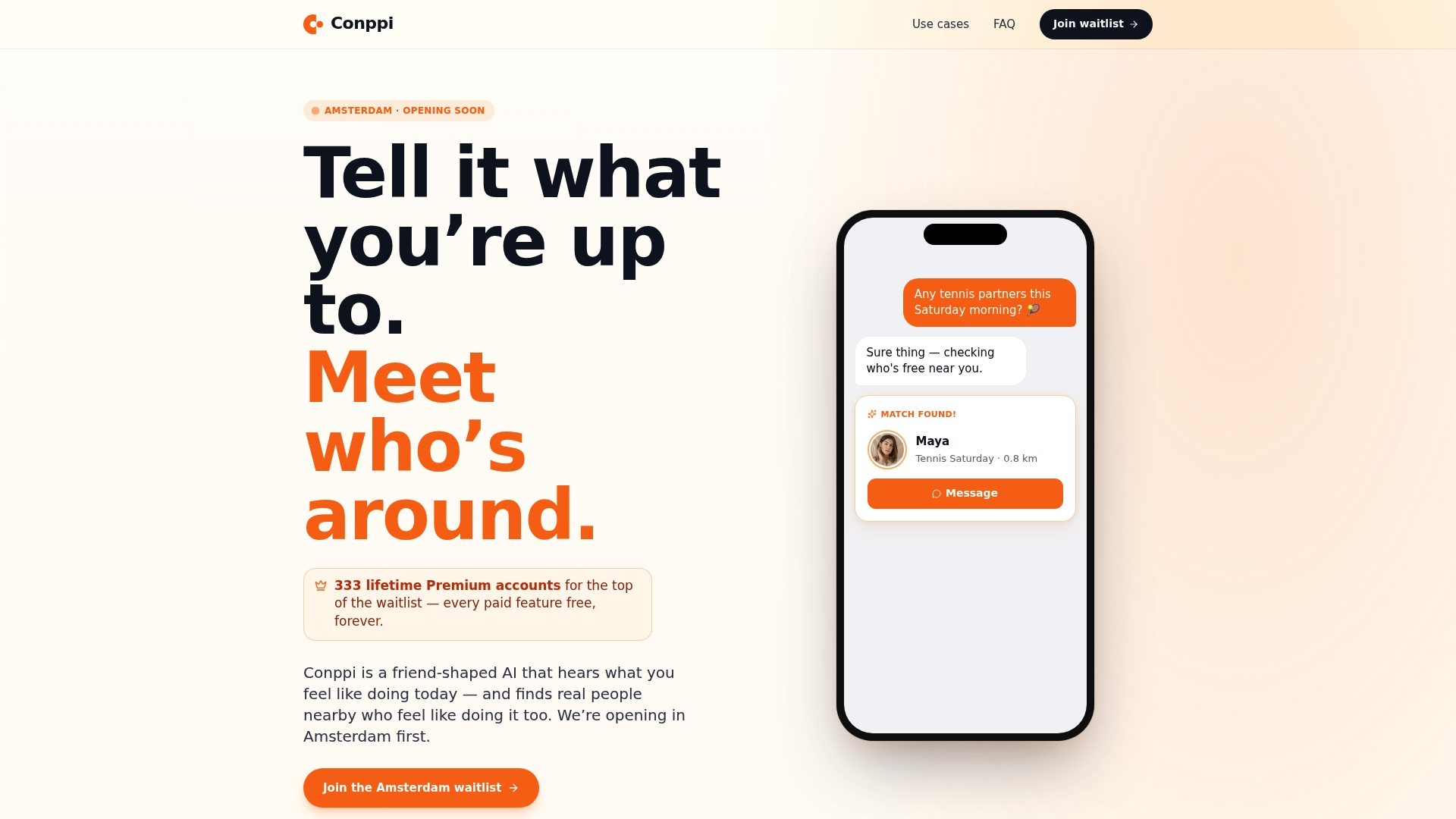
That is why we match on activity and filters such as time and skill level, not on profiles and swiping. You say what you want to do, roughly when, and at what level, and you see people nearby who want the same thing. We only show approximate distance, so you share what is needed to meet and nothing more.
Our advice is to describe your level in one sentence of what you can do, and to treat the label as a starting point for a conversation, not a badge. We are opening in Amsterdam first because a dense city means more people at every level, so a beginner and an advanced player can both find a game close by.
Ilya
Describing your level to a new partner
When you arrange a game with a stranger, a short message does more than any label. Try this formula: sport, scale and number if there is one, what you can do, what you are working on.
- "Tennis, KNLTB 7. I can rally from the baseline, my second serve is shaky."
- "Padel, around Playtomic 2. Comfortable with the glass on easy balls, still learning when to go to the net."
- "Running, 6:00 per km on easy runs, happy to go slower to chat."
This does three things. It lets the other person judge fit immediately, it sets expectations, and it keeps the conversation friendly. If you are meeting people through sport mainly to make friends, the level matters less than the habit of showing up, and our piece on meeting people through sports in the Netherlands covers how to turn a first game into a weekly session. For a good first-meeting routine, the doubles partner etiquette guide is worth a look too, and if you train with weights, saying the right thing before a heavy set applies the same logic to gym partners.
When levels do not line up
Real life is never tidy. Some things to keep in mind when you play across levels:
- A big gap is fine for practice, not for competition. An advanced player can hit with a beginner as a drill, as long as both know that is the plan.
- Adjacent levels are the sweet spot. One step above you is how you improve, since stronger partners show you what to aim for.
- Check the scale direction. On the KNLTB scale 1 is best. On most other numeric scales, a higher number is better. Mixing them up is a classic mistake.
- Cross-sport confidence is not skill. If you are a strong cyclist trying padel, call yourself a beginner at padel. Skills are specific to each sport, as the research above suggests.
There is a wider idea in Dutch sport policy that fits here. The Athletic Skills Model focuses on the skills that make up a sport instead of the sport itself, and sports that share several skills are called donor sports. So a sport you already know can give you a head start in a new one, even if your label starts at beginner.
The sport-science literature also shows how fuzzy this gets at the top. A 2022 paper proposed a six-tier framework running from Tier 0 (sedentary) to Tier 5 (world class), based on training volume and performance metrics, precisely because researchers lacked a uniform way to describe participants. For everyday play you do not need that precision, but it explains why casual labels vary so much.
Find someone at your level with Conppi
Conppi is a free app for iOS and Android that matches you with people nearby who want to do the same activity right now: tennis, padel, gym, running, cycling, swimming, co-working, coffee or language exchange. You set the activity, the time and the skill level, and there are no profiles to build and no swiping. You can organize one-on-one sessions or groups, and only approximate distance is shown. Take a look at the Conppi activity partner app to get started, or see how it works for tennis in Amsterdam.
If your idea of a good session involves a laptop, there is also a page on how to find people to co-work with in Amsterdam. And if you mainly want company without the dating-app feel, here is how we think about making friends without dating apps.
FAQ
What is the difference between beginner, intermediate and advanced?
A beginner is learning the rules and basic movements and struggles with consistency. An intermediate player has the basics and can sustain rallies or phases of play against similar opponents, but is still developing tactics. An advanced player plays with control, tactical awareness and sport-specific training, though still below elite level.
Is a lower number better in Dutch tennis?
Yes. The KNLTB playing strength scale runs from 1 to 9, where 1 is the highest level and 9 is a beginner. Most Dutch tennis players are in categories 7, 8 and 9, according to the federation's 2025 report.
Why do padel levels look different on different sites?
Padel has no single universal scale. Providers publish their own tiers and number systems, such as Peakz Rating, Playtomic levels or KNLTB-style numbers, and the intermediate band lands on slightly different numbers in each. When you describe your level, always name the scale as well as the number.
How do I know if I am intermediate?
Check what you can do consistently, not what you can do once. If you can keep rallies going, execute the core techniques at normal speed and play full games against similar players, you are likely intermediate. Confirm it by playing a session with someone at that level.
Can a beginner play with advanced players?
Yes, as a practice session where both sides agree on the goal. For competitive games, matching within about one step keeps points close and the session enjoyable for everyone.
Sources
- KNLTB Tennis in cijfers 2025
- IIHF general information
- Scientific Reports 2025 study on motor performance
- BBC Bitesize: feedback at beginner and elite levels
- Padel level guide (Peakz Padel)
- Padel level classification (Padel Fabriek)
- Padel level definitions (Hello Padel)
- Utrecht student basketball: what level suits me
- The Shore: intermediate surfer
- Wolfskamer Wintersport adult ski lessons
- USA Pickleball skill levels
- Pickleball Canada club rating assessment guide
- Athletic Skills Model (Sport en Strategie)
- Participant classification framework (PubMed)