
A meetup no-show is someone who RSVPs and then neither turns up nor cancels. It is common: Dutch event-industry figures put it at 10% to 30% of registered attendees at business events, and free social meetups tend to sit at the high end. You can't remove no-shows completely, but you can plan around them as a guest, cut them as a host, and pick formats where they hurt far less.
TL;DR
- A no-show is a confirmed guest who is absent without cancelling. Arriving late is not a no-show.
- Free events lose more people: a 2026 industry report puts the median at about 28% for free events and 17% for paid ones.
- As a guest, treat an RSVP list as a rough guide, and message the host or group before you travel.
- As a host, small groups, reminders, a clear cancel route and a little commitment cut no-shows the most.
- If you are the one who can't make it, cancel early and politely. It takes thirty seconds.
Table of Contents
- What counts as a no-show
- How reliable is an RSVP, really?
- Why people flake on meetups
- If you are the guest: how to avoid a wasted trip
- If you are the one who cannot make it
- If you are the host: how to cut no-shows
- Our perspective
- A simpler way to make plans stick
- Matching the format to what you want
- Is the meetup model broken?
- FAQ
- Sources
What counts as a no-show
The Dutch campaign No Show = No Go describes a no-show as someone who registers for an event but does not appear and does not cancel. The Dutch association KNVI is more precise. It defines a no-show as an absence without reason after confirmed participation, and notes that attendees can cancel until the event starts, and that arriving late or joining later is not a no-show.
That gives you a useful working definition for casual meetups too:
- No-show: you said yes, you did not come, you did not say anything.
- Late cancel: you told people, even at the last minute. Annoying, but fair.
- Late arrival: you came after the start. Not a no-show.
The silence is the problem. A host can adapt to a cancellation. They can't adapt to a mystery.
How reliable is an RSVP, really?
Less than the number on the screen suggests. A few data points from different angles:
| Source | What it found |
|---|---|
| Dutch events industry (CLC-VECTA) | 10% to 30% of registered attendees fail to appear at business events |
| 2026 industry data reported by Skift Meetings | Median no-show rate about 28% for free events, 17% for paid events |
| CalendarLink 2026 attendance study | 41% of invitees across 62 countries say they at least sometimes miss events they agreed to attend; 9% do so regularly |
These figures come from business and general events, not from casual friend-making meetups specifically, so read them as a range, not a promise. The pattern is still clear. When an event is free and the host is a stranger, saying yes costs nothing, and not showing up costs nothing either.
If you are going to an open, free meetup, plan on the basis that a good share of the yes list will not appear. That is a reason to arrive with a flexible mindset, not a reason to stay home.
Why people flake on meetups
There is no single reason, but the same few come up again and again.
Saying yes costs nothing. Paid-versus-free status was the strongest predictor of no-show rates in the PheedLoop findings reported by Skift. When there is no stake, commitment fades between sign-up and event day.
Anonymity. Jochem Gerritsen, a Dutch meetup organizer, argues that on large online platforms attendees often feel no connection to the organizer, so they feel little social pressure to honor the RSVP. That is one organizer's view, but it matches what many hosts report.
Memory and calendars. CalendarLink found that people who rely on memory or do nothing report regularly missing events more often than people who manually save the event: 26% versus 5%. Many no-shows are not decisions at all. They are forgotten plans.
Social energy. Meeting strangers takes effort. At 5 p.m. on a rainy Amsterdam Thursday, a sofa wins. The bigger and vaguer the event, the easier it is to tell yourself nobody will notice.

If you are the guest: how to avoid a wasted trip
Most of the frustration around meetup no-shows comes from traveling across the city for an event that turns out to be empty or tiny. A short routine helps.
- Read the attendee list before you go. Look at how many people have said yes and how many look active. A list of 40 names with no recent messages probably means 8 to 12 real people.
- Look for a recent sign of life. A host comment from today, a message in the group chat, a fresh photo. If there is none, ask.
- Message the host or the group the day before and again two hours before. A simple "Still on for 7? I'm coming from Oost" is enough, and it nudges others to confirm too.
- Choose a public, comfortable venue. If the event turns out smaller than planned, a café or a park is still a fine place to have a coffee and a book.
- Have a backup plan. Bring something to do, or know a second spot nearby. Then a thin turnout costs you almost nothing.
Safety matters too. Meet in a public place, tell a friend where you are going, and keep your travel plans your own. If an event says one thing and the place looks like another, you can leave.
What to do if the host or others do not show up
If you arrive on time and nobody is there:
- Wait 15 minutes. Late arrivals are common, and by KNVI's definition a late arrival is not a no-show.
- Message the host and the group. Someone may be stuck on a delayed tram or a closed bridge.
- Look around. Other attendees are often standing nearby, unsure whether they are in the right place.
- If nobody comes, turn it into the activity itself. Order the coffee, do the walk, play the court. You are still out, and you are still in a good position to say hello to the next person who arrives.
- Leave feedback or a short note to the group afterward. It helps the host adjust the next event.
One empty meetup says very little about a group. Three in a row do. Move on to a smaller or more active one.
If you are the one who cannot make it
Everyone cancels sometimes. The difference between a flake and a decent person is whether the host finds out. KNVI's definition itself says attendees can cancel until the event starts, so a late message is still far better than silence.
A good cancellation is short:
- Say it as early as you can.
- Give a one-line reason, or none. You don't owe a story.
- Offer to join the next one if you mean it.
We wrote a full guide to this: cancel meetup etiquette covers how to back out without burning bridges, with message templates.
If you are the host: how to cut no-shows
The Dutch campaign points out that no-shows cause food waste, unnecessary costs and disappointed participants. For a casual host the cost is smaller, but it is real: a table booked for eight with three people feels flat, and the next event gets fewer RSVPs.
Raise the cost of not showing up
At Jochem Gerritsen's Enter Network meetups in Utrecht, attendance rose from around 45% to 70% to 80% after he introduced a €5 fee. That is a single organizer's account from 2019, not a controlled study, but it lines up with the paid-versus-free gap in the 2026 data above.
You don't always need a fee. Commitment can be lighter:
- Ask guests to confirm with a one-word reply the day before.
- Keep the group small enough that everyone is missed when absent.
- Use a named, personal invitation instead of a mass post.
Make it easy to remember
People who save an event to their calendar miss it far less. CalendarLink's study found 5% regularly missing among those who saved manually, against 26% among those who relied on memory or did nothing. Send the time, the exact spot and a map pin, and encourage a calendar save.

Send reminders that say something specific
Perspective AI's research suggests organizers underinvest in pre-event reminders that reflect why the person signed up. For a meetup, that is easy. "Tomorrow, 10:00, padel at the court near Sloterdijk, we need a fourth player" beats "Reminder: event tomorrow".
Pick formats that survive a no-show
The best fix is a format where one absence doesn't ruin things.
- Two to six people instead of twenty. Our guide to small group meetups explains why 4 to 6 works well for real friendships.
- Short and casual. A 45-minute coffee costs everybody less than a three-hour dinner. See how to host a casual meetup in about 45 minutes.
- Activities that flex. A run or a walk works with two people or six. A fixed table for ten does not.
If you want a quick walkthrough for Amsterdam, there is also a guide on hosting a meetup in under 10 minutes.
Our perspective
Most meetup no-shows come from one design flaw: a big public list where saying yes is free and nobody knows anybody. A name on a list is easy to ignore. A person you were about to play tennis with is not.
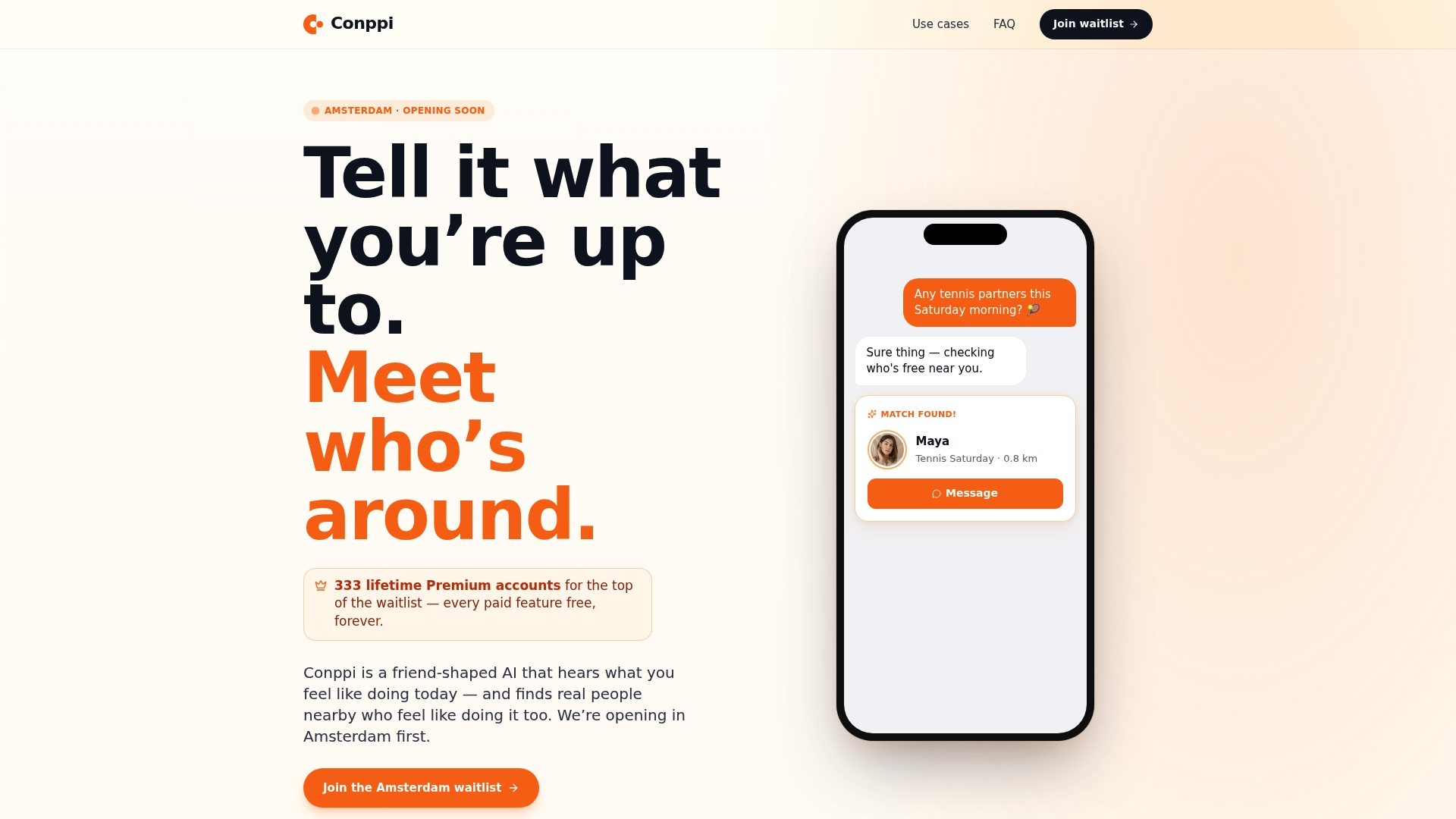
That is why we built Conppi around activities, not event pages. You post what you want to do, when, and where, and people nearby who want the same thing respond. There are no profiles to curate and no swiping, so the conversation starts about the activity. It is built for one-on-one and small-group plans, where each person matters to the outcome.
Because plans are real-time and specific, a coffee at 4 p.m. or a padel game tonight, there is less time for a yes to fade. We only show approximate distance, so you can check who is close without giving away where you live.
We are opening in Amsterdam first for a simple reason: you need density to make this work. When there are enough people nearby, a flaky match is not the end of the plan, because there is always another person to ask.
Ilya
A simpler way to make plans stick
If you are tired of long RSVP lists with a lot of silence, try planning around the activity and the people nearby. Conppi is a free iOS and Android app for finding activity partners in real time: sports like tennis, padel, running, cycling, swimming and the gym, plus coffee, co-working and language exchange. You set the time and the skill level, and you meet people who want to do the same thing.
See how it works on the activity partner app page.
Matching the format to what you want
No-shows weigh differently depending on what you are doing. A few quick pointers, each with a deeper guide:
- Coffee: low stakes, easy to rearrange. Our Amsterdam coffee meetups shortlist helps you pick spots.
- Work: co-working buddies are easier to keep when each of you has a reason to be there anyway. See coworking meetups and meeting remote workers in Amsterdam.
- New in town, or over 30: it is easier to start with one repeatable plan than with big events. Read meeting people after 30 in Amsterdam.
- Turning a one-off into a habit: try four steps to turn an activity into a regular plan, and follow up within 48 hours, as described in how to meet people without swiping.
Is the meetup model broken?
Some users on forums ask whether meetup platforms are dying, and complain that attendee lists have become unreliable. That frustration is real, but the underlying problem is older than any one platform: when strangers sign up to an open list at no cost, attendance is unpredictable. The fix is not to give up on meeting people in person. It is to make plans smaller, more personal and closer in time to the moment they happen.
FAQ
What is a no-show at a meetup?
It is someone who RSVPs yes and then neither attends nor cancels. No Show = No Go uses the same definition for events in the Netherlands. Someone who cancels, even late, or who arrives late, is not counted as a no-show by the KNVI definition.
How many people actually show up after RSVPing?
It depends on the event. Industry data from 2026 puts the median no-show rate at about 28% for free events and 17% for paid ones. For a free meetup, expect that roughly one in four or more of the yes replies will not appear, and more for large, anonymous groups.
How can I check whether a meetup is really happening?
Check the attendee list for recent activity, look for a host message from the same day, and message the host or group a few hours before. If you hear nothing, pick a public place where you are happy to be anyway.
What should I do if nobody turns up?
Wait about 15 minutes, message the host and the group, and look for other attendees nearby. If no one comes, enjoy the activity or the coffee, and join a smaller group next time. Repeated empty events are a good sign to switch groups.
How do I cancel without being rude?
Say so as early as possible, in one or two lines, and offer to come to the next one if you really would. Silence is what hosts remember, not the cancellation. Our cancel meetup etiquette guide has ready-to-use wording.
Sources
- No Show = No Go
- Branche zegt "nee" tegen no-show (Meeting Magazine)
- No-show regeling (KNVI)
- The $100 Experiment That Slashed No-Show Rates to Just 10% (Skift Meetings)
- The Show-Up Gap: 2026 Event Attendance Study (CalendarLink)
- Should You Charge for Meetups and other Events? (Jochem Gerritsen)
- Event Registration Management in 2026 (Perspective AI)