
Coworking works well for introverts when you control three things: how much noise surrounds you, when you arrive, and who you talk to. You do not need to become sociable. You need a space with quiet options, a routine that makes the room familiar, and one or two people you are comfortable working beside. In Amsterdam, where we are starting, that last part is what we built Conppi for: finding one person nearby who wants to work next to you, without profiles, swiping or small talk with a whole room.
TL;DR
- Introverts are a real part of the coworking crowd. In a global member survey, about one in five described themselves as more introverted, and many reported better workdays and less isolation.
- Pick the space by its quiet options: a true quiet zone, phone booths or small rooms, varied layouts, and seats away from entrances, kitchens and printers.
- Arrive early, become a regular, and let routine do the socializing for you. One good conversation beats working the room.
- Working next to one chosen companion gives you company without crowd pressure. Conppi matches you with people nearby for co-working, with filters such as time.
Table of Contents
- Why coworking suits more introverts than you would expect
- The buzz paradox, and how routine solves it
- What to look for in a coworking space
- Make connections without working the room
- Coworking with one companion instead of a crowd
- A low-pressure first month
- Special situations in Amsterdam
- Find a co-working partner in Amsterdam
- Our view on introverts and coworking
- FAQ
- Sources
Why coworking suits more introverts than you would expect
The stereotype says shared offices are loud and built for extroverts. The data says otherwise. The 2018 Global Coworking Survey, summarized by Deskmag, found that about one in five members identified as more introverted, roughly one in three as more extroverted, and almost half as a mix of both.

The same report found that introverted members often valued the social atmosphere of coworking without wanting contact with everyone. They also reported better workdays, getting more done, more creativity or skills, and less isolation. In other words, what introverts tend to want is not silence. It is people nearby, with the choice of when to engage.
That matters most if you work from home. Long stretches alone feel comfortable until they do not. If your remote days are piling up and your week has gone quiet, our piece on remote work loneliness explains how the drift happens and how to reverse it in a week.
The buzz paradox, and how routine solves it
Researchers at Erasmus University Rotterdam studied this tension in Dutch collective workplaces. Their 2022 study describes a coworking paradox: people are drawn to a workplace by the promise of interaction, yet they also need quiet conditions to do productive work. The title of the paper says it plainly: people like the buzz, but they also suffer from it.
Two findings from that research are useful to an introvert:
- Routines and spatial and time conditions help people reconcile the need for interaction with the need for quiet.
- Interactions in Dutch collective workplaces emerge through rituals and especially routines, rather than requiring constant socializing.
So you do not have to perform sociability. The same desk, the same hours and the same coffee break make you a familiar face. Familiarity does the work that networking mixers try to force.
What to look for in a coworking space
Needs differ by person, task and time of day. A Dutch Smart WorkPlace article makes this point: needs in shared offices include quiet, movement, nearby conversation, lighting, colour and an acoustic retreat, and it argues against one universal design. A space that suits your colleague may exhaust you. So judge a space on the features that protect your focus.
A useful checklist, drawn from guidance on flexible spaces for introverts:
- A genuinely quiet zone or floor. Ask whether it is enforced or just labeled.
- Phone booths or small bookable rooms. You can take a call or recover for ten minutes without leaving the building.
- Varied layouts. Open tables, corners and enclosed spots let you change setting as your energy changes.
- Seats away from high-traffic areas. Entrances, kitchens and printers are where the foot traffic and chatter collect.
- Community support that does not compel participation. Events should be an invitation, not an expectation.
Open or private? Most people want both
Deskmag's survey found that all personality groups preferred a mix of open space and private retreats, with introverts rating that mix somewhat higher. A small majority still preferred open workspaces. The lesson: do not assume you need a closed office. Many introverts do best in a lively room with a door close by.

Tour it at your own hours
When you visit, go at the time you would actually work. Shared spaces are often busiest between 10 a.m. and noon, and the same guide suggests arriving around 8 or 8:30 a.m. to settle in before activity picks up. Try a day pass before you commit to a membership. A morning and an afternoon visit will tell you more than any brochure.
Prices across the Netherlands vary widely by city and type of desk, so check the space's own page for current rates and trial options instead of relying on a number you read a year ago.
Make connections without working the room
Most introverts do not dislike people. They dislike unstructured, high-volume interaction. That points to a different approach to networking in a shared space.
Become a regular. Showing up at the same time builds recognition faster than any single event.
Keep greetings short. A smile, eye contact and a quick hello are enough to start. Think of it as building a series of tiny, low-cost interactions.
Aim for one good conversation. Stronger networks come from a few meaningful exchanges, not from volume.
Choose structured events. Ask whether events have a clear format, such as a lunch talk, workshop or skill share. Structure supplies a natural topic and reduces the pressure to mingle, which an open mixer does not.
Evidence from Amsterdam backs up the role of design and management. A University of Amsterdam study interviewed 19 entrepreneurs across three Amsterdam coworking spaces in 2019, and it links physical design, facilitative tools and community management to how people build social capital. Spaces where someone actively facilitates introductions tend to be easier for people who would never start a conversation cold.
After-work events often center on drinks, which adds a different kind of pressure for people who do not want alcohol. If that is you, this guide to socializing at work without drinking has practical ideas for taking part on your own terms.
If you want a fuller plan for the city, our guide to introvert networking strategies in Amsterdam and the 8-step plan for making friends through recurring activities go deeper. Both rest on the same idea as the research above: repetition beats intensity.
Coworking with one companion instead of a crowd
The hardest part for many introverts is the first move. Walking into a room of strangers asks you to find someone, start talking and hope the fit is right. A smaller route is to arrange to work beside one person who has already said they want the same thing.
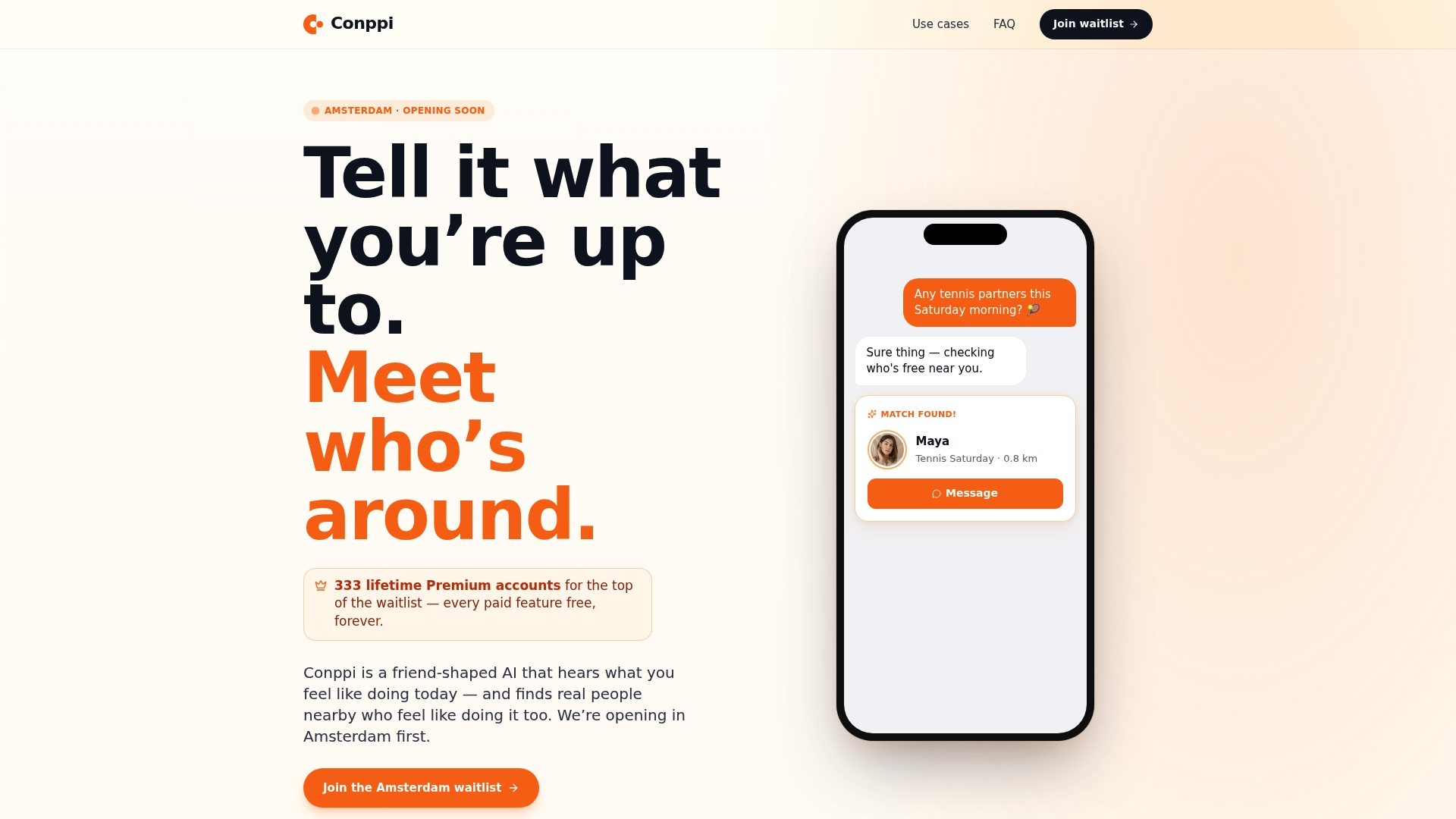
That is the situation Conppi is built for. You open the app, choose co-working, and see people nearby who want a work partner at a time that suits you. There are no profiles to read and no swiping. Matching is based on the activity and its filters, such as time and skill level where that applies. Only approximate distance is shown, so you are not sharing a precise location. You can organize a one-on-one session or a small group.
Here is how to run a first session so it protects your focus.
- Set the format before you meet. Agree that you will work in silence for set blocks, for example 90 minutes, and chat only during breaks. Saying it up front removes the guesswork that makes introverts anxious.
- Pick a place with quiet options. Use the checklist above. A table in a quiet zone beats a busy open area.
- Choose off-peak hours. Early starts leave you time to settle before the room fills.
- Keep the first meeting short. Two or three hours is plenty. You can extend next time.
- Repeat it. A standing weekly slot turns a stranger into a work friend through exactly the routine the Erasmus research describes.
If you want to compare where to work, including cafés, our guide to coworking versus a coffee shop shows how to match the task to the setting. Once you have a partner, the coworking etiquette rules cover booking, guests and polite ways to say you need to focus. And if you want a bigger group later, curated small group meetups of four to six people are a gentle next step.
A low-pressure first month
A plan helps because it replaces decisions with a routine. Here is one way to structure the first four weeks.
| Week | Goal | What to do |
|---|---|---|
| 1 | Find a space that fits | Try one or two day passes at off-peak hours and note where the noise and foot traffic reach you |
| 2 | Build a routine | Take the same seat and arrive at the same time three days in a row; greet the same people briefly |
| 3 | One good conversation | Join one structured event with a clear topic, or arrange a co-working session with one partner |
| 4 | Make it recurring | Fix a weekly slot with your partner and decide whether a membership or day passes suit you |
Adjust the pace to your energy. If a day goes badly, use a quiet room or booth and try again tomorrow. One loud afternoon says little about whether the space suits you. Notice patterns across a week instead.
Special situations in Amsterdam
Moving to a new city adds another layer. If you are an expat or a recent arrival, the first people you meet often come through work. Two of our guides help here: finding English-speaking coworkers in Amsterdam and meeting remote workers in Amsterdam cover day passes, rooftops and apps. If you travel for work, the list of digital nomad meetups in Amsterdam shows where people gather. For a view of how work style shapes the meetup you join, see coworking meetups in Amsterdam.
A common worry is that you will bore a stranger or break their concentration. Co-working sessions are built for the opposite: you both come to get something done, and sitting in parallel is the whole point. That takes the burden of entertaining anyone off you.
Find a co-working partner in Amsterdam
Conppi is a free mobile app for iOS and Android that matches you with people nearby for activities in real time. Co-working is one of them, alongside coffee meet-ups, sports such as tennis, padel and running, and language exchange. It focuses on activities and shared interests, not dating, and we are opening in Amsterdam first so that matches are close and quick.
If you want a work partner for your next focus session, start on the page for finding people to co-work with in Amsterdam. If you would rather begin with a lighter meeting, you can meet someone for coffee in Amsterdam first. You can also see how the whole activity partner app works.
Our view on introverts and coworking
We build Conppi around a simple observation: most people do not lack a place to work, they lack someone to work next to. For an introvert, that gap is felt sharply, because the usual fix is to go to an event, walk up to strangers and hope.
We think the better fix is smaller. One person, one activity, one time. That is why Conppi matches people by what they want to do, not by profile photos, and why it has no swiping. You say what you want to do, when, and see who nearby wants the same.
We also care about privacy. Meeting a stranger is easier when you are not broadcasting where you are, so the app shows only approximate distance.
Co-working is a natural fit for this. Nobody expects a performance. You both arrive with your own work, you agree on how quiet to be, and the company is a side effect. We are starting in Amsterdam because a dense city makes it possible to find someone close by, at the hour you want.
If you are an introvert, you do not need to change who you are to have a social working week. You need a format that respects how you work. We built Conppi to give you that.
Ilya
FAQ
Is coworking good for introverts?
Yes, for many. In a global member survey, introverted members valued the social atmosphere without wanting contact with everyone, and they reported better workdays and less isolation. It helps when the space offers quiet zones and lets you decide how much to interact.
What should an introvert look for in a coworking space?
Look for a real quiet zone, phone booths or small bookable rooms, varied layouts, and seats away from entrances, kitchens and printers. Also check that events are optional and structured. A day pass lets you test the atmosphere at the hours you would actually work.
When is the best time to arrive at a coworking space?
Early. Shared spaces are often busiest between 10 a.m. and noon, so arriving around 8 or 8:30 a.m. gives you time to settle in before the room fills. Arriving at the same time each day also helps you become a familiar face.
How do I meet people in coworking without small talk?
Become a regular, keep greetings short, and aim for one good conversation rather than many. Structured events with a clear topic, such as a workshop or skill share, are easier than open mixers. You can also arrange to work beside one person through Conppi.
Can I find a coworking buddy without giving up focus time?
Yes. Agree on the format before you meet: silent work blocks, chat only in breaks, and a short first session. On Conppi you can choose co-working and filter by time, then work one-on-one or in a small group.
Sources
- Erasmus University Rotterdam: "I like the buzz, but I also suffer from it"
- Deskmag: Coworking for Introverts and Extroverts
- The Introvert's Guide to Flexible Spaces
- Smart WorkPlace e-zine, June 2021: Gepaste ruimtes
- University of Amsterdam: coworking and social capital study