

The best networking strategy for an introvert is to stop treating it as working a room. Pick a small goal, prepare a short introduction and a few questions, choose settings with one person or a handful of people, and meet the same faces again and again. That is how acquaintances turn into real contacts. Below is how to do it step by step, with examples that fit life in Amsterdam.
TL;DR
- Set one small goal per outing, such as talking to one person, instead of aiming to "make connections."
- Prepare three things: a one-sentence intro, two open-ended questions and a graceful exit line.
- Choose recurring, activity-based settings (sports, co-working, language cafés, volunteering) over big mixers.
- Give yourself a finish line, such as 30 minutes, and follow up within a few days.
Table of Contents
- Why networking feels harder for introverts, and why that is fixable
- Start with a goal small enough to achieve
- Prepare your three-part toolkit
- Starting and sustaining a one-to-one conversation
- Choose settings that suit how you work
- Make it recurring: the Netherlands advantage
- Our perspective: networking is a by-product of doing things together
- Try it with Conppi
- Protect your energy while you network
- Follow up without it feeling forced
- A simple plan for your first month
- FAQ
- Sources
Why networking feels harder for introverts, and why that is fixable
Most networking advice assumes you gain energy from crowds. If you do not, a drinks reception with 200 strangers is a poor test of your ability to build professional relationships. It tests your tolerance for noise.
The good news is that networking is much broader than events. A veterinary association's guide for introverts points out that it includes one-on-one conversations, informational interviews and small group interactions, and it recommends a one-on-one mindset of connecting with one person at a time. That framing changes the job. You are not trying to be impressive in a crowd. You are trying to have one decent conversation, then another.
Preparation is where introverts tend to have an edge. You think before you speak, you listen, and you notice details. Those habits build trust, which is the whole point of a network.
Start with a goal small enough to achieve
"I must make friends today" is a goal that sets you up to fail. A clearer one is "I'll look and talk to one person", which is the kind of first step that is easy to check off. Here are goals that work well:
- Arrive, say hello to one person, and ask them one question.
- Learn one new fact about someone's work.
- Get one contact you would genuinely like to talk to again.
Write the goal down before you leave home. When you hit it, you are allowed to count the evening as a success. That matters, because introverts who judge themselves against the loudest person in the room quit early.
If you want a gentle, structured starting point, Solo Era's plan for introverts also recommends a small goal, a short introduction and prepared questions.
Prepare your three-part toolkit
Experts quoted in a Forbes piece on introvert networking advise preparing three simple components to conserve social energy: a short, authentic self-introduction, two open-ended questions, and a planned exit line. Here is what each looks like in practice.

A one-sentence introduction
Include your name, what you do and one interest. Solo Era suggests a sentence or two covering those three things. For example:
"I'm Sanne, I do UX research for a logistics startup, and I'm trying to get back into padel."
The interest gives the other person something to grab. People rarely ask follow-up questions about a job title, but they often react to "padel."
Two open-ended questions
Open-ended means it cannot be answered with yes or no. Have two ready so you never freeze:
- "What are you working on at the moment that you're excited about?"
- "How did you end up in Amsterdam?" (a reliable one in an international city)
If you want more options, our 25 icebreaker questions with follow-ups are written to keep a conversation moving after the first answer.
A graceful exit line
Knowing how you will leave removes the fear of being trapped. Keep it warm and honest: "It was great talking to you. I'm going to grab a coffee and say hi to a colleague, but I'd love to keep in touch." Planning the exit is not rude. It is what lets you start the conversation in the first place.
Rehearse out loud
The same Forbes source notes that rehearsing your introduction aloud, to a mirror or a recording, reduces social anxiety more than only thinking it through. Ten minutes in the bathroom mirror the night before is enough. If your nerves spike in tense conversations at work, not only at events, the short scripts in this guide to difficult conversations show the same rehearsal approach applied to harder moments.
Starting and sustaining a one-to-one conversation
This is the part most guides skip. You have said hello. Now what?
- Open with the setting. Comment on what you both share: the speaker, the venue, the climbing wall, the weather that everyone in the Netherlands has an opinion about. It is low-pressure and always relevant.
- Use a simple formula. The same veterinary guide recommends the COST method: compliment, observation, story and tip. A compliment on a talk, an observation about the room, a short story of your own, or a useful tip all give the other person an easy way in.
- Ask, then follow the answer. Do not move to your second prepared question until you have asked about something they just said. "You mentioned you moved from Lisbon. What surprised you most here?" beats any scripted line.
- Share one thing in return. Conversations stall when one person only asks. Offer a small, real detail about yourself.
- Let silence breathe. A pause of two or three seconds is normal. You do not need to fill it.
For more openers designed for casual meetings, see our conversation starters for 30-minute coffee chats, and for activity settings, these three icebreaker frameworks with scripts.
Choose settings that suit how you work
The single biggest upgrade is changing where you network. A large conference is one option. It is rarely the best one.
Small groups and one-on-ones
If you can, set up a coffee date with someone before an event. The veterinary guide notes it can feel less intimidating and more authentic than a large reception. Small groups of four to six people also work well, because nobody can hide and nobody gets lost. We cover why in our piece on curated small group meetups.
Activities with built-in talking points
When there is something to do, the activity carries half the conversation. Sports can offer a way to bond without the pressure of a sit-down conversation, which is a big relief if face-to-face small talk drains you. A game of tennis, a run along the Amstel or a swim gives you something to focus on, and chatting happens in the gaps.

Co-working and shared work sessions
If you are a remote worker or freelancer, a shared work session is networking in its quietest form. You sit near others, have a coffee break together and build familiarity over time. Our guides to Amsterdam coworking meetups and to meeting remote workers in Amsterdam cover where this works. If your week is mostly remote, our article on remote work loneliness explains why a few scheduled in-person slots matter.
Make it recurring: the Netherlands advantage
Dutch social life leans heavily on clubs, associations and routines, and that helps introverts. Recurring weekly activities such as sports clubs, volunteer projects, language cafés and hobby groups are recommended for building deeper connections, because you see the same people over time. You do not need to be charming on day one. You only need to turn up.
That is also why the first minute of every meeting matters less than it feels. By the third week, nobody remembers your clumsy opener. They remember that you are the person who always brings the good cycling route.
Options worth considering:
- Sports and fitness: a weekly padel, running or climbing group.
- Language practice: a language café or a Dutch course. Joining a Dutch course, a sports class or volunteering are all suggested ways for newcomers to meet people in Amsterdam.
- Volunteering: it gives you an organized setting and a weekly commitment that helps participants get to know each other. For some newcomers it also counts toward civic integration: under the 2021 law, the B1 route combines language learning with paid or unpaid work, and volunteering plays a large role in participation.
- Small hobby groups: book clubs and board-game groups are easy-going settings where conversation flows more naturally.
We wrote a full walkthrough of this approach in 8 steps to make friends through recurring activities.
Our perspective: networking is a by-product of doing things together
We built Conppi around a simple observation: most people do not struggle to find events, they struggle to walk into them alone. For an introvert, the cost is not the two hours at the event. It is the days of dread before it and the energy spent deciding whether to go.
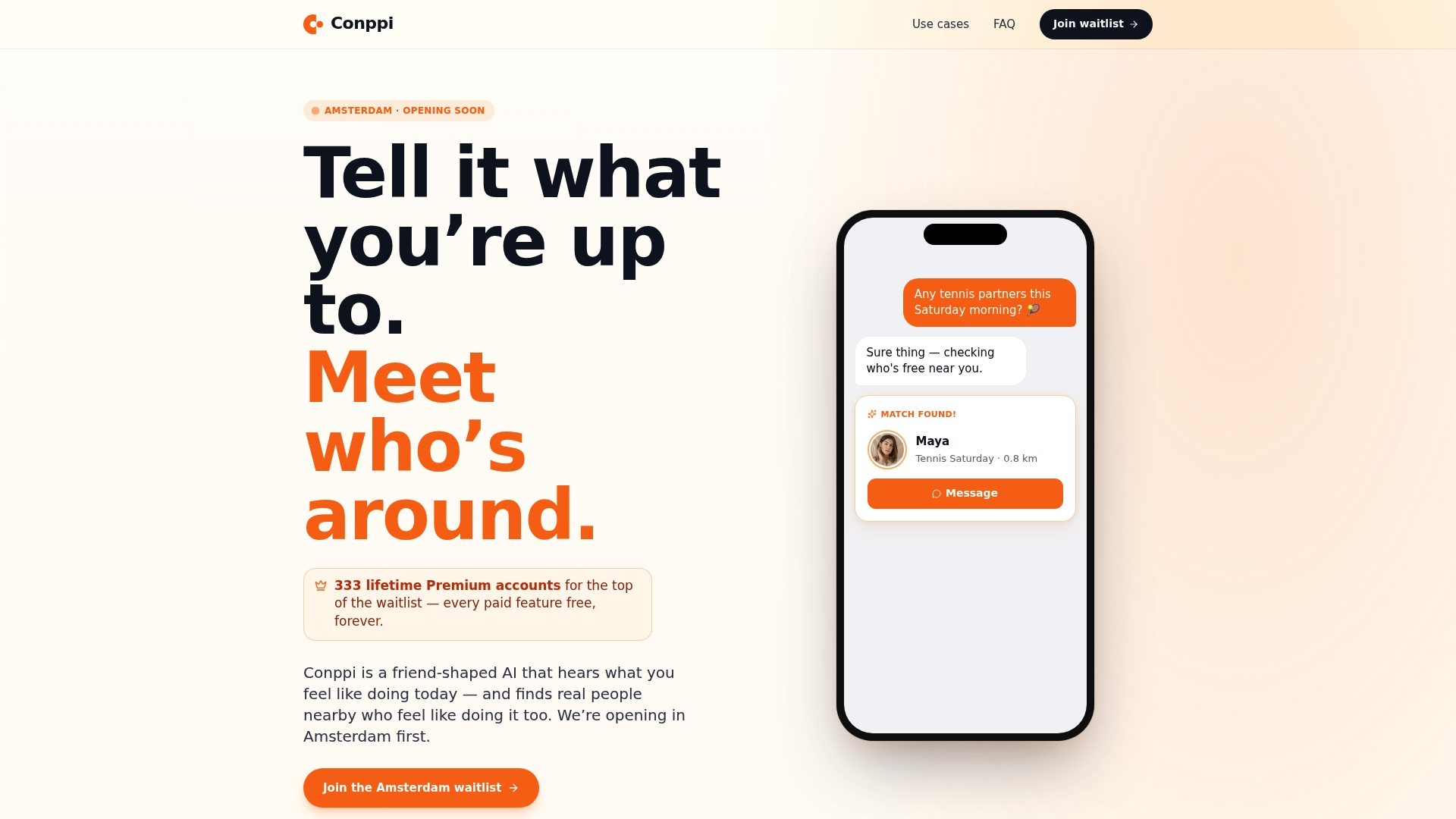
So we take a different route. Instead of profiles and swiping, Conppi matches you with people nearby who want to do the same activity at a similar time, whether that is tennis, padel, a run, a co-working session or a coffee. You choose the activity and filters such as time and skill level, and you only see an approximate distance, never an exact location. The activity gives you the topic, the time limit and the reason to be there. We are opening in Amsterdam first so that matches are dense enough to be useful.
This is not dating, and it is not about collecting contacts. It is about making the first step small enough that you actually take it. In our view, the strongest professional relationships often start as someone you happened to play a match or share a table with, and only later become "a contact."
— Ilya
Try it with Conppi
If you would rather start with one activity and one person than with a crowded room, Conppi is built for that. Pick an activity, set your time and level, and meet someone nearby who wants the same. It is currently free to use. You can read how it works on our activity partner app page, or see how we approach professional connections on our networking in Amsterdam page.
Protect your energy while you network
Respecting your limits is part of the strategy, not a sign you are doing it wrong.
Set a finish line
Committing to a fixed time, such as 30 minutes, makes events more sustainable because it removes the fear of feeling trapped. If you are having a good time at minute 30, stay. If not, you leave with your goal met and no guilt.
Prefer quality over quantity
Two real conversations beat fifteen business cards. The same sources encourage self-kindness: accept that social skills take practice and that your energy is finite.
Count the small moments
Not every connection has to be a networking milestone. Dutch broadcaster KRO-NCRV notes that small interactions, like smiling at a barista or holding the lift for a neighbor, can create a real feeling of connection and help break the cycle of loneliness. That is worth knowing, because loneliness is common: a regional Dutch news report cited an average of 37% of people suffering from loneliness at the end of 2020. You are not the only one finding this hard.
Book your social time
One source on social isolation suggests treating small, weekly social slots as non-negotiable appointments, which saves the mental energy you would otherwise spend deciding each time. Pick one fixed evening, such as Thursday padel or Tuesday morning co-working, and protect it. If anxiety is the main barrier, our guide on starting with 15 minutes of activity is a gentler entry point. If anxiety is severe or constant, a GP (huisarts) or a psychologist is the right person to talk to.
Follow up without it feeling forced
Most connections die in the days after the first meeting. Introverts often skip this step because it feels pushy. It is not. It is the part that turns a nice chat into a relationship.
- Within 48 hours, send a short message that mentions something specific: "Good to talk about the Lisbon move. I'd love to hear how the apartment search turns out."
- Propose something small and concrete, such as a 30-minute coffee near one of you, or a game next week.
- Keep showing up. Follow up with people you've matched with, attend events consistently and be patient; making friends from scratch takes time.
- Be the one who suggests the second meeting. Most people are waiting for someone else to do it.
A second meeting at the same weekly activity is the easiest ask of all, because there is no invitation to decline. If you are looking for something to do today, our guide to instant meetups in the Netherlands can help.
A simple plan for your first month
| Week | Goal | Setting |
|---|---|---|
| 1 | Say hello to one person and ask one question | A small group or a coffee with one person |
| 2 | Return to the same place and recognize one face | A weekly activity or co-working session |
| 3 | Follow up with one person from week 1 or 2 | A short message and a coffee proposal |
| 4 | Invite someone to a shared activity | A match, a run or a work session together |
By the end of the month you will have a routine, a few familiar faces and at least one person you could call a contact. That beats a pile of business cards.
FAQ
What are the best networking strategies for introverts?
Set a small goal, prepare a short introduction and two open-ended questions, and plan your exit. Favor one-on-one meetings, small groups and recurring activities over large events. Then follow up within a couple of days.
How do I network if I hate small talk?
Skip it by choosing an activity where the task provides the conversation, such as sport, a co-working session or volunteering. Ask open-ended questions about what the person is working on, and follow the answer rather than a script.
How long should I stay at a networking event?
Decide before you go. A finish line such as 30 minutes keeps the event manageable, and you can stay longer if you are enjoying it. Pair it with a goal, like talking to one person.
Where can introverts meet people in Amsterdam?
Look for recurring settings: sports clubs, language cafés, Dutch courses, volunteering, hobby groups and co-working sessions. Seeing the same people weekly makes conversation easier. Apps like Conppi can also match you with someone nearby for a specific activity.
Sources
- One connection at a time: A guide to networking for introverts (AVMA)
- 4 Networking Strategies For Introverts To Connect With Confidence (Forbes)
- Networking for Introverts: A Gentle Plan (Solo Era)
- Nieuwe mensen leren kennen: zo begin je (Boostjouwleven)
- How to Build a Friend Circle in the Netherlands as an Introvert (Expat Republic)
- Where to meet people in the Netherlands 2026 (NLCompass)
- 7 tips to make friends in Amsterdam (Koentact)
- New Civic Integration Act 2021 (Government.nl)
- Hunkeren naar verbinding (KRO-NCRV)
- Eenzaam? De Social Club biedt uitkomst (BD.nl)
- How to Overcome Social Isolation: 6 Steps (SolveItHow)