
The best first message to a new friend is short, specific and easy to answer. Mention one real thing you share, say in a few words why you are writing, and ask one small question. Skip the life story, skip the compliments on looks, and don't ask for much. Below you'll find the formula, ready-to-use examples for sports, coffee and co-working, and how to move from chat to meeting in person in the Netherlands.
TL;DR
- Use three parts: a specific detail, a light reason for writing, and one question that takes a sentence to answer.
- Keep it to one to three sentences. Long paragraphs before the other person shows interest feel like pressure.
- When you share an activity, the activity is your hook. It is the easiest opener there is.
- In the Netherlands, plans are often made well ahead, so suggest a small, specific meetup and leave room for a later date.
- Keep the conversation going by picking up one detail from their reply, not by firing off new questions.
Table of Contents
- Why the first message feels harder than it is
- The simple formula: hook, reason, easy question
- Copyable first messages by situation
- What to avoid in a first message
- Keeping the conversation going after the first message
- Suggesting a meetup without pressure
- A note on Dutch timing
- Perspective
- Try it with a shared activity
- After the first meetup: keeping it going
- A quick template to adapt
- FAQ
- Sources
Why the first message feels harder than it is
Most of us overthink the opener because we treat it like a performance. It isn't. The other person is mostly asking themselves two things: "Is this safe?" and "Can I answer this without effort?" A good first message says yes to both.
The reason it feels awkward with potential friends is that there is no script. Texting a crush has a long tradition of advice. Texting someone you'd simply like to play tennis with, or work next to on a Tuesday, has almost none. People often fall back on "Hey" and wait, which puts all the work on the other side.
The fix is to give the message a job. It should open a door and make stepping through it effortless.
The simple formula: hook, reason, easy question
The structure that comes up again and again in advice on this topic is the same: an observation, a reason, and a question. A Dutch guide on first messages describes it as a hook, a personal note and one open question, and other guides on first messages describe the same three parts in different words. Here is how each piece works for friendship.

1. The hook: one specific detail
The hook proves you wrote this message to this person. It can be something they posted, an activity you both signed up for, or the place you both go to. Be concrete. "I saw you play padel on Thursdays" beats "I saw we have stuff in common."
2. The reason: a light, honest note about you
One short sentence explaining why you are writing. It connects to the hook and doesn't assume closeness. "I'm new in town and still looking for people to play with" works well because it is true, small and relatable.
3. The question: answerable in one sentence
Ask one thing, and make it open but light. "Which court do you recommend?" is easy. "What are your life goals?" is not. A question that asks for a recommendation lets the person be helpful, which is a pleasant thing to be.
Copyable first messages by situation
Change the details, keep the shape. Each of these is two or three sentences at most.
You share a sport
- "Hi! I saw you're looking for a tennis partner on Sunday mornings. I'm around the same level and have been missing regular games. Do you prefer indoor or outdoor courts?"
- "Hey, I also run along the Amstel in the evenings. I'm usually doing around 8 km at an easy pace. What route do you like?"
- "Hi, I'm trying to get back into swimming and need someone to keep me honest. Do you go early or after work?"
You want a co-working buddy
- "Hi! I work remotely and a café on my own gets quiet after a few days. Are you usually working mornings or afternoons?"
- "Hey, I noticed you're also looking for someone to co-work with. I'm mostly heads-down until lunch, then happy to chat. Which neighborhood works best for you?"
If co-working is what you're after, our page on how to find people to co-work with in Amsterdam covers how it works in practice.
You want a coffee meetup
- "Hi! I'm new to the area and trying to get to know a few people over coffee. Do you have a favorite café near you?"
- "Hey, I saw you like trying new coffee places. I'm collecting recommendations. What's the best one you've found lately?"
More scripts of this kind live in our guide to 30-minute coffee chats and conversation starters.
You are a newcomer meeting a local
Amsterdam-specific questions work well because locals usually enjoy being asked. A guide on making friends in Amsterdam suggests asking things like your contact's favorite spot in the city or for a recommendation for a gezellige sports club. Turned into a message:
- "Hi! I moved to Amsterdam a couple of months ago and I'm still exploring. What's your favorite spot in the city for a quiet coffee?"
- "Hey, I'm looking for a gezellige sports club, nothing too serious. Do you know one you'd recommend?"
Using one Dutch word like gezellig shows effort without trying too hard. Don't overdo it.
You are traveling and want to meet a local
- "Hi! I'm in town for a few days and would love to do something a local would do. Where would you go for a morning run?"
- "Hey, I'm here until Saturday and looking for a language exchange over coffee. I can help with English. Interested?"
What to avoid in a first message
Most mistakes come from trying too hard. Common ones, based on what chat-etiquette guides repeatedly warn about:
- Copy-paste compliments on appearance. They read as templates, and they steer the tone away from friendship.
- Very personal questions early. Questions about relationships, money or past hurts belong much later.
- Walls of text. A long first message before the other person has shown any interest feels heavy.
- Fake familiarity. Nicknames, inside jokes and "we should totally hang out" from a stranger feel off.
- Asking to switch platforms at once. Moving to another app in the first few messages can feel pushy. Stay where you met until there is some rapport.
- Chasing. If there is no reply, a "why aren't you replying?" follow-up closes the door. One friendly nudge after a few days is the limit.
A quick checklist before you hit send: is it specific, short, safe, easy to answer and written like a human? If yes, send it.
Keeping the conversation going after the first message
A reply is not the finish line. The next few messages decide whether this turns into a plan or fades out.
The most useful habit is to pick one thread from their reply, a specific detail they gave you, and expand on it with your own view. Avoid interviewing them with a list of unrelated questions. A bare question feels like a form to fill in. A question paired with a small piece of your own perspective feels like a conversation.
Compare these two follow-ups after they say they play padel on Thursdays:
- Interview style: "Cool. How long have you played? Where do you work? Do you like Amsterdam?"
- Thread style: "Thursdays are good for me too. I started padel last spring and my backhand is still a mess. Do you play doubles or mostly practice?"
The second gives them something to react to and shows who you are. If you want a deeper set of ideas, our activity-first meetup icebreakers give three frameworks you can reuse.
Suggesting a meetup without pressure
The best time to suggest meeting is once the exchange has gone back and forth a few times and you've found something concrete in common. Don't wait for weeks, though. Friendships that stay in chat usually stay in chat.
The invitation should be small, specific and easy to decline. Coffee, a 45-minute run, one set of tennis. Add a graceful exit: "No pressure at all if not." A vague "we should hang out sometime" is harder to say yes to, and also harder to say no to kindly. A specific one lets people answer honestly.
Examples:
- "Want to grab a coffee on Saturday around 11 near Oost? Totally fine if the week's too full."
- "I'm heading to the courts Sunday at 10. Want to hit for an hour? No pressure if not."
If you're deciding what to do for a first meetup, our list of platonic hangout ideas helps. And once you have set a time, turning online chat into coffee is a nice reminder of how a short break together can change the mood of a day.
A note on Dutch timing
If you're in the Netherlands, expect planning to run on a longer clock than you might be used to. Dutch residents commonly keep agendas filled weeks or even months ahead, so last-minute arrangements are often a bad bet. A message like "Are you free sometime in the next couple of weeks?" is more natural than "Free tonight?"
Directness is welcome too. One expat guide advises telling a potential friend plainly that you'd like to get to know them better, and it also notes that Dutch people often have plans lined up far ahead, so booking a date early helps. So: be warm, be clear, and give notice.

One more point on pace. A longer-term guide to Dutch friendships describes a gradual path from regular group events to coffees to one-on-one activities over many months. You needn't follow its timetable, but the direction is useful: showing up repeatedly at the same activity makes every later message easier, because you're already a familiar face.
Perspective
We built Conppi because the hard part of making friends is rarely the friendship. It's the moment before: the first message that feels too big, the profile that makes you perform, the swipe that turns people into a stack of cards.
Our view is that a shared activity solves most of that. If two people both want to play padel on Thursday evening, the hook is already built in. You don't need clever lines, and you don't need to reveal your whole personality. You need a time, a place and an easy question.
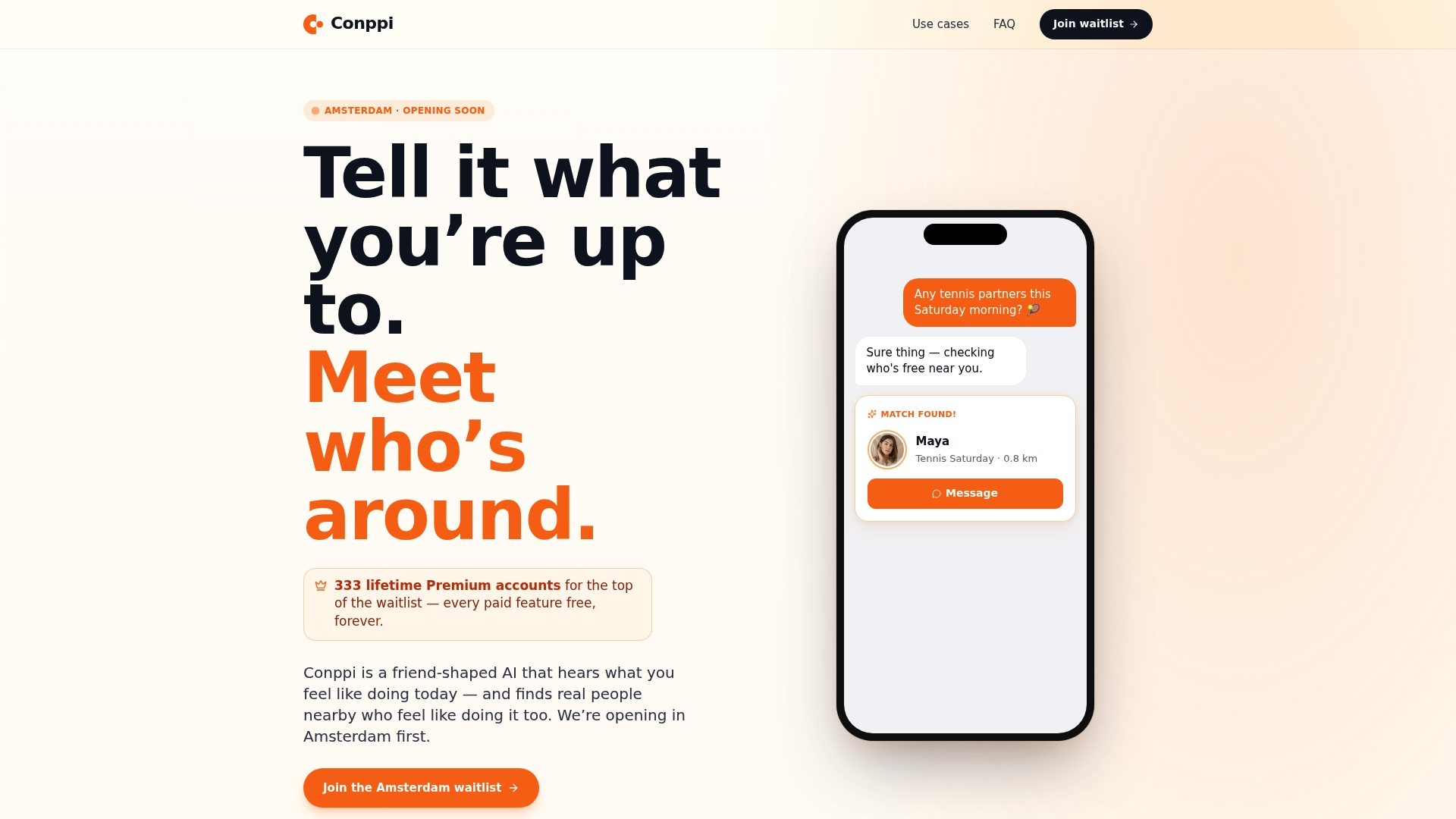
That's why Conppi is designed around activities rather than profiles, and around friendship rather than dating. You can see how far away someone is only approximately, which keeps your privacy intact, and you can filter by things that actually matter, like time and skill level. We're opening in Amsterdam first so that when you post a plan, there's a real chance someone nearby says yes.
If you take one thing from this article: the shorter and more specific your message, the more likely you'll get a reply. Everything else is practice.
Ilya
Try it with a shared activity
A first message is easiest when the other person has already said what they want to do. That's the idea behind Conppi: a free mobile app for iOS and Android that connects you with people nearby who want a partner for sports, co-working, coffee or language exchange, with no profile browsing and no swiping. You choose the activity, set the time, and start the conversation from a shared plan.
If coffee is your starting point, see how to meet someone for coffee in Amsterdam, or have a look at the Conppi activity partner app to see how it works.
After the first meetup: keeping it going
A friendship forms through repetition. After a first meeting, a short message within a day or two does the most: mention something from the time together and propose the next small step.
- "That was fun, and your tip about the café on the corner was spot on. Same time next week?"
- "Good game! My legs will hate me tomorrow. Want to book the court again on Sunday?"
The same principle applies in the other direction: if you want to avoid drifting, make recurring plans, such as a weekly run or a regular co-working morning. Our guide on meeting people without swiping lays out a post, show up, follow up routine within 48 hours, and the steps in turning an activity into a regular plan are useful if you want consistency. If one-on-one feels like a lot, small groups of four to six people take the pressure off.
A quick template to adapt
Write your own in under a minute:
- Hook: "I saw you [specific detail or shared activity]."
- Reason: "I'm [new here / getting back into it / looking for regular people to do it with]."
- Question: "[Easy question about a place, a time or a preference]?"
Example: "Hi! I saw you're also going to the Sunday morning run in Vondelpark. I'm new in Amsterdam and still finding my pace group. Do you usually run the long loop or the short one?"
That is three sentences, one detail, one honest reason and one easy question. It works because it takes no effort to answer, and it sounds like a person.
FAQ
How do I write a message to a new friend?
Start with one specific detail you share, add a short reason for writing, and finish with one easy question. Keep it to one to three sentences. Write it the way you'd say it out loud.
Should I mention that I want to be friends?
You don't have to in the first message, but being clear helps, especially in the Netherlands where directness is appreciated. Something like "I'm looking to meet people to play tennis with" says it naturally. Once you've exchanged a few messages, saying you'd like to get to know them better is fine.
How soon should I suggest meeting up?
After a few friendly exchanges, once you've found something concrete in common. Propose something small and specific, like a coffee or a one-hour run, and add a no-pressure exit. In Amsterdam, suggest a date a week or two ahead rather than same-day.
What if they don't reply?
Don't take it personally, since people are busy and Dutch calendars are often full. One light follow-up after several days is enough, and it should be friendly and easy to ignore. After that, move on to the next person with a shared interest.
What if I'm shy or my English isn't perfect?
Short messages help here. A simple hook and one question is easier to write than a paragraph, and most people in Amsterdam are comfortable switching to English. Having a shared activity gives you something to talk about even if the small talk is hard.
Sources
- 7 tips to make friends in Amsterdam, Koentact
- 18 ways to actually make friends as an expat in the Netherlands, DutchReview
- Making friends in the Netherlands, NLCompass
- Datingtips: Het perfecte eerste bericht, OproepjesNederland