
Setting boundaries with a new friend means telling them, in plain and friendly words, how much time, energy, personal information and contact you want to give right now. Do it early, keep it specific, and say it as something about you, not about them. A new friendship is the easiest time to do this, because there are no old habits to untangle yet.
This guide covers how to find out what you need, what to say (with scripts you can copy), how boundaries look around time, messages, personal details, money and shared activities, and what to do when someone pushes back.
TL;DR
- Decide your limits before the conversation: your values, your energy, and what makes you feel safe.
- State a boundary with a concrete request and an "I" statement, not an accusation.
- Start small and early. A boundary is easier to set at the second coffee than in month six.
- If someone keeps crossing a line, repeat it calmly, name what you will do, and reduce contact if needed.
- Boundaries change as trust grows. Review them instead of treating them as fixed rules.
Table of Contents
- Why boundaries matter most at the start
- Work out what you need before you speak
- How to say it: a simple formula and scripts
- What healthy boundaries look like in practice
- Physical and romantic boundaries
- When a new friend reacts badly or keeps crossing a line
- How boundaries change as the friendship grows
- Our perspective
- Meet people on your terms in Amsterdam
- FAQ
- Sources
Why boundaries matter most at the start
Many people think boundaries are for the end of a friendship, when something has gone wrong. In practice they work best at the beginning. The Cleveland Clinic advises setting healthy boundaries early in a relationship so that communication patterns are clear from the start and your physical and emotional wellbeing stays protected.
The same source describes boundaries as protecting your identity and personal space, and as making clear what you want and will accept from friends. That is a useful way to see it. A boundary is not a wall. It is information that helps the other person treat you well.
There is also a cost to staying silent. The Dutch mental health platform iPractice notes that if you don't state your boundaries, others may overstep them, and that regularly doing things you don't want to do or can't manage can build up into stress over time. For someone new to a city, this matters. When you are eager to build a social circle, it is tempting to say yes to everything. A few weeks later you are tired, resentful, and avoiding messages from someone who did nothing wrong except not know your limits.
A Dutch GZ-psychologist, Aukelien van Abbema, makes a point that fits new friendships well: healthy boundaries let you connect more deeply with others without losing sight of your own limits. Boundaries and closeness are not opposites. They are what make closeness sustainable.
Work out what you need before you speak
You cannot explain a limit you haven't identified. Before you talk to anyone, take ten minutes with these questions. They follow the approach the Cleveland Clinic outlines: consider your values and core beliefs, what you need to stay healthy and feel safe, and how much time and energy you are willing to give.
Translated into everyday questions:
- Time: How many evenings a week do I realistically want to spend socializing? Do I need a quiet night after a busy day?
- Energy: Do I enjoy long, intense conversations, or do I prefer an hour of tennis and a short coffee?
- Contact: How fast do I want to reply to messages? Am I happy to be called, or do I prefer text?
- Privacy: What am I comfortable sharing about my job, my home, my relationships, my past?
- Money: Do I split bills, take turns, or avoid expensive plans for now?
- Safety: Where do I want to meet someone I don't know well, and what do I want others to know about my plans?
Write short answers. You are not creating rules for the other person. You are getting clear on your own preferences, so they come out calmly instead of in the middle of an awkward moment. Hulplijn, the Dutch helpline run by Offlimits, makes a related point in an online-safety context: knowing your own wishes makes it much easier to state them.
The University of Alberta adds an important nuance: boundaries vary depending on culture, the people involved and the depth of the friendship, and they are meant to convey your expectations, not to control anyone. If you live abroad, remember that your new friend may come from a place with different norms about punctuality, directness, or how quickly people share personal details. Your boundary may need a sentence of explanation, not a defense.
How to say it: a simple formula and scripts
Good boundaries have two parts. According to Psychology.com, a boundary includes the specific limit you set and the concrete action you will take if it is crossed. With a new friend, you rarely need the second part at first. Start with the limit, said warmly.
Use "I" statements and describe, don't accuse
The Cleveland Clinic suggests using "I" statements to keep the focus on your own needs, which tends to cause less defensiveness than "you" statements that assign blame. iPractice gives matching advice: describe the behavior or request concretely and explain its effect on you, without pointing fingers.
Compare:
- Less helpful: "You always text me too late."
- Better: "I switch my phone off around 10, so I'll reply in the morning. I'm not ignoring you."
Scripts for common early situations
When you want to slow things down
- "I'm really enjoying this. I'm just not ready for that yet." Hulplijn lists "I am not ready for that yet" among its suggested phrases.
- "I need to think about it. Can I get back to you tomorrow?"
When you are uncomfortable with a request
- "I don't feel comfortable with what you're asking." This is another phrase from the same Hulplijn page, which also reminds readers that you don't have to do everything others want and that your feelings and opinions count.
When you need space
- "I'm wiped after work, so I'll skip tonight. Saturday morning works though."
- "I'm a bit shy with new people, so bear with me if I'm quiet at first." (Almost word for word the kind of line people suggest in friendship forums, and it works because it is honest and light.)
When you want to pause a chat The Dutch site IntiemComfort recommends stating your decision directly, for example "I'm stopping for today", and explaining your contact pattern, such as being less responsive during work. You can pause or end a conversation without asking permission.
For more ready-made lines for first meetups, we collected them in seven conversation boundary scripts for awkward meetups.
Keep it short
You do not owe a long justification. One sentence of reason is plenty, and sometimes none is needed. Over-explaining can invite negotiation. Say it once, kindly, and move on to something you can say yes to: "I can't do Thursday, but I'd love to play next week."
What healthy boundaries look like in practice
The area where you need a boundary shapes the wording. Here is a quick map for new friendships.
| Area | Example boundary | What you might say |
|---|---|---|
| Time | One social evening on weeknights; quiet after a busy day | "Weeknights are tough for me. Weekend mornings are better." |
| Messages | No replies during work or late evening | "I check messages in the evening, so I may be slow." |
| Personal information | No home address or workplace details early on | "I'd rather keep that private for now. Tell me about your week instead." |
| Money | Splitting costs, skipping costly plans | "Let's keep it simple and pay for our own." |
| Shared activities | Public places first, set end time | "I've got an hour. Let's grab a coffee and then see." |
Time and energy
Geestelijke Gezondheid, a Dutch mental health information site, gives examples of time boundaries such as deciding how much time you spend with others versus yourself, saying no to plans, asking for quiet after a busy day, and stating what you can realistically give during a stressful week. These are the boundaries new friends most often trip over, simply because nobody has said them aloud yet.
Messages and digital contact
New friends often start on chat apps, and the pace can feel pressing: instant replies, voice notes, late-night streams of messages. Decide your pattern and say it once. If you want a few extra ideas for respectful wording in written conversations, there are practical tips for respectful communication that translate well to friend chats of any kind.
Personal information
Share at the pace trust grows. The Dutch government warns that personal data and photos placed online can be misused, which is a good reason to hold back details such as your address, your daily routine, or private photos until you know someone. In the Netherlands, the AVG (the Dutch name for GDPR) also gives you control over how organizations handle your data: Rijksoverheid explains you have rights of access, correction, deletion and objection, and that organizations may not collect more than necessary. Use the same logic with people: you can share only what is needed.
Location is part of this. If you plan to meet someone you found through an app, our guide on safe, short-lived location sharing walks through six rules, and sharing approximate distance instead of exact GPS explains why less precision is usually enough to arrange a meetup.
Money
Money boundaries in a new friendship are mostly about avoiding unspoken expectations. Suggest plans that fit your budget, split simply, and say "let's pay separately" without apology. Lending money to someone you met a month ago is a decision you are free to decline with one friendly sentence.
Shared activities
Activities are one of the easiest places to practice boundaries, because the structure does half the work. A one-hour tennis match has a built-in start and end. You can decide the level, the frequency and whether you chat afterward. That is why many people find it easier to build friendships around recurring activities than around open-ended socializing.

Physical and romantic boundaries
If a new friendship might drift into something romantic, or you want to be sure it won't, say so early and lightly. Our piece on platonic friendship versus dating offers signs to watch for and scripts for making your intentions clear.
On consent, the law in the Netherlands is explicit. The new Sexual Offenses Act, in force since 1 July 2024, makes clear that sexual contact must be consensual, and the Ministry of Justice and Security stresses checking verbal and non-verbal signals such as someone resisting or freezing. Hulplijn adds that consent can be withdrawn at any time, and that a violation of your boundary is never your fault, even if you didn't state it clearly. If something has happened that left you feeling unsafe, you can contact Hulplijn or your general practitioner (huisarts) for support.
When a new friend reacts badly or keeps crossing a line
Most people respond well to a friendly boundary. Some don't, and it helps to have a plan.

Step 1: Repeat it calmly
iPractice stresses that it is normal to state a boundary more than once, because others may be surprised or slow to adjust. A first overstep is often forgetfulness, not hostility. Repeat the same sentence in the same tone.
Step 2: Name what will happen
If the behavior continues, explain factually what you will do, without making threats. That is the advice from iPractice, and it matches the two-part boundary idea from Psychology.com. For example: "I've asked you not to turn up unannounced. If it happens again, I'll stop answering the door and we'll only meet by arrangement."
Step 3: Reduce contact and get support
Women's Health Netherlands recommends making boundaries specific, communicating calmly, setting consequences when someone repeatedly crosses a line, reducing contact if needed, and seeking support from people you trust. It frames consequences as protection rather than punishment. Stepping back is not cruel. It is a way of looking after yourself.
If the pressure is persistent, Offlimits suggests telling the person to stop and warning that you will block them. After that, blocking is a legitimate step.
Handling your own guilt
Saying no can feel uncomfortable at first. The Dutch suicide prevention service 113 notes that self-compassion helps you be kinder to yourself while you learn the hard skill of setting personal limits, and that assertiveness training can help if anger or frustration keeps building. If you feel stuck in a pattern of saying yes when you mean no, a psychologist or your huisarts can point you to help.
How boundaries change as the friendship grows
Boundaries are not set once and forgotten. In a new friendship, you might not share your address, your family situation or your worries. Six months later, after plenty of consistent behavior, you may happily do all three. That is trust working as it should.
Check in with yourself now and then:
- Do I still feel comfortable with how often we meet and message?
- Is there something I agreed to out of politeness that I'd now like to change?
- Does this person respond well when I say no?
The last question is the one that matters most. The University of Alberta suggests that before ending a friendship you reflect on whether the friend knows their behavior is a problem and whether they are sensitive to your needs once you have expressed them. A friend who adjusts, even clumsily, is usually worth keeping. A friend who repeatedly ignores clear, kind requests is telling you something about what the friendship will be.
A small study cited by Verywell Mind found lower cortisol levels when younger and older women discussed a challenging task with friends rather than strangers. It is a reminder of why this effort is worth it: good friendships are calming, and boundaries are part of how they get there.
Our perspective
We built Conppi because we believe people make friends more easily when the setting does some of the work. Most awkward boundary moments come from vagueness: nobody knows how long the coffee lasts, how serious the match is, or what the other person expects.
That is why we focus on activities. When you arrange a padel game, a run or a co-working morning, the plan itself carries the boundaries: when, where, how long, and at what level. You can say yes to an hour without promising a friendship, and the friendship can grow from there at its own pace.
We also designed Conppi so you don't need a profile full of personal details or endless swiping. Matching is based on shared interests and activity filters, and we only show approximate distance, not your exact location. In our view, privacy is a boundary you shouldn't have to negotiate with a stranger. We are starting in Amsterdam, where many people, including expats, are new to the city and looking for exactly this kind of low-pressure connection.
Our advice: start with something small, public and time-boxed. Say what you need in one sentence. Then see how the other person responds. That response tells you more than any profile could.
Ilya
Meet people on your terms in Amsterdam
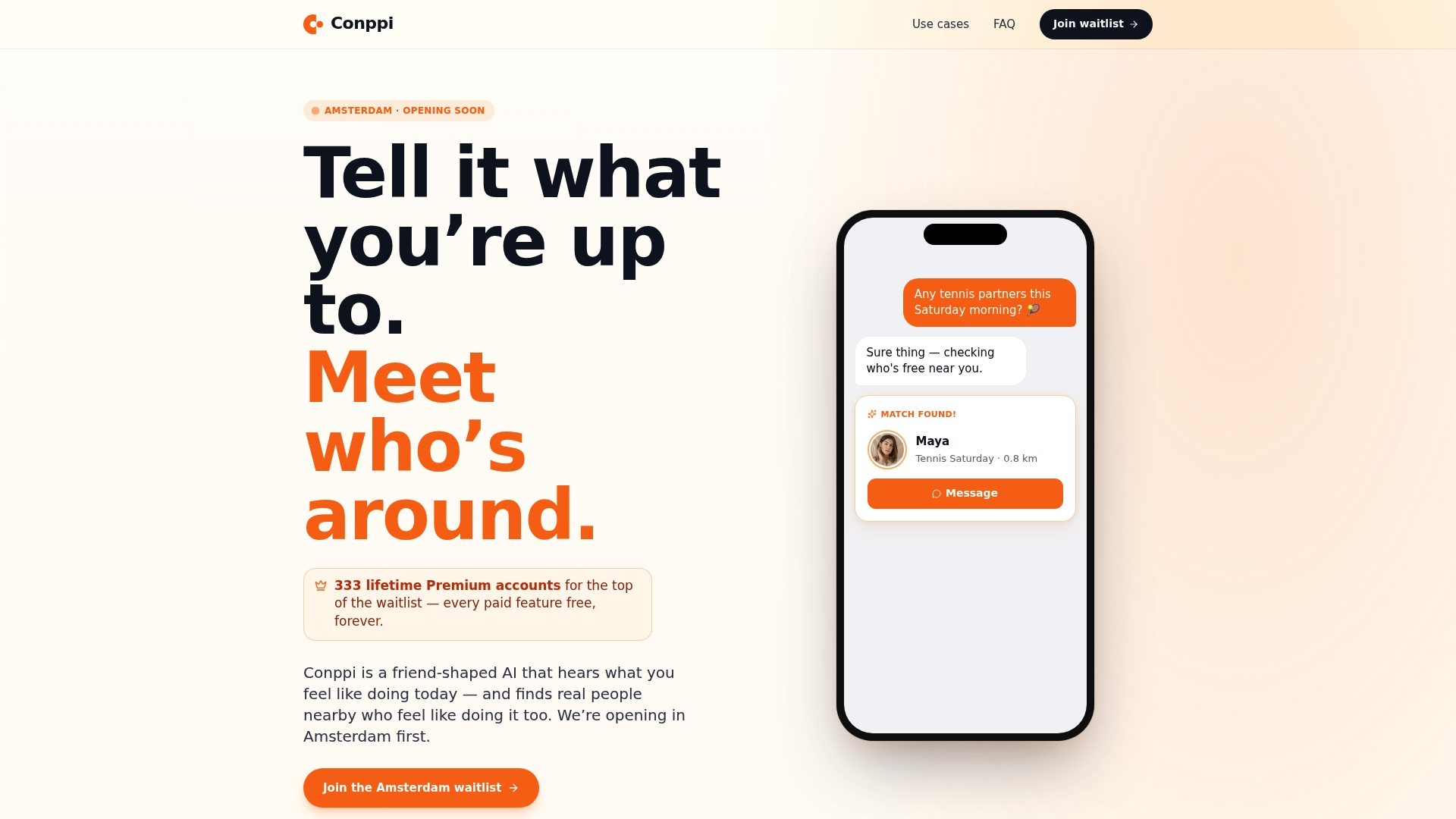
If you are new to the city, the easiest way to practice everything above is to meet people around something you both like. Conppi is a free iOS and Android app that matches you with people nearby for real-time activities, from sports to co-working to coffee. You choose the activity and filters such as time and skill level, and you only share approximate distance.
Ready to try? Explore the activity partner app, or start with a specific plan: meet someone for coffee in Amsterdam, find a tennis partner, or find a gym buddy. For more ideas on building a circle, read our guides to making friends after moving to the Netherlands and meeting people without social media in Amsterdam.
FAQ
When is the right time to set a boundary with a new friend?
As soon as you notice you are uncomfortable, and ideally before resentment builds. The Cleveland Clinic recommends setting boundaries early in a relationship. In practice, that can be as simple as saying you can only stay an hour on your first meetup.
Will setting boundaries make me seem cold or ruin the friendship?
Usually not, if you say it warmly and offer an alternative, such as "I can't do Thursday, but Saturday works." A friend who respects your limits is more likely to feel at ease with you. If someone reacts badly to a polite, clear request, that is useful information about the friendship.
What do I say if I don't want to share personal details yet?
Try: "I'd rather keep that private for now." Then steer to a topic you enjoy, such as your sport or a recent trip. You do not need to explain further, and you can share more later as trust grows.
What if a new friend keeps ignoring my boundary?
Repeat it calmly once or twice, then say factually what you will do if it continues, such as limiting contact to planned meetups. If the behavior persists or makes you feel unsafe, reduce contact or block them, and talk to someone you trust. Hulplijn is available if pressure or unwanted behavior is serious.
Should I talk about boundaries before or after meeting in person?
Both work. Practical limits, like how long you can meet or which public place you prefer, are easiest to state before the first meetup. Emotional or personal boundaries tend to come up naturally as you get to know each other, so state them when they arise.
Sources
- How To Set Healthy Boundaries in Relationships, Cleveland Clinic
- Grenzen aangeven, iPractice
- Counsellor Aukelien van Abbema
- Tips en veiligheidsmaatregelen, Hulplijn
- Hoe kan ik mijn wensen en grenzen aangeven, Hulplijn
- Dear Maddi: toxic friendships, University of Alberta
- Healthy Boundaries: Types, Examples and a Worksheet, Psychology.com
- Grenzen in de chat, IntiemComfort
- Grenzen stellen in relaties, Geestelijke Gezondheid
- Veilig gebruik internet, Rijksoverheid
- Privacyregels beschermen persoonsgegevens, Rijksoverheid
- Nieuwe Wet seksuele misdrijven van kracht, Rijksoverheid
- Gaat iemand over je grenzen, Women's Health Netherlands
- Frustraties, 113 Zelfmoordpreventie
- How to Set Boundaries With Friends, Verywell Mind
- Building Strong Friendships: Communication Tips for Men